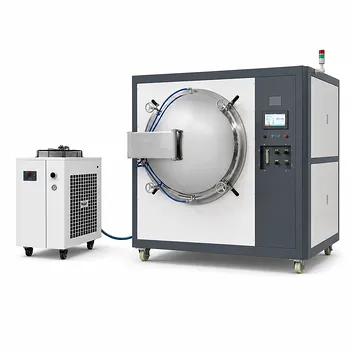
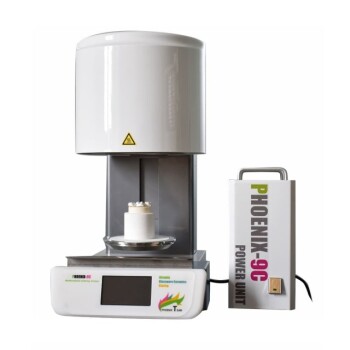
A long-duration heat treatment is essential to maximize optical transparency. While vacuum hot pressing creates a dense material, the subsequent annealing process—held at slightly lower temperatures (e.g., 1450°C) for extended periods (e.g., 16 hours)—is strictly required to eliminate residual mechanical stresses and refine the ceramic's microstructure.
Vacuum hot pressing creates the necessary density, but annealing creates the necessary clarity. This secondary heat treatment is the critical step that transforms a dense MgAl2O4 ceramic into an optical-grade component with high in-line transmittance.
The Aftermath of Vacuum Hot Pressing
To understand the need for annealing, you must first recognize the state of the material immediately after hot pressing.
Achieving Density
Vacuum hot pressing is a forceful process. By integrating high temperatures (approx. 1500°C), high vacuum, and significant axial pressure (e.g., 30 MPa), the process forces particle rearrangement and plastic flow.
The Creation of Internal Stress
This aggressive combination eliminates pores and gas, achieving near-theoretical density. However, the high pressure and thermal gradients involved invariably introduce residual stresses within the ceramic body.
Limitations on Transparency
While the material is dense, these internal stresses and minor microstructural imperfections can act as scattering centers. Without further treatment, the ceramic may not achieve its maximum potential for optical clarity.
The Specific Functions of Annealing
The annealing furnace provides a controlled environment to correct the side effects of the densification process.
Eliminating Residual Stress
The primary function of the annealing phase is stress relief. By maintaining the ceramic at a temperature slightly lower than the sintering point (e.g., 1450°C), the material undergoes thermal relaxation.
Refining the Microstructure
During this extended hold time (often around 16 hours), the microstructure of the Magnesium Aluminum Spinel stabilizes. This refinement ensures a homogeneous structure that is critical for the uniform passage of light.
Enhancing In-Line Transmittance
The cumulative effect of removing stress and refining grains is a significant boost in in-line transmittance. This specifically improves the ceramic's performance in the visible light spectrum, ensuring the material is transparent rather than just translucent or opaque.
Understanding the Trade-offs
While annealing is beneficial, it introduces specific constraints to the manufacturing workflow that must be managed.
Increased Cycle Time
The most immediate trade-off is time. Adding a 16-hour hold time, plus heating and cooling ramps, significantly extends the total production cycle compared to hot pressing alone.
Energy Consumption
Maintaing high temperatures (1450°C) for long durations requires substantial energy input. This increases the operational cost per unit, making the process more expensive than standard structural ceramic sintering.
Diminishing Returns
There is an optimal window for annealing. Excessive duration beyond what is required for stress relief may lead to abnormal grain growth, which can paradoxically degrade mechanical strength or optical quality.
Making the Right Choice for Your Goal
The necessity of this long-duration treatment depends entirely on the final application of your Magnesium Aluminum Spinel ceramics.
- If your primary focus is Optical Transparency: You must prioritize the full 16-hour annealing cycle to maximize in-line transmittance and eliminate light-scattering centers.
- If your primary focus is Structural Density: You may be able to shorten or modify the annealing phase, as minor residual stresses may not impact non-optical mechanical applications as severely.
A disciplined annealing schedule allows the material to transition from a dense solid into a high-performance optical window.
Summary Table:
| Process Stage | Primary Objective | Key Parameters | Resulting Material State |
|---|---|---|---|
| Vacuum Hot Pressing | Achieve Theoretical Density | ~1500°C, 30 MPa, High Vacuum | Dense but stressed; limited transparency |
| Annealing Treatment | Stress Relief & Microstructure Refinement | ~1450°C for 16+ Hours | High in-line transmittance; optical-grade |
| Microstructure Refinement | Homogenization | Controlled Cooling/Hold | Stabilized grains; reduced scattering centers |
Elevate Your Advanced Ceramic Production with KINTEK
Transition from simple densification to superior optical performance with KINTEK’s high-precision thermal solutions. Whether you are processing Magnesium Aluminum Spinel or advanced composites, our vacuum hot pressing systems and high-temperature annealing furnaces provide the thermal stability and pressure control required for industry-leading results.
Why partner with KINTEK?
- Comprehensive Range: From muffle and vacuum furnaces to crushing, milling, and hydraulic pellet presses, we supply the entire workflow.
- Precision Engineering: Our equipment is designed for long-duration cycles (16+ hours) to ensure complete stress relief and microstructural refinement.
- Specialized Expertise: We support laboratory and industrial applications with high-quality consumables including ceramics, crucibles, and PTFE products.
Ready to achieve maximum transparency and material integrity? Contact KINTEK today to optimize your heat treatment process!
Related Products
- Controlled Nitrogen Inert Hydrogen Atmosphere Furnace
- Vacuum Heat Treat Furnace with Ceramic Fiber Liner
- High Temperature Muffle Oven Furnace for Laboratory Debinding and Pre Sintering
- Laboratory Muffle Oven Furnace Bottom Lifting Muffle Furnace
- Graphite Vacuum Furnace High Thermal Conductivity Film Graphitization Furnace
People Also Ask
- Why is hydrogen used in furnaces? Achieve Superior Purity and Bright Finishes
- What is the role of a hydrogen atmosphere furnace in diamond/copper composites? Enhance Your Material Purity
- What are the characteristics and risks of a hydrogen atmosphere in a furnace? Master the Balance of Power and Control
- Can hydrogen be used in furnaces? Yes, for Oxide-Free Metal Processing & Rapid Heating
- What role does an atmosphere furnace utilizing hydrogen gas play in Cu-Cr-Nb alloy powder pretreatment? (Key Insights)