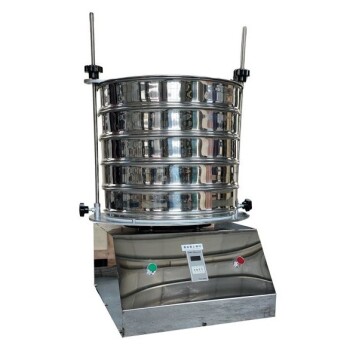
The primary purpose of using a standard sieve is to rigorously control particle size distribution by removing large agglomerates from ground LiTa2PO8 (LTPO) powder. This separation process ensures that only fine, uniform particles are utilized in the subsequent hot-pressing sintering stage.
Sieving is not merely a sorting step; it is a critical enabler for densification. By ensuring a uniform powder bed, you allow for denser packing during hot-pressing, which is essential for eliminating defects and maximizing the mechanical strength of the final ceramic pellet.
The Role of Particle Uniformity
Removing Agglomerates
Grinding processes often leave behind clumps or large agglomerated particles.
If these are left in the powder, they create irregularities within the material structure. A standard sieve, such as a 200-mesh sieve, physically blocks these larger clusters, allowing only fine powder to pass through.
Optimizing Packing Density
Uniform particle distribution is the foundation of dense packing.
When particles are of a consistent, fine size, they can arrange themselves more tightly during the hot-pressing process. This tight arrangement minimizes the empty space between particles before the heat and pressure are even applied.
Impact on the Final Ceramic Pellet
Eliminating Pore Defects
The presence of large particles or uneven distribution often leads to large pore defects.
These voids are detrimental to the integrity of the ceramic. By sieving the powder, you significantly reduce the risk of these defects forming during the sintering phase.
Enhancing Mechanical Strength
A ceramic pellet is only as strong as its internal structure.
By achieving denser packing and removing pore defects, the final density and mechanical strength of the LTPO pellet are substantially enhanced. A dense, defect-free pellet is far more durable and reliable.
Common Pitfalls to Avoid
Neglecting the Mesh Size
Selecting the wrong mesh size can compromise your results.
If the sieve is too coarse, agglomerates will pass through, defeating the purpose of the step. Conversely, if the sieve is too fine for the grinding level, you may lose excessive material or struggle to process the powder efficiently.
Inconsistent Screening
Incomplete sieving can leave a "tail" of larger particles in the mix.
It is vital to ensure the entire batch is processed uniformly. Inconsistency at this stage will manifest as inconsistent density in the final sintered pellet.
Making the Right Choice for Your Goal
To ensure high-quality LiTa2PO8 electrolytes, apply the following principles based on your specific objectives:
- If your primary focus is Maximum Density: strict sieving is non-negotiable to achieve the tightest possible particle packing during hot-pressing.
- If your primary focus is Mechanical Reliability: Ensure you use a mesh (like 200-mesh) capable of filtering out all large agglomerates that act as stress concentrators and crack initiation sites.
Uniformity in your powder preparation is the single most controllable factor in guaranteeing the structural integrity of your final ceramic.
Summary Table:
| Factor | Impact of Sieving on LTPO Pellets | Benefit to Final Ceramic |
|---|---|---|
| Particle Size | Removes large agglomerates and clusters | Ensures a defect-free internal structure |
| Packing Density | Enables tighter arrangement of fine particles | Minimizes voids before heat/pressure application |
| Structural Integrity | Eliminates stress-concentrating pore defects | Significantly enhances mechanical strength |
| Consistency | Ensures uniform powder bed distribution | Guarantees reliable and repeatable pellet quality |
Elevate Your Battery Research with KINTEK Precision Solutions
High-quality LiTa2PO8 (LTPO) electrolytes demand uncompromising material preparation. KINTEK specializes in high-performance laboratory equipment designed to help you achieve maximum density and mechanical reliability.
Whether you need precision sieving equipment to eliminate agglomerates, advanced crushing and milling systems for uniform powder preparation, or industrial-grade hot-pressing sintering systems and hydraulic presses, our portfolio is built for excellence. We also provide specialized battery research tools, high-temperature furnaces, and ceramic crucibles tailored for advanced electrolyte development.
Ready to optimize your pellet fabrication? Contact our technical experts today to discover how KINTEK's comprehensive range of laboratory consumables and equipment can streamline your research and improve your material performance.
Related Products
- Laboratory Test Sieves and Sieving Machines
- Advanced Engineering Fine Ceramics Low Temperature Alumina Granulation Powder
- Custom PTFE Teflon Parts Manufacturer for PTFE Mesh F4 Sieve
- Laboratory Vibratory Sieve Shaker Machine Slap Vibrating Sieve
- Three-dimensional electromagnetic sieving instrument
People Also Ask
- What are laboratory test sieves used for? A Guide to Particle Size Analysis
- How do you calculate the sieve test? Master Particle Size Distribution for Quality Control
- How does a lab test sieve contribute to biomass charcoal powder preparation? Achieve Uniform Particle Size
- What are the specifications for test sieves? A Guide to ASTM & ISO Standards for Accurate Particle Analysis
- What materials are required for sieving? Achieve Accurate Particle Size Analysis