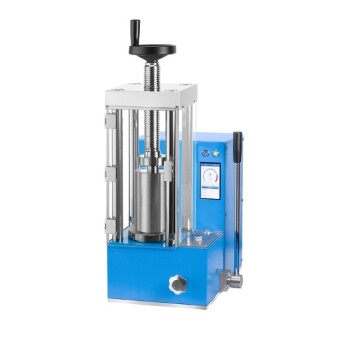
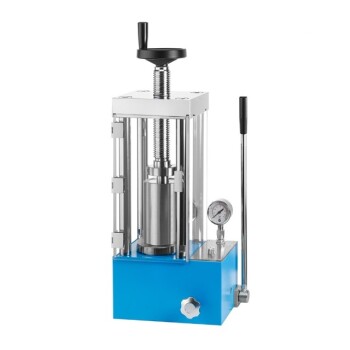
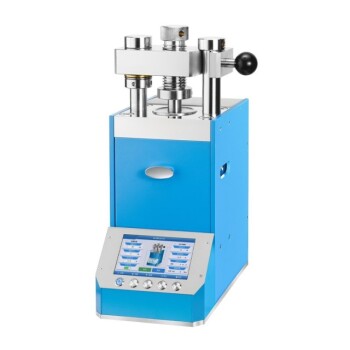
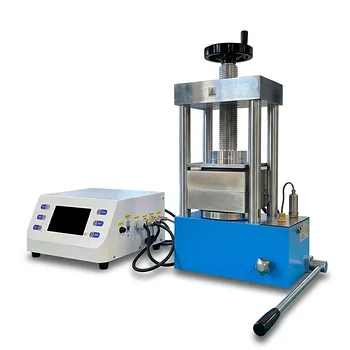
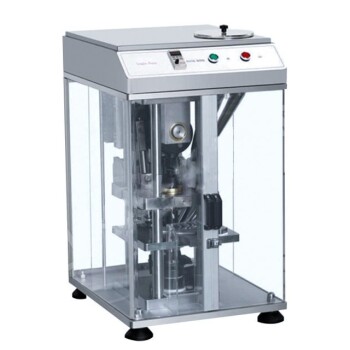
Cold-pressing serves as the essential bridge between loose raw materials and high-performance sintered components. By applying uniaxial hydraulic pressure—typically around 18 MPa—you transform volatile, loose metal powders into a cohesive "green body" capable of withstanding the rigors of the vacuum hot pressing process.
Core Takeaway The uniaxial hydraulic press is not utilized to sinter the material, but to precondition it. Its primary function is to mechanically lock powder particles together to expel trapped air, establish structural integrity for handling, and ensure the precise alignment of mold components prior to the application of heat.
Establishing Mechanical Stability
You cannot effectively load loose powder directly into a vacuum hot pressing furnace without risking contamination or mold misalignment. The cold-pressing stage solves the logistical challenges of powder metallurgy.
Creating the "Green Body"
The hydraulic press compacts loose powder into a pre-form known as a "green compact" or "green body." This compact maintains a specific shape and possesses sufficient strength to hold together without binders or heat.
Ensuring Safe Transport
Once compacted, the mold assembly must be physically moved from the preparation bench to the furnace. Cold-pressing provides the powder body with the structural integrity required to be safely handled and positioned without crumbling or shifting.
Optimizing Material Density
Beyond simple handling, cold-pressing significantly alters the internal physics of the powder mass to prepare it for sintering.
Increasing Loading Density
By applying initial pressure, you significantly increase the packing density of the alloy powders. This mechanical rearrangement brings particles into closer contact, reducing the distance atoms must diffuse during the subsequent hot pressing stage.
Expelling Entrapped Air
Loose powders contain vast amounts of air within the inter-particle voids. Cold-pressing forces this air out before the material enters the vacuum environment. This is critical for reducing defects and ensuring the uniformity of the final internal structure.
Process Control and Precision
The application of uniaxial pressure does more than compact the powder; it standardizes the mechanical setup of the mold assembly.
Correct Punch Positioning
The pressure ensures the correct positioning of the upper and lower punches within the die. Proper alignment at this stage prevents jamming or uneven force distribution once the assembly is under the extreme conditions of the hot press.
Managing Shrinkage Behavior
Pre-pressing reduces the initial volume of the powder, which optimizes displacement control. By minimizing the volume change that occurs during the hot phase, you achieve better dimensional accuracy and prevent deformation caused by uneven loading.
Understanding the Trade-offs
While cold-pressing is vital, it must be executed with precision to avoid downstream issues.
Pressure Calibration is Key
Applying the correct pressure is a balancing act. For example, while 18 MPa is a standard baseline for some applications, other contexts may require pressures as high as 500 MPa or as low as 10 MPa depending on the material. Insufficient pressure results in a fragile green body that breaks during transport.
The Limits of Uniaxial Loading
Uniaxial pressing applies force in only one direction. This can occasionally lead to density gradients, where the powder is denser near the punches and less dense in the center, though this is generally resolved during the hot pressing stage.
Making the Right Choice for Your Goal
The specific parameters of your cold-pressing stage should be dictated by your final requirements.
- If your primary focus is Process Safety: Ensure your pressure is sufficient (e.g., approx. 18 MPa) to create a green body robust enough to prevent mold assembly failure during transport.
- If your primary focus is Dimensional Accuracy: Utilize higher pre-load pressures to maximize initial density, thereby minimizing unpredictable shrinkage during the sintering phase.
Ultimately, the cold-pressing stage is not just a packing step; it is a quality control checkpoint that defines the success of the entire vacuum hot pressing cycle.
Summary Table:
| Feature | Purpose in Cold-Pressing |
|---|---|
| Structural Goal | Creation of a stable "Green Body" for safe handling |
| Material Physics | Expels entrapped air and increases initial packing density |
| Mechanical Alignment | Ensures correct punch positioning to prevent mold jamming |
| Quality Control | Minimizes volume shrinkage during final sintering stage |
| Standard Pressure | Typically ~18 MPa (adjustable based on material needs) |
Elevate Your Powder Metallurgy Precision with KINTEK
Maximize the success of your vacuum hot pressing cycle by choosing the right pre-processing equipment. KINTEK specializes in advanced laboratory solutions, offering high-performance uniaxial hydraulic presses (pellet, hot, and isostatic) designed to create perfect green bodies with superior structural integrity.
Whether you are working with metal powders, ceramics, or advanced alloys, our comprehensive range of crushing and milling systems, high-temperature furnaces, and precision molds ensures every stage of your material research is optimized for accuracy. Our experts are ready to help you select the ideal pressure calibration and equipment for your specific application.
Ready to achieve superior material density and dimensional accuracy?
Contact KINTEK Today for a Expert Consultation
Related Products
- Electric Lab Cold Isostatic Press CIP Machine for Cold Isostatic Pressing
- Manual Cold Isostatic Pressing Machine CIP Pellet Press
- Round Bidirectional Press Mold for Lab
- Automatic Lab Cold Isostatic Press CIP Machine Cold Isostatic Pressing
- kbr pellet press 2t
People Also Ask
- What role does cold isostatic pressing play in the formation of feed rods for single crystal growth? Ensure Stability.
- What is isostatic pressing method for ceramics? Achieve Uniform Density for Complex Parts
- In what ways does Cold Isostatic Pressing (CIP) enhance LiFePO4 battery performance? Boost Density and Conductivity
- How does Cold Isostatic Pressing (CIP) benefit SiC ceramic reactors? Achieve Flawless Material Integrity
- Why is a cold isostatic press advantageous for Argyrodite sulfide solid-state batteries? Achieve Optimal Densification