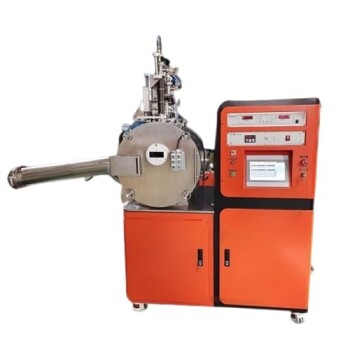
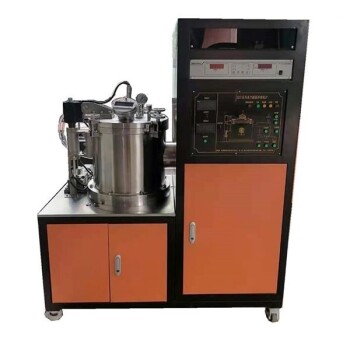
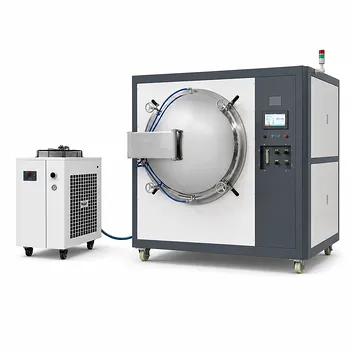
A vacuum induction melting (VIM) furnace is strictly required for the preparation of Platinum-Palladium (Pt/Pd) alloy catalysts to ensure both chemical purity and structural homogeneity. This specific equipment combines a high-vacuum environment to eliminate contamination with electromagnetic forces that actively mix the metals at the atomic level.
Core Takeaway Platinum group metals are highly sensitive to impurities and require precise atomic distribution to function as catalysts. VIM furnaces solve this by isolating the melt from atmospheric gases while simultaneously using electromagnetic stirring to guarantee a uniform, contaminant-free alloy.
Eliminating Environmental Contamination
The Necessity of a High-Vacuum Environment
Platinum and Palladium are sensitive to environmental factors, particularly when heated to their melting points.
A VIM furnace creates a high-vacuum environment that removes atmospheric gases. This prevents oxygen from reacting with the metals, ensuring the final alloy remains free of oxides that would degrade catalytic performance.
Preventing Gas Absorption
Beyond simple oxidation, molten metals have a tendency to absorb gases from their surroundings.
If gas absorption occurs, it compromises the structural integrity of the alloy. The vacuum environment effectively precludes this absorption, maintaining the extreme purity required for high-grade catalytic applications.
Achieving Precise Stoichiometry
The Power of Electromagnetic Stirring
Melting the metals is not enough; they must be mixed perfectly.
The induction heating mechanism within a VIM furnace generates electromagnetic stirring action. This force naturally agitates the molten pool, circulating the liquid metals without the need for physical stirring rods which could introduce contaminants.
Uniform Distribution for Catalysis
Catalytic efficiency depends heavily on the specific ratio of Platinum to Palladium (stoichiometry) at the surface.
Electromagnetic stirring ensures the components are distributed with extreme uniformity throughout the ingot. This guarantees that the final alloy possesses the precise stoichiometric ratios necessary for predictable and reliable catalytic structures.
Understanding Process Boundaries
Differentiating Furnace Roles
It is critical not to confuse the creation of the alloy with its characterization or activation.
While a VIM furnace is used to melt and alloy the raw metals, a high-temperature tube furnace is used later to simulate industrial environments (like methane combustion) and evaluate performance. Attempting to prepare the primary alloy in a standard tube furnace often results in insufficient mixing or contamination.
The Role of Downstream Processing
The VIM furnace produces the high-quality bulk alloy, but it is part of a larger workflow.
Subsequent steps may involve a reduction furnace to convert surface oxides into active metallic states using hydrogen, or a hydraulic press to shape powders into pellets. However, the quality of these final forms is entirely dependent on the purity and uniformity of the initial VIM-produced alloy.
Making the Right Choice for Your Goal
To ensure the validity of your Platinum-Palladium catalyst project, align your equipment with your specific process stage:
- If your primary focus is synthesizing the raw alloy: You must use a vacuum induction melting furnace to guarantee the metal is homogeneous and free of gas or oxide contamination.
- If your primary focus is activating the catalyst: Move the VIM-prepared material to a reduction furnace to expose it to reducing gases like hydrogen for surface activation.
- If your primary focus is performance testing: Use a high-temperature tube furnace with inert components (alumina or quartz) to simulate thermodynamic conditions without altering the material's composition.
Success in Pt/Pd catalysis begins with the purity and mixing quality that only vacuum induction melting can provide.
Summary Table:
| Feature | Benefit for Pt/Pd Catalysts |
|---|---|
| High-Vacuum Environment | Prevents oxidation and gas absorption; ensures extreme chemical purity. |
| Electromagnetic Stirring | Guarantees atomic-level mixing and precise stoichiometry. |
| Induction Heating | Provides rapid, uniform heating without physical contamination. |
| Structural Homogeneity | Ensures consistent catalytic performance across the material surface. |
Elevate Your Catalyst Synthesis with KINTEK Precision
High-performance Platinum-Palladium catalysts demand a foundation of absolute purity and uniform stoichiometry. At KINTEK, we specialize in the advanced laboratory equipment necessary to achieve these standards. From our precision vacuum induction melting (VIM) furnaces and high-temperature tube furnaces to our robust hydraulic pellet presses and high-pressure reactors, we provide the end-to-end solutions your research requires.
Ready to optimize your material preparation? Our technical experts are here to help you select the ideal furnace or processing system for your specific application.
Contact KINTEK Today to Enhance Your Lab Efficiency
References
- L Botha, Elizaveta Ivanovna Plastinina. Ab Initio Study of Structural, Electronic, and Thermal Properties of Pt/Pd-Based Alloys. DOI: 10.3390/condmat8030076
This article is also based on technical information from Kintek Solution Knowledge Base .
Related Products
- Lab-Scale Vacuum Induction Melting Furnace
- Vacuum Induction Melting Spinning System Arc Melting Furnace
- Vacuum Heat Treat Furnace and Levitation Induction Melting Furnace
- Vacuum Arc Induction Melting Furnace
- Non Consumable Vacuum Arc Induction Melting Furnace
People Also Ask
- How do vacuum induction or arc melting furnaces facilitate the synthesis of U-Al-C MAX phases? Precision Heat & Purity
- Why use VIM for rare earth steel? Essential Precision for Melting Reactive Lanthanum and Cerium
- What types of metals are typically processed in a vacuum induction melting furnace? High-Purity Alloys for Critical Applications
- What is the primary function of a vacuum induction melting furnace in Ni-Mo-Cr-Fe master alloy prep? Ensure High Purity
- What are the key components inside the vacuum chamber of a vacuum induction melting furnace? A Guide to the Core Melting Assembly