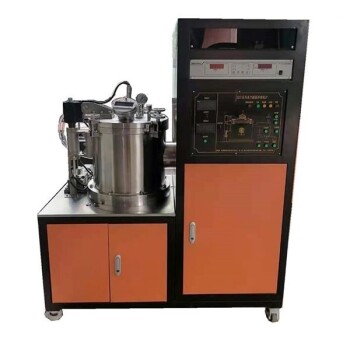
Gasification dephosphorization requires a vacuum tube furnace to manipulate the thermodynamic equilibrium of the reaction through precise pressure and temperature control. By providing temperatures up to 1300°C and a consistent negative pressure environment, the furnace lowers the partial pressure of phosphorus vapor. This physical change forces $P_4$ gas to escape the reaction interface rapidly, preventing the system from reaching a standstill and significantly increasing the overall phosphorus removal rate.
Core Takeaway: The vacuum tube furnace serves as a specialized reactor that drives dephosphorization by coupling high thermal energy with a vacuum-induced "pull" to continuously remove gaseous phosphorus byproducts.
The Thermodynamic Drivers of Phosphorus Removal
Breaking Chemical Equilibrium
In a standard atmosphere, the accumulation of phosphorus vapor at the reaction site can cause the dephosphorization process to stall. The vacuum tube furnace maintains a specific negative pressure that effectively "vacuums" the generated $P_4$ gas away from the phosphomagnetite. This continuous removal prevents the system from reaching chemical equilibrium, allowing the reaction to proceed toward completion much faster than in a non-vacuum environment.
High-Temperature Capability
Phosphomagnetite requires significant energy to break the chemical bonds holding phosphorus within the iron ore matrix. A vacuum tube furnace is engineered to reach and sustain temperatures up to 1300°C, providing the necessary thermal activation energy for gasification. Without this high-intensity heat, the conversion of solid-phase phosphorus to a gaseous state would be energetically impossible.
Reduction of Partial Pressure
The primary mechanism for dephosphorization in this context is the reduction of the partial pressure of phosphorus vapor. By lowering the total pressure within the quartz or corundum tube, the furnace makes it physically easier for phosphorus atoms to transition into the gas phase. This reduction in resistance at the molecular level is the key to achieving high-purity results in metallurgical research.
Precision Control and Experimental Consistency
Uniform Gas Flow and Atmosphere
The tubular design of the furnace ensures that carrier gases and reaction byproducts move in a predictable, uniform path over the solid precursors. This allows researchers to adjust the temperature gradient and gas flow rates to control the depth and breadth of the reaction precisely. Such control is vital for constructing specific interfaces at the nanoscale and ensuring repeatable experimental data.
Structural Integrity and Sealing
To maintain the required vacuum, these furnaces utilize high-strength quartz or corundum tubes sealed with stainless steel flanges. This airtight environment prevents contamination from the outside atmosphere and ensures that the internal pressure remains constant. The integrated vacuum pump and air inlets allow for the introduction of specific atmospheres, such as inert gases, to further refine the chemical process.
Real-Time Monitoring and Assessment
Advanced vacuum tube systems allow for the monitoring of internal pressure changes during the heating cycle. This capability is crucial for identifying specific "peaks" in gas release, which correspond to different chemical phases being treated. By tracking these pressure fluctuations, researchers can qualitatively and quantitatively assess the efficiency of the dephosphorization at various temperature stages.
Understanding the Technical Trade-offs
Material Degradation and Corrosion
While corundum and quartz tubes are highly heat-resistant, they are susceptible to chemical attack from reactive phosphorus vapors over time. Repeated exposure to high-temperature gasification can lead to tube embrittlement or surface etching. This necessitates regular inspection of the furnace hardware to prevent vacuum leaks or structural failure during an experiment.
Thermal Lag and Gradient Challenges
Maintaining a perfectly uniform temperature across the entire length of the tube can be difficult. The ends of the tube, near the stainless steel flanges, are naturally cooler than the center, creating a thermal gradient. Researchers must carefully calibrate the "hot zone" of the furnace to ensure the phosphomagnetite sample is treated at the exact temperature required for gasification.
Vacuum Pump Maintenance
The extraction of $P_4$ gas poses a risk to the vacuum pump system if the gas is allowed to condense within the pump oil or internal components. Secondary filtration or cold traps are often required to capture the phosphorus before it reaches the pump. Failure to manage these byproducts can lead to pump degradation and inconsistent negative pressure readings.
How to Optimize Your Dephosphorization Experiment
To achieve the highest conversion rates and experimental accuracy, consider the following strategic focuses:
- If your primary focus is Maximum Phosphorus Removal: Prioritize the highest stable vacuum level to lower the partial pressure of $P_4$ as much as possible.
- If your primary focus is Material Recovery and Yield: Focus on precise temperature gradient control to prevent the unintended sintering of the iron ore while the phosphorus is gasified.
- If your primary focus is Experimental Repeatability: Implement a strict protocol for flange sealing and leak testing before each heating cycle to ensure consistent negative pressure.
The vacuum tube furnace remains the definitive tool for phosphomagnetite research because it provides the unique environmental conditions necessary to turn a difficult metallurgical impurity into a manageable gaseous byproduct.
Summary Table:
| Feature | Role in Dephosphorization Experiments |
|---|---|
| High Temperature (up to 1300°C) | Provides thermal energy to break phosphorus-iron chemical bonds. |
| Vacuum/Negative Pressure | Lowers $P_4$ partial pressure to prevent reaction equilibrium stalls. |
| Tubular Design | Ensures uniform gas flow path and precise atmospheric control. |
| Airtight Sealing | Prevents contamination and maintains consistent negative pressure levels. |
| Real-Time Monitoring | Allows tracking of gas release peaks to assess reaction efficiency. |
Precision Heat Treatment for Your Metallurgical Research
Unlock the full potential of your gasification experiments with KINTEK’s advanced thermal solutions. Whether you are working on dephosphorization, material synthesis, or phase transformation, our high-performance vacuum tube furnaces provide the precise temperature and pressure control required for repeatable, high-purity results.
Our laboratory-grade portfolio includes:
- High-Temperature Furnaces: Tube, muffle, rotary, vacuum, CVD/PECVD, and atmosphere furnaces.
- Specialized Systems: Induction melting, high-pressure reactors, and autoclaves.
- Sample Preparation: Crushing, milling, sieving, and hydraulic presses.
- Essential Consumables: High-purity ceramics, crucibles, and PTFE products.
At KINTEK, we empower researchers and industrial labs with the tools needed to overcome complex thermodynamic challenges. Contact us today to find the perfect furnace for your application!
References
- Guoping Luo, Xiang-Hui Ji. Study on gasification dephosphorization of phosphorus magnetite reduced by SiC. DOI: 10.1007/s42452-022-05264-w
This article is also based on technical information from Kintek Solution Knowledge Base .
Related Products
- Vacuum Sealed Continuous Working Rotary Tube Furnace Rotating Tube Furnace
- Laboratory High Pressure Vacuum Tube Furnace
- Laboratory Vacuum Tilt Rotary Tube Furnace Rotating Tube Furnace
- Split Chamber CVD Tube Furnace with Vacuum Station Chemical Vapor Deposition System Equipment Machine
- 1200℃ Controlled Atmosphere Furnace Nitrogen Inert Atmosphere Furnace
People Also Ask
- What are the advantages of using a rotary tube furnace for MoVOx catalysts? Elevate Uniformity and Crystallinity
- What are the process advantages of using a rotary tube furnace for WS2 powder? Achieve Superior Material Crystallinity
- Why is a vacuum tube furnace with argon protection required for RGO/Cu? Ensure Conductivity and Material Purity
- Why is a rotary tube furnace preferred over a fixed tube furnace for the carbonization of asphaltenes? Superior Quality
- What is a rotary tube furnace? Achieve Superior Uniformity for Powders and Granules