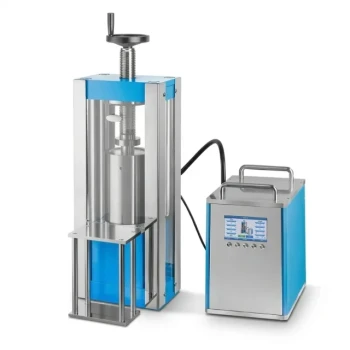
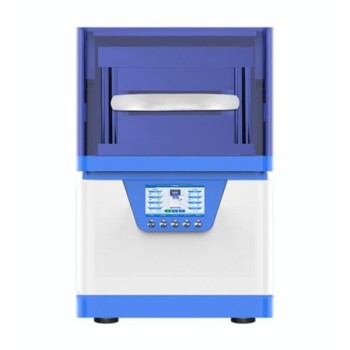
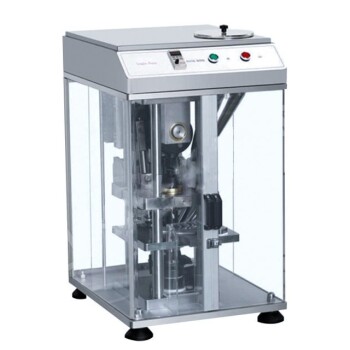
The primary reason for using an isostatic or high-precision hydraulic press during Li/LLZO/Li assembly is to overcome the poor physical contact inherent at solid-solid interfaces. By applying significant, uniform pressure (often around 71 MPa), the press induces plastic deformation in the soft lithium metal, forcing it to fill microscopic voids on the hard LLZO ceramic surface.
Core Takeaway: The fundamental challenge in solid-state batteries is that two solids merely touching creates high resistance due to microscopic air gaps. The press uses force to mechanically mold the Lithium into the LLZO, transforming a rough, "point-to-point" contact into a continuous, low-impedance interface.
Solving the "Solid-Solid" Interface Problem
The Challenge of Microscopic Voids
Unlike liquid electrolytes that naturally wet a surface, solid electrolytes like LLZO are rigid ceramics.
When you place lithium metal against LLZO, they only touch at microscopic peaks. This leaves voids (gaps) between the materials.
These voids act as insulators, blocking the flow of ions and creating high interfacial impedance.
The Mechanism: Plastic Deformation
The press functions by exploiting the mechanical properties of lithium.
Lithium is a relatively soft metal. When subjected to high pressure (e.g., 71 MPa), it undergoes plastic deformation.
This means the lithium effectively "flows" like a highly viscous fluid, filling the surface irregularities and pores of the LLZO membrane.
The Result: Enhanced Connectivity
This deformation creates an intimate, void-free physical bond.
The result is a significant reduction in interface impedance, establishing efficient ion transport channels between the anode and the electrolyte.
Impact on Battery Performance
Enabling High Current Densities
A tight interface is critical for power performance.
Without proper pressing, the battery fails under high loads. With the interface voids eliminated, the battery can withstand much higher critical current densities (such as 12.5 mA cm⁻²).
Ensuring Uniformity
The "high-precision" or "isostatic" nature of the press is vital.
Uneven pressure leads to "hotspots" of contact and areas of non-contact. Uniform pressure ensures the current is distributed evenly across the entire active area.
Understanding the Trade-offs: Pressure vs. Temperature
High Pressure (Cold Pressing)
The primary method described relies on brute mechanical force (approx. 71 to 80 MPa) at ambient temperatures.
This relies on the plasticity of lithium. It is effective but requires robust equipment capable of delivering high force without cracking the brittle ceramic electrolyte.
Thermal-Pressure Bonding (Heated Pressing)
An alternative approach involves using a heated hydraulic press.
By heating the sample (e.g., to 170°C), you utilize the creep characteristics of lithium.
This allows you to achieve similar void-filling results with significantly lower stack pressure (e.g., 3.2 MPa), reducing mechanical stress on the ceramic components.
Making the Right Choice for Your Goal
To optimize the assembly of your symmetric cells, consider the specific constraints of your materials and equipment:
- If your primary focus is maximizing room-temperature assembly speed: Utilize high-pressure (approx. 71-80 MPa) isostatic pressing to induce immediate plastic deformation and ensure robust contact.
- If your primary focus is protecting fragile ceramic electrolytes: Utilize a heated pressing method to exploit lithium creep, allowing for effective bonding at significantly lower pressures (approx. 3 MPa).
Ultimately, the press is not just an assembly tool; it is a critical instrument for interface engineering that dictates the final electrochemical performance of the cell.
Summary Table:
| Feature | High-Pressure (Cold) Pressing | Thermal-Pressure (Heated) Bonding |
|---|---|---|
| Mechanism | Plastic Deformation | Creep Characteristics |
| Typical Pressure | ~71 - 80 MPa | ~3.2 MPa |
| Temperature | Ambient (Room Temp) | Elevated (e.g., 170°C) |
| Key Benefit | Immediate contact, no heat needed | Protects fragile ceramic electrolytes |
| Result | Reduced interfacial impedance | Low-stress, intimate bonding |
Elevate Your Battery Research with KINTEK Precision
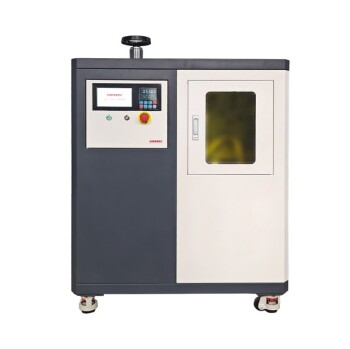
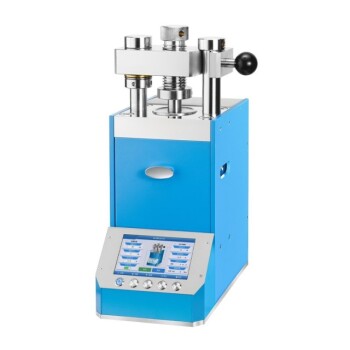
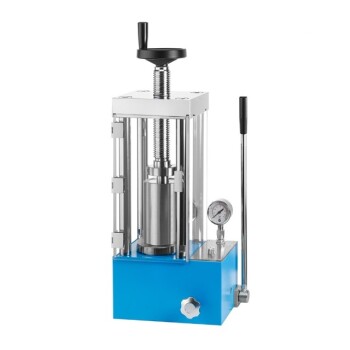
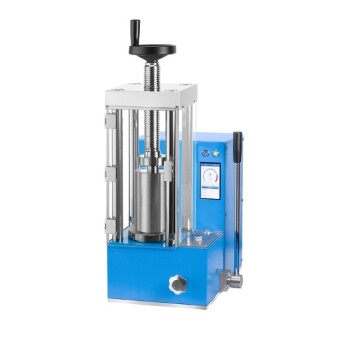
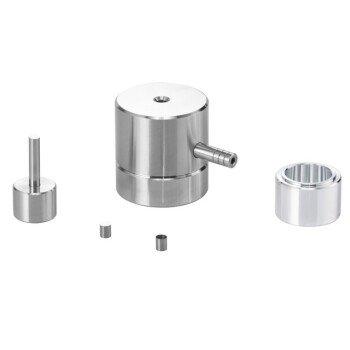
Achieving the perfect solid-state interface requires equipment that delivers uncompromising accuracy. KINTEK specializes in advanced laboratory solutions designed for the most demanding energy research applications. Our high-precision isostatic and hydraulic presses (available in pellet, hot, and isostatic configurations) are engineered to provide the uniform pressure distribution essential for eliminating voids in Li/LLZO/Li symmetric cells.
Beyond pressing, KINTEK offers a comprehensive ecosystem for battery innovation, including high-temperature furnaces (vacuum, tube, and atmosphere), glovebox-ready battery research tools, and high-durability consumables like crucibles and ceramic components.
Ready to reduce your interfacial impedance and achieve higher critical current densities? Contact our technical experts today to find the ideal pressing or heating solution for your laboratory’s needs.
Related Products
- Warm Isostatic Press for Solid State Battery Research
- Automatic Lab Cold Isostatic Press CIP Machine Cold Isostatic Pressing
- Manual Cold Isostatic Pressing Machine CIP Pellet Press
- Electric Lab Cold Isostatic Press CIP Machine for Cold Isostatic Pressing
- Electric Split Lab Cold Isostatic Press CIP Machine for Cold Isostatic Pressing
People Also Ask
- What is the temperature of a warm isostatic press? Achieve Optimal Densification for Your Materials
- What is the function of a Warm Isostatic Press (WIP) in all-solid-state pouch cells? Optimize Battery Density
- Why are Warm Isostatic Presses (WIP) necessary for solid-state batteries? Achieve Atomic-Level Contact
- What advantages does a warm isostatic press offer over a traditional uniaxial press for Li6PS5Cl electrolyte sheets?
- How do warm isostatic presses improve dry electrode performance? Enhance ASSB Conductivity with Heat & Pressure