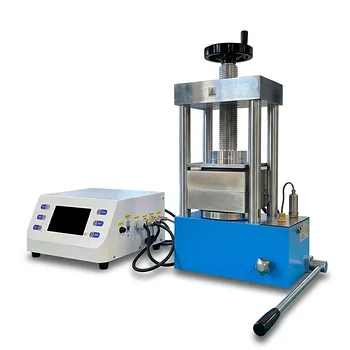
High pressure stability and precision are required to ensure that UO2-BeO powder particles achieve an ideal packing density while minimizing internal porosity. This precise control is the only way to dictate the exact shrinkage rate during the sintering process. Without this stability, it is impossible to maintain the critical initial gap—typically between 60 and 85 micrometers—between the fuel pellet and its cladding.
Core Takeaway The physical integrity and safety of nuclear fuel rely on the "green" (pre-sintered) stage. Precise hydraulic pressure determines the initial density and geometry, which ultimately controls the gap size required to delay Pellet-Cladding Interaction (PCI) during reactor operation.
Achieving Ideal Microstructure
Maximizing Packing Density
The primary goal of applying pressure is to force powder particles into a cohesive arrangement. High-precision hydraulic presses ensure that UO2-BeO powders achieve ideal packing density by mechanically reducing the space between particles.
Minimizing Internal Porosity
Inconsistent pressure leads to voids within the pellet. Stable pressure application is critical to minimize internal porosity in the green pellet, creating a uniform internal structure.
Establishing Particle Contact
The mechanical compression process provides the necessary physical foundation for atomic diffusion. By ensuring close contact between particles, the press facilitates the phase transformation that occurs during high-temperature sintering.
Controlling Sintering Dynamics
Regulating Shrinkage Rates
The density of the green pellet directly dictates how much it will shrink when heated. Precise pressure control allows engineers to predict and control the shrinkage rate during the subsequent sintering phase.
Eliminating Density Gradients
If pressure is applied unevenly, the pellet will have areas of varying density. Uniform axial pressure minimizes these density gradients, which is essential to prevent the pellet from warping, deforming, or cracking under heat.
The Safety Interface: Pellet and Cladding
Defining the Initial Gap
The most critical geometric tolerance in nuclear fuel manufacturing is the gap between the fuel pellet and the cladding. High-precision pressing ensures the final pellet dimensions maintain a precise initial gap, typically between 60 and 85 micrometers.
Mitigating Pellet-Cladding Interaction (PCI)
This specific gap size is not arbitrary; it is a safety feature. An optimized gap design accommodates thermal expansion and swelling, delaying Pellet-Cladding Interaction (PCI) and reducing the risk of cladding rupture during operation.
Understanding the Trade-offs
The Risk of Density Gradients
While high pressure is necessary, the method of application matters. Poorly controlled pressure can introduce density gradients that are invisible in the green stage but result in catastrophic deformation or cracking during sintering.
Equipment Calibration Dependencies
Reliance on high precision means that equipment calibration is paramount. A minor drift in hydraulic stability does not just affect the pellet's weight; it alters the geometric tolerance required for the fuel-cladding interface, potentially rendering the batch unusable.
Making the Right Choice for Your Goal
To ensure the success of your fuel pellet fabrication, consider the following based on your specific objectives:
- If your primary focus is Geometric Fidelity: Prioritize a press with advanced displacement control to maintain the 60–85 micrometer gap tolerance rigidly.
- If your primary focus is Structural Integrity: Focus on presses that offer uniform axial pressure distribution to eliminate density gradients and prevent sintering cracks.
Precision in the pressing stage is not merely about shaping powder; it is about engineering the safety margins of the final nuclear fuel assembly.
Summary Table:
| Requirement | Technical Impact | Safety Benefit |
|---|---|---|
| High Packing Density | Maximizes particle contact | Facilitates uniform atomic diffusion |
| Pressure Stability | Minimizes internal porosity | Prevents cracking during sintering |
| Precision Control | Regulates shrinkage rates | Maintains 60-85 μm cladding gap |
| Uniform Axial Pressure | Eliminates density gradients | Prevents warping and deformation |
Elevate Your Nuclear Research with KINTEK Precision
Precision is the foundation of nuclear fuel integrity. KINTEK specializes in advanced laboratory hydraulic presses (pellet, hot, and isostatic) designed to meet the rigorous demands of UO2-BeO fuel fabrication. Whether you are aiming for perfect geometric fidelity or structural integrity, our high-precision equipment ensures you maintain critical tolerances and eliminate density gradients.
From high-temperature furnaces to specialized crushing and milling systems, KINTEK provides the comprehensive tools needed for advanced materials research. Contact our technical experts today to discuss how our hydraulic solutions can optimize your pellet-cladding interface and enhance your lab's safety and efficiency.
References
- Wei Zhou, Wenzhong Zhou. Thermophysical and Mechanical Analyses of UO2-36.4vol % BeO Fuel Pellets with Zircaloy, SiC, and FeCrAl Claddings. DOI: 10.3390/met8010065
This article is also based on technical information from Kintek Solution Knowledge Base .
Related Products
- kbr pellet press 2t
- Automatic Laboratory Hydraulic Pellet Press Machine for Lab Use
- Laboratory Manual Hydraulic Pellet Press for Lab Use
- Laboratory Manual Hydraulic Pellet Press for Lab Use
- Automatic Laboratory Hydraulic Press for XRF & KBR Pellet Press
People Also Ask
- How do you prepare samples for IR spectroscopy? A Step-by-Step Guide for Solids, Liquids, and Gases
- What measurement methods are commonly used for powder samples in infrared spectroscopy? Optimize Your FTIR Analysis
- Why KBr is used in IR spectrophotometry? A Key to Transparent Sample Analysis
- How are a KBr pellet press and mortar utilized in FTIR analysis of activated carbon? Expert Sample Prep Guide
- How do you prepare KBr pellets for FTIR analysis? Master the Technique for High-Quality IR Spectra