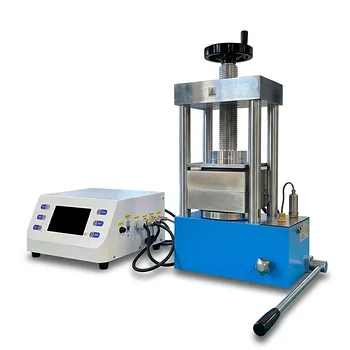
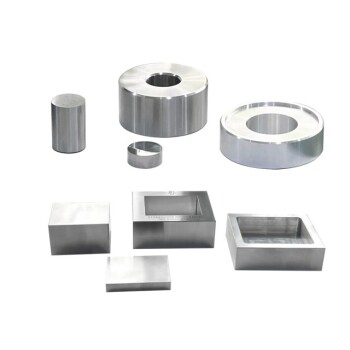
High mechanical pressure acts as a necessary substitute for thermal energy during the secondary molding of AlMgTi composites. Because the process temperature is strictly limited to 430°C to prevent the material from melting, the natural rate at which atoms move and bond is significantly reduced. Adjusting the pressure to 20 MPa forces the magnesium alloy and AlTi layers into closer contact, mechanically driving the atomic activity needed to form a strong, sufficiently thick diffusion bond.
The secondary molding stage operates at a temperature restricted below the Al-Mg eutectic point to preserve structural integrity, which creates a deficit in diffusion kinetics. The application of 20 MPa pressure compensates for this low thermal environment by mechanically increasing atomic activity and contact area to ensure successful bonding.
The Thermal Constraint: Why Heat Isn't Enough
To understand the need for high pressure, you must first understand the strict thermal limitations of this specific manufacturing stage.
Avoiding the Eutectic Limit
The reaction temperature is intentionally set at a relatively low 430°C.
This specific ceiling is chosen to remain below the Al-Mg eutectic temperature.
Preventing Material Remelting
Exceeding this temperature limit would cause the composite components to remelt.
Remelting during the secondary stage would degrade the composite's structure and destroy the prefabricated layers.
The Problem of Low Diffusion
The downside of this safety-focused temperature is a significant decrease in the atomic diffusion rate.
At 430°C, the atoms do not possess enough thermal energy to naturally migrate across the material boundaries effectively.
The Role of 20 MPa Pressure
To overcome the sluggish atomic movement caused by the low temperature, the laboratory hot press utilizes mechanical force as a catalyst.
Compensating for Kinetics
The 20 MPa pressure serves as a direct compensation for the insufficient diffusion kinetics caused by the 430°C environment.
By applying significant force, the system artificially boosts atomic activity without needing to raise the temperature to dangerous levels.
Maximizing Contact Area
The high pressure forces the magnesium alloy layer and the prefabricated AlTi layer into intimate contact.
This reduction of microscopic gaps ensures that atoms from opposing layers are physically close enough to interact.
Ensuring Bond Thickness
The ultimate goal of this pressure is to ensure the formation of a sufficiently thick diffusion bonding layer.
Without the 20 MPa boost, the diffusion layer would likely be too thin or discontinuous to provide structural reliability.
Understanding the Process Trade-offs
Success in this process relies on balancing thermodynamic safety against kinetic requirements.
The Temperature-Pressure Balance
You cannot simply increase the temperature to improve bonding, as this risks liquifying the phases (remelting).
Conversely, if the pressure is below 20 MPa while keeping the temperature at 430°C, the bond will fail due to a lack of diffusion.
The Necessity of "Force-Fed" Diffusion
This process relies on mechanical bridging rather than thermal flowing.
The 20 MPa setting effectively "force-feeds" the diffusion process, ensuring the materials merge despite the thermally stagnant environment.
Optimizing the Secondary Molding Process
When managing the parameters for AlMgTi composite fabrication, your focus should be on maintaining the critical equilibrium between heat and force.
- If your primary focus is Structural Integrity: Strictly maintain the temperature at or below 430°C to prevent the catastrophic failure associated with eutectic remelting.
- If your primary focus is Interfacial Strength: Verify that the hot press pressure reaches and stabilizes at 20 MPa to guarantee the diffusion layer forms completely across the AlTi and Mg interface.
The 20 MPa requirement is not arbitrary; it is the specific mechanical key required to unlock diffusion bonding when thermal energy is deliberately restricted.
Summary Table:
| Parameter | Setting | Purpose in AlMgTi Composite Molding |
|---|---|---|
| Temperature | 430°C | Prevents Al-Mg eutectic remelting and structural degradation. |
| Pressure | 20 MPa | Compensates for low diffusion kinetics; forces atomic bonding. |
| Target Goal | Diffusion Layer | Ensures a thick, continuous bond between Mg and AlTi layers. |
| Mechanism | Mechanical Activation | Substitute for thermal energy to drive atomic migration. |
Maximize Your Material Bonding Precision with KINTEK
Achieving the perfect balance between temperature and pressure is critical for advanced composite fabrication. KINTEK specializes in high-performance laboratory hot presses and hydraulic presses, designed to deliver the precise, stable force required for complex tasks like AlMgTi secondary molding.
Whether you are working with high-temperature high-pressure reactors, specialized crushing and milling systems, or precision pellet and isostatic presses, KINTEK provides the reliability your research demands. Our comprehensive portfolio supports everything from battery research to advanced ceramics and high-temperature furnace applications.
Ready to upgrade your lab's capabilities? Contact our technical experts today to find the perfect equipment solution for your specific manufacturing requirements!
Related Products
- Automatic Laboratory Heat Press Machine
- Automatic Heated Hydraulic Press Machine with Heated Plates for Laboratory Hot Press 25T 30T 50T
- Heated Hydraulic Press Machine with Heated Plates Split Manual Laboratory Hot Press
- Manual Heated Hydraulic Press Machine with Heated Plates for Laboratory Hot Press
- Automatic High Temperature Heated Hydraulic Press Machine with Heated Plates for Lab
People Also Ask
- What are the core advantages of using a laboratory hot press to produce Bi2Se3? Achieve 93% Density & High Conductivity
- Why is a laboratory hot press necessary for all-solid-state battery assembly? Reduce Impedance and Enhance Performance
- How does a three-stage pressure program affect rice husk particleboards? Optimize Bond Strength & Stability
- What is the primary function of a laboratory hot press in MEA assembly? Optimize Fuel Cell Bonding & Performance
- How does a laboratory hot press improve alloy performance? Optimize Liquid Phase Sintering for High-Strength Materials