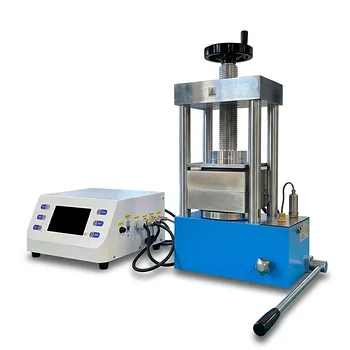
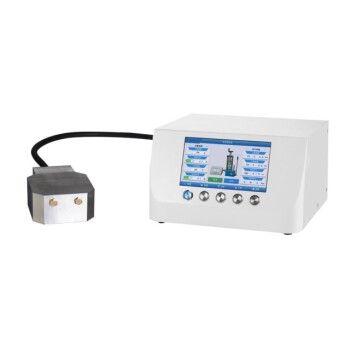
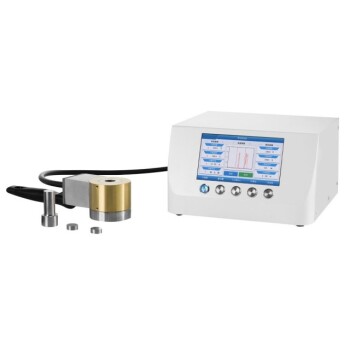
Integrating a heating device with your hydraulic press is strictly necessary to transition the process from simple physical compaction to active chemical densification. While pressure forces particles together, maintaining a temperature of 180°C is required to trigger the dissolution-precipitation mechanism essential for bonding BZY20 ceramics.
Core Insight: The hydraulic press provides the mechanical force for particle contact, but the thermal energy (180°C) is the catalyst that activates the dissolution-precipitation process. Without this heat, the BZY20 powder would merely undergo physical packing; with it, the material achieves preliminary chemical bonding and significantly higher microstructural density.
The Role of Thermal Energy in Cold Sintering
Activating Physicochemical Mechanisms
Pressure alone, even at 400 MPa, typically results in physical rearrangement of particles.
To achieve cold sintering, you must introduce heat to activate specific physicochemical mechanisms.
The application of heat (via tapes or platens) transforms the environment within the die, allowing the transient solvent (usually water) to facilitate mass transfer effectively.
Accelerating Dissolution-Precipitation
The core mechanism driving cold sintering is the dissolution-precipitation process.
Heat accelerates reaction rates at the solid-liquid interface between the BZY20 particles and the solvent.
This thermal input ensures that the ceramic dissolves into the transient fluid and precipitates back onto the particles, creating "necks" or bridges between grains.
The Synergy of Heat and Pressure
Beyond Physical Compaction
A standard hydraulic press effectively compresses ball-milled amorphous powders to reduce porosity.
However, physical compression is limited to mechanical interlocking and particle rearrangement.
By adding a heating device to reach 180°C, you move beyond simple compaction to induce chemical bonding between the grains.
Achieving High Green Density
The combination of high pressure (forcing close contact) and heat (driving mass transfer) results in a superior "green body."
This synergy allows the compact to reach a relative density of approximately 76 percent at comparatively low temperatures.
This high initial density is crucial for constructing continuous three-dimensional ion conduction channels during the final sintering stage.
Understanding the Operational Trade-offs
Temperature Control vs. Pressure Stability
Integrating heating elements adds complexity to the mechanical setup.
You must ensure that the heating device (tapes or platens) does not compromise the press's ability to maintain uniform pressure.
Fluctuations in pressure caused by thermal expansion of the equipment can lead to density gradients in the final pellet.
The Necessity of the Transient Solvent
It is critical to remember that heat alone at 180°C is insufficient for sintering ceramics without a solvent.
The heat is strictly there to empower the transient solvent (water) to do its work.
If the sample dries out before the temperature creates the dissolution effect, the process will fail regardless of the pressure applied.
Optimizing Your Cold Sintering Setup
To ensure you are effectively densifying BZY20 ceramics, evaluate your setup against these specific goals:
- If your primary focus is Maximum Density: Ensure your heating ramp rate allows the sample to reach 180°C while the solvent is still present to maximize the dissolution-precipitation effect.
- If your primary focus is Structural Integrity: Verify that your press maintains constant pressure (up to 400 MPa) throughout the heating cycle to prevent pore formation during the chemical bonding phase.
Summary: You must treat the heating device not as an accessory, but as the chemical trigger that converts your hydraulic press from a simple compactor into a low-temperature sintering reactor.
Summary Table:
| Feature | Physical Compaction Only | Cold Sintering (Heat + Pressure) |
|---|---|---|
| Mechanism | Mechanical Interlocking | Dissolution-Precipitation |
| Temperature | Ambient | 180°C |
| Pressure | Up to 400 MPa | Up to 400 MPa |
| Resulting Density | Low (Physical Packing) | ~76% (Chemical Bonding) |
| Key Outcome | Porous Green Body | Continuous 3D Ion Channels |
Elevate Your Material Research with KINTEK
Precision is paramount when transitioning from physical compaction to chemical densification. KINTEK specializes in advanced laboratory solutions designed for high-performance ceramic research. We provide industry-leading hydraulic presses (pellet, hot, and isostatic) integrated with precise heating systems, alongside essential crushing and milling systems to prepare your BZY20 powders.
Whether you need high-temperature furnaces, high-pressure reactors, or specialized PTFE and ceramic consumables, our equipment ensures uniform pressure and temperature stability for superior green density.
Ready to optimize your cold sintering process? Contact KINTEK today to find the perfect equipment for your lab!
Related Products
- 24T 30T 60T Heated Hydraulic Press Machine with Heated Plates for Laboratory Hot Press
- Heated Hydraulic Press Machine with Heated Plates for Vacuum Box Laboratory Hot Press
- Heated Hydraulic Press Machine with Heated Plates for Vacuum Box Laboratory Hot Press
- Automatic Heated Hydraulic Press Machine with Heated Plates for Laboratory Hot Press 25T 30T 50T
- Heated Hydraulic Press Machine with Integrated Manual Heated Plates for Lab Use
People Also Ask
- What role does a heated hydraulic press play in Cold Sintering (CSP)? Enhancing LATP-Halide Densification
- Why is the heating function of a laboratory hydraulic press essential for MEA assembly in DEFC? Optimize Cell Bonding
- What technical conditions does a heated hydraulic press provide for PEO batteries? Optimize Solid-State Interfaces
- How is a heated hydraulic press used for Li-LLZO batteries? Optimize Interfacial Bonding with Thermal-Pressure
- What is the core function of a laboratory heated hydraulic press in CSP? Revolutionize Low-Temp Ceramic Sintering