Processing nickel ore powder into pellets is a critical mechanical step that serves as the foundation for effective reductive roasting. By converting fine powder into larger, structured units (typically around 10mm), you dramatically improve gas permeability, ensuring that the reducing gases within the furnace can freely circulate and penetrate the material mass.
The transformation from powder to pellet is not merely aesthetic; it creates essential void spaces in the material bed. This structural change allows reducing gases to interact thoroughly with the ore, leading to a more uniform and deeper reduction reaction.
The Mechanics of Gas Permeability
The Problem with Fine Powder
In its raw state, nickel ore powder tends to pack densely when loaded into a furnace.
This compaction minimizes the space between particles, effectively choking the flow of gas. Without adequate spacing, the reducing gases required for the chemical reaction cannot navigate through the material.
Creating Flow Channels
Processing the ore into pellets using a laboratory pelletizer or granulator solves the compaction issue.
The 10mm pellets naturally stack with gaps between them, creating a network of open channels. These channels allow the reducing atmosphere within the tube furnace to flow unimpeded around the ore.
Optimizing Reaction Consistency
Ensuring Thorough Interaction
For reductive roasting to be successful, the gas must contact the solid ore surface efficiently.
Pellets ensure that this interaction happens thoroughly across the entire batch. Unlike powder, which may only react on the surface layers while leaving the core unreacted, pellets facilitate exposure to the gas throughout the furnace load.
Achieving Deep Reduction
The ultimate goal of roasting is to produce a calcined ore with a high degree of reduction.
Because pellets facilitate better gas access, the chemical reduction process can penetrate deeper into the ore structure. This results in a deeper reduction reaction and a significantly higher quality final product compared to processing raw powder.
Understanding the Process Trade-offs
Added Operational Complexity
While essential for quality, pelletizing introduces an additional unit operation to your workflow.
You must introduce a laboratory pelletizer or granulator into the process chain prior to the furnace stage. This increases the time and equipment footprint required for sample preparation.
The Importance of Size Control
The benefits of pelletizing rely on maintaining the specific 10mm diameter mentioned in standard protocols.
If pellets are too variable in size or break apart back into dust, you may lose the permeability benefits. Consistency in the granulation phase is just as important as the roasting phase itself.
Making the Right Choice for Your Goal
To ensure you achieve the highest degree of reduction in your nickel ore, follow these guidelines:
- If your primary focus is maximum reduction: Ensure your pellets are consistent in size (approx. 10mm) to maximize gas penetration depth.
- If your primary focus is process stability: Verify that your pelletizer produces durable pellets that do not disintegrate into powder before the reaction is complete.
By prioritizing physical structure before chemical processing, you unlock the full potential of the reductive roasting phase.
Summary Table:
| Feature | Raw Nickel Ore Powder | Pelletized Nickel Ore (10mm) |
|---|---|---|
| Material Structure | Densely packed fines | Structured, porous units |
| Gas Permeability | Low (chokes gas flow) | High (open flow channels) |
| Reaction Depth | Surface level only | Deep, uniform reduction |
| Process Efficiency | Poor; inconsistent quality | High; consistent calcined ore |
| Equipment Needed | Standard furnace | Pelletizer + Tube/Rotary furnace |
Maximize Your Ore Reduction Yield with KINTEK
Transform your material processing with KINTEK’s industry-leading laboratory solutions. From precision crushing and milling systems to high-performance laboratory pellet presses and granulators, we provide the tools necessary to prepare consistent 10mm pellets for optimal gas permeability. Pair your sample preparation with our advanced rotary or tube furnaces and vacuum/atmosphere systems to achieve superior reduction depth and uniformity.
Ready to elevate your research consistency? Contact our technical experts today to find the perfect equipment for your nickel ore roasting and battery research workflows.
References
- Yuqing Chang, Batrić Pešić. Selective leaching of nickel from prereduced limonitic laterite under moderate HPAL conditions- part I: Dissolution. DOI: 10.2298/jmmb151102023c
This article is also based on technical information from Kintek Solution Knowledge Base .
Related Products
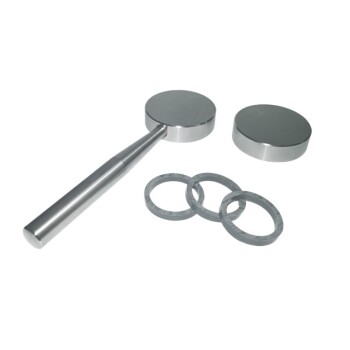
- XRF & KBR plastic ring lab Powder Pellet Pressing Mold for FTIR
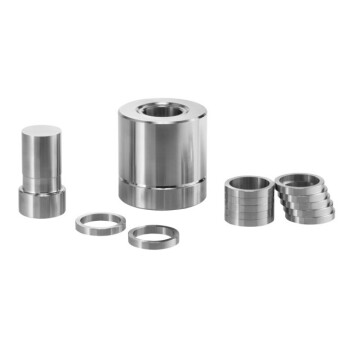
- XRF & KBR steel ring lab Powder Pellet Pressing Mold for FTIR
People Also Ask
- What is the purpose of using a mold for pellet pressing when preparing catalyst test samples? Ensure Data Consistency
- How does the selection of a pressure mold affect the performance of all-solid-state batteries? Expert Pelletizing Guide
- What is the pressed powder pellet method? A Guide to Accurate FTIR Sample Preparation
- What is the XRF method of sampling? Achieve Accurate Elemental Analysis with Proper Sample Prep
- What is the XRF pressed pellet method? A Fast, Cost-Effective Sample Prep Guide