Magnetic stirring acts as the critical kinetic driver in the synthesis of hybrid materials involving GPTMS and Bisphenol A (BPA). It provides the necessary continuous mechanical shear force to ensure that the functional groups of the GPTMS and the BPA crosslinkers achieve thorough contact and diffusion at the molecular level. Without this active mechanical intervention, the reaction relies on passive diffusion, which is insufficient for high-quality hybrid synthesis.
Core Takeaway: Efficient kinetic mixing is the only way to eliminate concentration gradients within your reaction system. Magnetic stirring facilitates the formation of a uniform crosslinked network, directly preventing structural defects such as local brittleness and microscopic phase separation.
The Physics of Molecular Interaction
Generating Essential Shear Force
The primary role of magnetic stirring is to introduce continuous mechanical shear. This force is required to physically move the reactants—GPTMS and BPA—past one another, overcoming static inertia.
Facilitating Molecular Diffusion
Shear force accelerates the rate of diffusion. By actively circulating the fluid, the equipment ensures that GPTMS functional groups frequently encounter BPA molecules, maximizing the probability of successful reaction events.
Achieving Structural Homogeneity
Eliminating Concentration Gradients
In a static or poorly mixed vessel, reactants can pool in specific areas, creating "hot spots" of high concentration. Magnetic stirring homogenizes the mixture, ensuring the ratio of GPTMS to BPA remains consistent throughout the entire volume.
Preventing Microscopic Phase Separation
Hybrid materials are prone to separating into distinct phases if not managed correctly. Continuous agitation prevents the components from segregating, maintaining a single, cohesive phase during the critical crosslinking window.
Impact on Material Properties
Forming a Uniform Network
The ultimate goal of the synthesis is a consistent internal structure. Efficient mixing ensures the crosslinked network develops evenly across the material, rather than forming dense clusters surrounded by weak links.
Avoiding Local Brittleness
When a network is uneven, specific regions become prone to failure. By preventing localized inconsistencies, magnetic stirring ensures the final material possesses uniform mechanical strength, avoiding patches of brittleness that compromise integrity.
Understanding the Operational Limits
The Risk of Intermittent Mixing
The reference emphasizes the need for continuous force. Any interruption in the stirring process allows concentration gradients to re-establish, potentially locking in defects before the synthesis is complete.
Shear Force vs. Viscosity
While magnetic stirring provides necessary shear, one must ensure the equipment is powerful enough for the specific viscosity of the hybrid mixture. If the magnetic coupling slips due to high resistance, the "necessary mechanical shear" is lost, leading to incomplete diffusion.
Making the Right Choice for Your Synthesis
To ensure the integrity of your GPTMS and BPA hybrid materials, your equipment choice must align with your quality goals.
- If your primary focus is Structural Integrity: Prioritize equipment that guarantees constant RPM to prevent microscopic phase separation and local brittleness.
- If your primary focus is Reaction Efficiency: Ensure your setup delivers sufficient shear force to maximize the diffusion rate between functional groups.
Consistent kinetic energy is not a luxury; it is the prerequisite for a defect-free hybrid material.
Summary Table:
| Key Role of Stirring | Impact on Synthesis | Benefits to Final Material |
|---|---|---|
| Shear Force Generation | Overcomes static inertia and facilitates diffusion | Eliminates structural defects and hot spots |
| Kinetic Mixing | Prevents concentration gradients | Ensures a uniform crosslinked network |
| Homogenization | Avoids microscopic phase separation | Prevents local brittleness and failure |
| Continuous Agitation | Maintains single-phase consistency | Guarantees consistent mechanical strength |
Elevate Your Material Synthesis with KINTEK Precision
Don't let poor mixing compromise your research. KINTEK specializes in high-performance laboratory equipment designed for the most demanding chemical syntheses. Our advanced magnetic stirring systems and homogenizers provide the precise shear force and constant RPM required to eliminate phase separation in GPTMS and BPA hybrids.
From high-temperature reactors to specialized stirring tools, KINTEK offers a comprehensive range of solutions for battery research, material science, and chemical engineering.
Ready to ensure defect-free hybrid materials? Contact our technical experts today to find the perfect equipment for your laboratory needs!
References
- Himani Shivhare -, Dr Preeti Chincholikar -. 3-Glycidoxypropyltrimethoxysilan: Description, and Analysis of Works Approaches and Applications. DOI: 10.36948/ijfmr.2023.v05i05.6389
This article is also based on technical information from Kintek Solution Knowledge Base .
Related Products
- Laboratory Small Constant Temperature Heated Magnetic Stirrer Heater and Stirrer
- Custom PTFE Teflon Parts Manufacturer for Magnetic Stirring Bar
- Three-dimensional electromagnetic sieving instrument
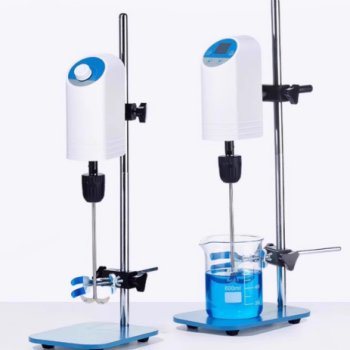
- High Performance Laboratory Stirrers for Diverse Applications
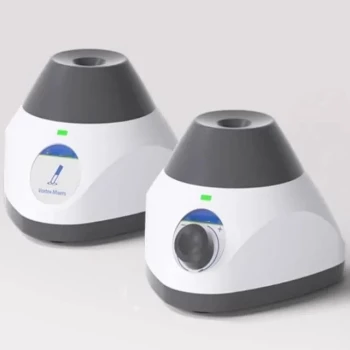
- Laboratory Vortex Mixer Orbital Shaker Multifunctional Rotation Oscillation Mixer
People Also Ask
- What role does a magnetic stirrer with heating play in ZnO nanoparticle synthesis? Precision Control for Quality Results
- What role does a constant temperature heating magnetic stirrer play in MFC-HAp synthesis? Achieve Material Homogeneity
- What is the function of a laboratory magnetic stirrer in Ni–Cr–P electrodeposition? Optimize Ion Transport & Coating
- Why is a laboratory magnetic stirrer required for benzoic acid esters? Boost Reaction Speed & Yield with High RPM
- What role does a laboratory magnetic stirrer play in TiO2 and TiO2-Ag sol preparation? Master Chemical Kinetics