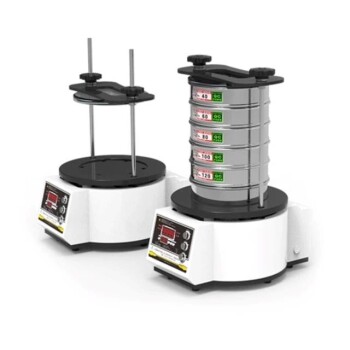
The use of a standard sieve is a non-negotiable quality control step. It is necessary to physically remove large particles and hard agglomerates that form during calcination or storage. Passing the material through a specific mesh, such as 150 µm, ensures that the powder entering the mold is consistent and free of coarse irregularities.
Core Takeaway Sieving is not just about sizing; it is about maximizing packing density. By enforcing a uniform particle size distribution, you ensure the powder compacts efficiently during pressing, which is the only way to prevent large, performance-killing pores in the final sintered NaSICON ceramic.
Managing Powder Consistency
Removing Hard Agglomerates
NaSICON powders often develop "hard agglomerates" during the high-temperature calcination phase or subsequent storage. These clusters are physically robust and do not break down easily during standard mixing or handling.
Correcting Grinding Inconsistencies
While grinding reduces the average particle size, it rarely produces a perfectly uniform batch. A standard sieve acts as a final checkpoint to intercept and remove any residual large particles that survived the grinding process.
The Mechanics of Pressing
Optimizing Packing Density
The primary goal of press-molding is to push powder grains into close contact to minimize void space. A narrow, uniform particle size distribution facilitates better rearrangement of particles, leading to significantly higher packing density before sintering begins.
Facilitating Particle Flow
Under pressure, particles must flow and rearrange to close gaps before undergoing plastic deformation and bonding. Large, irregular chunks disrupt this flow, creating localized areas of low density that the press cannot correct.
Impact on the Final Sintered Body
Eliminating Structural Voids
If large agglomerates are pressed into the "green" (unsintered) body, they result in large pores after sintering. These pores act as stress concentrators and flaws, compromising the mechanical integrity of the ceramic.
Enhancing Optical Transparency
For high-performance ceramics, porosity is the enemy of transparency. By minimizing pore defects through rigorous sieving, you achieve the high density required for optical clarity in the final product.
Common Pitfalls to Avoid
Assuming Grinding is Sufficient
Do not assume that extensive ball milling or grinding eliminates the need for sieving. Grinding creates fines but does not guarantee the absence of coarse outliers that ruin consistency.
Overlooking Mesh Selection
The specific mesh size (e.g., 150 µm vs. 325 µm) determines the upper limit of your particle size. Using a sieve that is too coarse will fail to catch harmful agglomerates, while a sieve that is too fine may unnecessarily reduce yield without adding performance value.
Making the Right Choice for Your Goal
To optimize your NaSICON ceramic fabrication, consider your specific performance requirements:
- If your primary focus is Structural Integrity: Ensure you sieve to remove all agglomerates, as these create large pores that weaken the ceramic body.
- If your primary focus is Optical Transparency: Prioritize a narrow particle size distribution to maximize packing density and minimize light-scattering defects.
- If your primary focus is Process Efficiency: Integrate sieving immediately after aging or grinding to prevent agglomerates from complicating the pressing stage.
Uniformity in the powder phase is the single best predictor of density in the sintered phase.
Summary Table:
| Feature | Impact of Sieving | Benefit for NaSICON Ceramics |
|---|---|---|
| Agglomerate Removal | Eliminates hard clusters from calcination | Prevents localized defects and large pores |
| Particle Size | Ensures a narrow, uniform distribution | Maximizes green body packing density |
| Powder Flow | Facilitates smooth rearrangement under pressure | Reduces internal stress and structural flaws |
| Final Quality | Minimizes light-scattering defects | Enhances mechanical strength and transparency |
Elevate Your Material Research with KINTEK Precision
Achieving high-performance NaSICON ceramics starts with perfect powder preparation. KINTEK specializes in high-quality laboratory equipment, including precision sieving equipment, crushing and milling systems, and advanced hydraulic presses (pellet, hot, isostatic) designed to optimize your material density and structural integrity.
Whether you are developing solid-state batteries or high-performance ceramics, our team provides the essential tools—from high-temperature furnaces to PTFE consumables—to ensure your research yields consistent, flaw-free results.
Ready to optimize your powder processing workflow? Contact KINTEK today for expert guidance and tailored solutions!
Related Products
- Custom PTFE Teflon Parts Manufacturer for PTFE Mesh F4 Sieve
- Laboratory Test Sieves and Sieving Machines
- Vibratory Sieve Shaker Machine Dry Three-Dimensional Vibrating Sieve
- Laboratory Vibratory Sieve Shaker Machine for Dry and Wet Three-Dimensional Sieving
- Laboratory Vibratory Sieve Shaker Machine Slap Vibrating Sieve
People Also Ask
- What are the primary reasons for selecting PTFE as a matrix? Enhance Composites with Carbon Nanotube Reinforcement
- How is PTFE utilized for insulation in Alloy 22 corrosion setups? Ensure Signal Purity & Accuracy
- Is PTFE corrosion resistant? Discover the Ultimate Chemical Resistance for Your Lab
- What are the specific applications of PTFE in micro-batch slug flow systems? Enhance Your Microfluidic Reaction Purity
- What is the mesh size of a sieve? A Guide to Particle Size and Sieve Selection