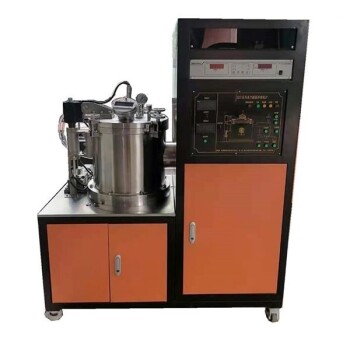
A vacuum environment is strictly mandatory for Electron Beam Directed Energy Deposition (WEAM) because electron beams function poorly when exposed to atmospheric gas. If an electron beam travels through air, it collides with gas molecules, causing the beam to scatter and resulting in a significant loss of kinetic energy and processing precision.
Core Takeaway The vacuum serves two critical functions: it preserves the beam's energy and focus by preventing collisions with air molecules, and it provides an ultra-clean environment that completely eliminates oxidation and minimizes material impurities.
Preserving Beam Integrity
Preventing Beam Scattering
The primary physical reason for using a vacuum is the nature of the electron beam itself.
When electrons are projected through a standard atmosphere, they collide with gas molecules.
This interaction causes the beam to scatter, destroying the tight focus required for precision manufacturing.
Avoiding Energy Loss
Scattering does not just affect the direction of the beam; it affects its power.
Collisions with air molecules dissipate the beam's energy before it reaches the target material.
By utilizing a vacuum, the system ensures significant energy loss is avoided, maintaining the high energy density needed to melt the metal feedstock effectively.
Ensuring Material Quality
Eliminating Oxidation
Beyond the physics of the beam, the vacuum acts as a powerful quality control measure for the material.
The vacuum furnace environment completely prevents oxidation reactions during the deposition process.
This is critical for reactive metals that would otherwise degrade instantly if heated in the presence of oxygen.
Minimizing Impurities
The "ultra-clean" nature of the vacuum furnace extends beyond just oxygen control.
It actively minimizes other material impurities that could compromise the structural integrity of the final part.
This results in a finished component with superior mechanical properties compared to those processed in less controlled environments.
Understanding the Operational Constraints
The "Mandatory" Nature of the Environment
Unlike other additive manufacturing methods that may use inert gas shielding, WEAM has no flexibility regarding the environment.
The reference explicitly states the vacuum is mandatory, not optional.
This means the process is entirely dependent on the integrity of the vacuum chamber; any breach in the vacuum leads to immediate beam dispersion and process failure.
Precision vs. Complexity
The requirement for a vacuum ensures processing precision, but it imposes strict boundaries on the manufacturing setup.
The part size is strictly limited by the size of the vacuum furnace.
Furthermore, the process cannot "step outside" the controlled environment, making it a highly specialized procedure reserved for applications requiring maximum integrity.
Making the Right Choice for Your Goal
The necessity of a vacuum in WEAM defines its best-use cases.
- If your primary focus is Geometric Precision: The vacuum is essential because it prevents beam dispersion, ensuring the electron beam remains tightly focused for accurate deposition.
- If your primary focus is Material Purity: The vacuum is the deciding factor, as it provides the ultra-clean environment necessary to completely prevent oxidation and minimize internal impurities.
Summary: The vacuum in WEAM is not merely a protective measure; it is the fundamental enabler that allows the electron beam to retain its energy and focus while ensuring the metallurgical purity of the final component.
Summary Table:
| Feature | Impact of Vacuum Environment | Benefit to WEAM Process |
|---|---|---|
| Beam Focus | Prevents collisions with gas molecules | Maintains high precision and prevents scattering |
| Energy Density | Eliminates kinetic energy dissipation | Ensures efficient melting of metal feedstock |
| Atmospheric Control | Removes oxygen and reactive gases | Completely eliminates oxidation of reactive metals |
| Material Integrity | Creates an ultra-clean processing zone | Minimizes impurities for superior mechanical properties |
Elevate Your Advanced Manufacturing with KINTEK Precision
At KINTEK, we understand that high-performance processes like Electron Beam Directed Energy Deposition (WEAM) demand uncompromising environment control. Our specialized range of high-temperature vacuum furnaces is engineered to provide the ultra-clean, stable environments necessary to preserve beam integrity and ensure metallurgical purity.
Whether you are working with reactive metals or require maximum geometric precision, KINTEK offers a comprehensive portfolio of laboratory equipment—from high-temperature furnaces and crushing systems to isostatic presses and specialized ceramics—designed to support the most demanding research and production workflows.
Ready to optimize your material processing? Contact our technical experts today to discover how KINTEK’s advanced vacuum solutions can enhance your laboratory's efficiency and output quality.
References
- Won Chan Lee, Jeoung Han Kim. Evaluation of Mechanical Properties of Pure Ni Coatings on a Type 316H Stainless Steel Substrate via High-Velocity Oxy-fuel and Directed Energy Deposition Processes. DOI: 10.4150/jpm.2025.00185
This article is also based on technical information from Kintek Solution Knowledge Base .
Related Products
- Vacuum Hot Press Furnace Heated Vacuum Press Machine Tube Furnace
- 600T Vacuum Induction Hot Press Furnace for Heat Treat and Sintering
- Vacuum Hot Press Furnace Machine Heated Vacuum Press
- Vacuum Heat Treat Furnace and Levitation Induction Melting Furnace
- 2200 ℃ Tungsten Vacuum Heat Treat and Sintering Furnace
People Also Ask
- What advantages does a vacuum hot press furnace provide for LSLBO ceramic electrolytes? Achieve 94% Relative Density
- What role does a Vacuum Hot Press (VHP) furnace play in the densification of austenitic stainless steel 316 composites?
- What are the advantages of using a vacuum hot pressing furnace? Superior Densification for 2024Al/Gr/SiC Composites
- What are the advantages of a vacuum hot press furnace for LTPO solid electrolytes? Boost Density and Conductivity
- What core processing conditions does a vacuum hot press furnace provide? Achieve High-Density Cu-SiC/Diamond Composites