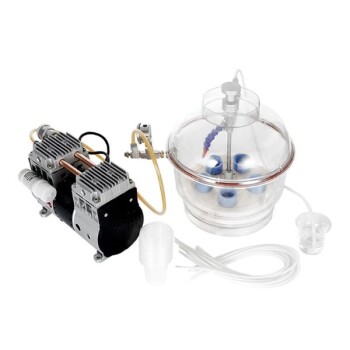
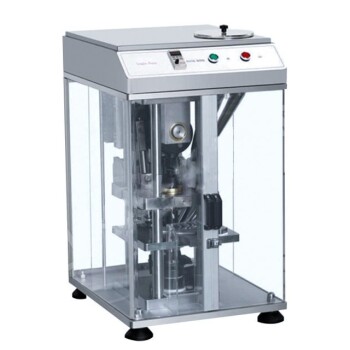
The primary necessity for vacuum or atmospheric protection in pressing equipment is to prevent the rapid oxidation of metal nanopowders. Due to their extremely high specific surface area, these powders are highly reactive and will instantly adsorb oxygen if exposed to air. Protective environments reduce the oxygen partial pressure to near-zero levels, preventing the formation of oxide layers that inhibit densification and degrade material performance.
Metal nanopowders possess a surface area so vast that they behave differently than bulk metals, making them chemically unstable in air. Without atmospheric control, the formation of oxide barriers is inevitable, rendering the material useless for high-performance applications.
The Mechanism of Reactivity
High Specific Surface Area
The defining characteristic of a nanopowder is its high specific surface area. Relative to their volume, nanoparticles expose a massive amount of atoms to the surrounding environment.
This increases the material's chemical energy and reactivity. While beneficial for sintering, it makes the powder highly susceptible to contamination.
Oxygen Adsorption
When exposed to standard air, metal nanopowders experience immediate oxygen adsorption. The exposed atoms react with oxygen molecules to form stable oxides.
For example, copper nanopowders will rapidly form Cu2O (copper(I) oxide) layers on their surfaces. This reaction can occur almost instantaneously upon contact with the atmosphere.
Consequences for Densification
Barrier Layer Formation
The oxide layers formed during exposure act as a physical barrier between metal particles. In a pure metal powder, particles fuse directly through metallic bonding.
However, an oxide shell prevents this direct contact. Instead of metal-to-metal contact, you get metal-oxide-metal interfaces, which are structurally weak.
Inhibition of Sintering
These oxide layers interfere with the diffusion processes required for densification. Effective pressing and sintering rely on atoms moving across grain boundaries to close pores.
Oxides generally have higher melting points and lower diffusion rates than the parent metal. This stalls the densification process, resulting in a final product with higher porosity and lower mechanical strength.
Impact on Physical Properties
Electrical Conductivity Degradation
The presence of oxides severely impacts electrical properties. Metal oxides are typically semiconductors or insulators, not conductors.
If particles are separated by oxide layers, electrons cannot flow freely through the material. This increases electrical resistivity, negating the benefits of using high-conductivity metals like copper or silver.
Thermal Performance Loss
Similarly, oxide interfaces disrupt thermal conductivity. Phonons and electrons, which carry heat, scatter at these oxide boundaries.
For applications requiring heat dissipation, such as electronic packaging, the presence of internal oxides will cause the component to fail its thermal specifications.
Understanding the Trade-offs
Equipment Complexity vs. Material Purity
Implementing vacuum or inert gas (like nitrogen or argon) systems significantly increases equipment cost and complexity. It requires robust sealing, pumps, and monitoring systems.
However, this is not an optional "add-on." Attempting to press metal nanopowders in open air is functionally futile for high-performance parts. The cost of equipment is the trade-off for accessing the superior properties of nanomaterials.
Process Sensitivity
Vacuum systems introduce process sensitivity. Even a microscopic leak or a slight impurity in the protective gas can compromise the entire batch.
Operators must maintain strict control over the vacuum level or gas purity. A partial failure in the protection system can result in invisible internal oxidation that is only detected during final testing.
Ensuring Material Integrity
To maximize the performance of your pressed components, you must align your processing environment with your material goals.
- If your primary focus is Electrical Conductivity: You must ensure the lowest possible oxygen partial pressure to prevent insulating oxide boundaries between particles.
- If your primary focus is Mechanical Density: You must prevent surface oxidation to allow for unobstructed metallic bonding and pore closure during densification.
Ultimately, atmospheric protection is the only variable that allows you to translate the theoretical potential of nanopowders into a functional reality.
Summary Table:
| Factor | Impact of Atmospheric Exposure | Benefit of Vacuum/Inert Protection |
|---|---|---|
| Surface Chemistry | Rapid oxygen adsorption and oxide layer formation | Maintains high-purity metallic surfaces |
| Densification | Oxide shells inhibit sintering and atom diffusion | Enables strong metallic bonding and density |
| Electrical Flow | Increased resistivity due to insulating oxides | Preserves high electrical conductivity |
| Thermal Conductivity | Heat scattering at oxide interfaces | Maintains optimal thermal dissipation |
| Mechanical Strength | Weak metal-oxide interfaces; high porosity | Results in high-strength, low-porosity parts |
Unlock the Potential of Your Nanomaterials with KINTEK
Don't let oxidation compromise your research or production. KINTEK specializes in advanced laboratory equipment designed for sensitive material processing. From high-precision hydraulic presses (pellet, hot, and isostatic) to sophisticated high-temperature vacuum furnaces and atmosphere-controlled reactors, we provide the exact environment your metal nanopowders require to maintain integrity.
Whether you are focusing on battery research, electronic packaging, or high-performance sintering, our team is ready to help you select the right tools—including PTFE consumables, ceramic crucibles, and cooling solutions—to ensure your densification processes achieve maximum density and conductivity.
Ready to upgrade your lab's capabilities? Contact us today to discuss your specific application needs and receive a tailored quote!
Related Products
- Vacuum Hot Press Furnace Machine for Lamination and Heating
- Vacuum Cold Mounting Machine for Sample Preparation
- Round Bidirectional Press Mold for Lab
- Touchscreen Automatic Vacuum Heat Press
- Laboratory Hydraulic Pellet Press for XRF KBR FTIR Lab Applications
People Also Ask
- What advantages does a vacuum hot press furnace provide for LSLBO ceramic electrolytes? Achieve 94% Relative Density
- Why is it necessary to maintain a high-vacuum environment within a vacuum hot press furnace? Optimize Cu-SiC Sintering
- What are the advantages of using a vacuum hot press furnace for sintering CNT/Cu composites? Superior Density & Bonding
- What are the advantages of a vacuum hot press furnace for W-50%Cu? Achieve 99.6% Density at Lower Temperatures
- What role does mechanical pressure play during the vacuum diffusion bonding of tungsten and copper? Keys to Solid Bonding