The Psychology of a Perfect Environment
At its core, materials science is about control.
It’s the human desire to fight randomness, to impose will on an atomic structure, and to create something predictable, strong, and reliable. We aren’t just making things hot; we are engineering certainty.
The vacuum furnace is the ultimate theater for this contest. It’s a machine built not just to generate heat, but to eliminate variables.
The Illusion of a Single Machine
It's easy to look at a vacuum furnace and see a single object: a robust, sealed box. This is a comforting but misleading simplification.
A furnace is not a monolith. It’s an ecosystem.
It’s a collection of highly specialized systems that must work in perfect, silent unison. The success of a multi-hour thermal cycle depends on dozens of components performing flawlessly, as a team. If one falters, the entire process is compromised.
The Anatomy of the Furnace
To trust a furnace, you must understand its constituent parts—not as a list of features, but as a series of promises.
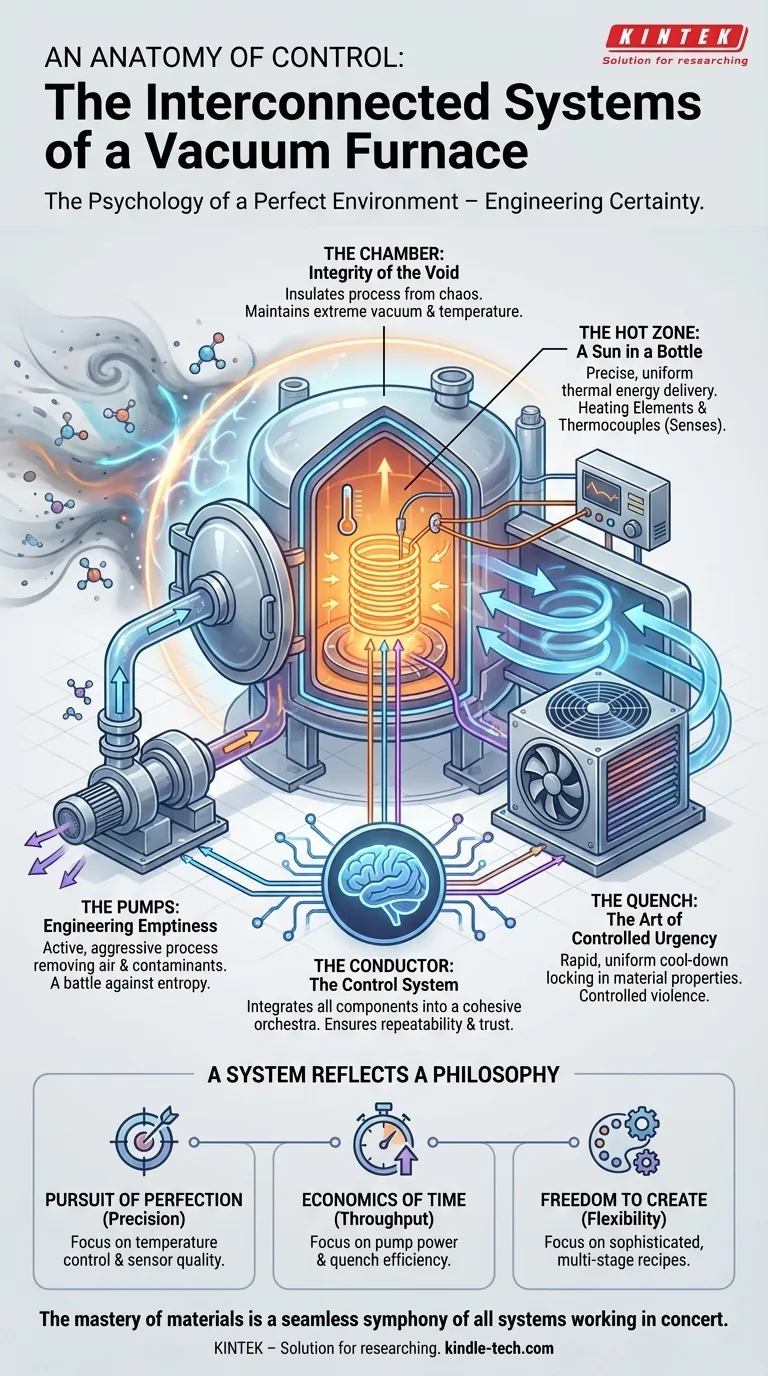
The Chamber: The Integrity of the Void
The vacuum chamber is the heart of the operation. Its primary job is to withstand immense external pressure while maintaining an internal environment of extreme temperature and near-perfect vacuum.
It isn't just a container; it's a vessel built to insulate the process from the chaos of the outside world. Its hinged door is more than an access point; it's a seal that guarantees the integrity of the controlled void within.
The Pumps: Engineering Emptiness
The vacuum is not a state of absence, but the result of an active, aggressive process. The pumping system is responsible for this.
Through multiple stages, it systematically removes air, moisture, and other gaseous contaminants. Every molecule ejected from the chamber is a variable eliminated, bringing the process one step closer to a pure, known state. This system is a constant battle against entropy.
The Hot Zone: A Sun in a Bottle
This is where the transformation happens. The heating system, or "hot zone," must deliver precise thermal energy uniformly across the entire workload.
- Heating Elements: These are the instruments of creation. Poorly designed or installed, they create hot and cold spots, introducing stress and compromising the final product. They are the most common point of failure.
- Thermocouples: These are the system's senses. They provide the critical feedback that allows the control system to steer the thermal profile with precision. Their strategic placement, often easier in vertical furnace configurations, is a non-negotiable part of process control.
The Quench: The Art of Controlled Urgency
After hours at peak temperature, the final properties of the material are locked in during the cool-down. This cannot be left to chance.
The cooling system, often a high-pressure gas quench, performs this critical step. A powerful fan circulates inert gas through a heat exchanger and over the workload, forcing a rapid but uniform drop in temperature. It is a moment of controlled violence that turns potential properties into reality.
The Conductor: The Control System
The electrical and pneumatic controls are the brain. This unseen conductor integrates every pump, valve, sensor, and heater into a single, cohesive orchestra.
This is where trust is forged. The control system ensures that the hundredth cycle is an exact replica of the first. It provides the repeatability that is the bedrock of all industrial and scientific processes.
A System Reflects a Philosophy
A furnace is more than the sum of its parts. Its design reflects a philosophy of use. When choosing a system, you are choosing to prioritize a certain goal.
- The Pursuit of Perfection: If your primary goal is absolute precision, you obsess over the temperature control system—the quality of the thermocouples and the intelligence of the controller.
- The Economics of Time: If high throughput is your driver, you focus on the power of the vacuum pumps and the efficiency of the gas quench. Every minute saved in a cycle is a direct economic win. -- The Freedom to Create: If you need flexibility for research and development, you require a sophisticated control system that acts as a canvas, not a straitjacket, allowing for complex, multi-stage recipes.
Core Furnace Systems at a Glance
| Component | Primary Function | Key Attributes for High Performance |
|---|---|---|
| Vacuum Chamber | Provides a sealed, stable environment | Structural integrity, efficient gas flow |
| Pumping System | Creates the low-pressure atmosphere | Multi-stage efficiency, accurate measurement |
| Heating System | Delivers precise, uniform temperature | Quality heating elements, strategic sensors |
| Cooling System | Locks in material properties rapidly | Powerful gas circulation, controlled rates |
| Control System | Integrates and automates all operations | Process repeatability, safety, flexibility |
The mastery of materials doesn't come from a single component, but from the seamless symphony of all systems working in concert. This is the difference between a simple oven and a true metallurgical instrument.
At KINTEK, we specialize in high-performance laboratory equipment where every system is engineered for reliability and integration. Our vacuum furnaces are designed to provide the control and repeatability your critical processes demand, whether you prioritize precision, throughput, or flexibility. To find the system that matches your philosophy, Contact Our Experts.
Visual Guide
Related Products
- Vacuum Hot Press Furnace Heated Vacuum Press Machine Tube Furnace
- 600T Vacuum Induction Hot Press Furnace for Heat Treat and Sintering
- Vacuum Hot Press Furnace Machine Heated Vacuum Press
- Vacuum Heat Treat Furnace and Levitation Induction Melting Furnace
- 2200 ℃ Tungsten Vacuum Heat Treat and Sintering Furnace
Related Articles
- The Purity Paradox: Choosing the Heart of Your Vacuum Hot Press Furnace
- Comprehensive Guide to Vacuum Hot Press Furnace Application
- Vacuum Hot Press Furnace: A Comprehensive Guide
- Forging Perfection in a Void: The Physics of Ultra-Dense Materials
- Defeating the Void: The Quiet Power of Vacuum Hot Pressing