The Pressure of a Vacuum
Inside the silent, airless chamber of a vacuum furnace, a drama of physics unfolds. Here, materials are transformed under conditions impossible to achieve on Earth's surface. To an outsider, the process looks serene. But for the engineer, it's a high-wire act.
The heart of this act is the heating element. It’s more than a component; it's the engine of transformation. And its selection is one of the most consequential decisions in materials science—a choice that balances raw power against the unforgiving laws of physics. Get it right, and you create the impossible. Get it wrong, and the result is catastrophic failure.
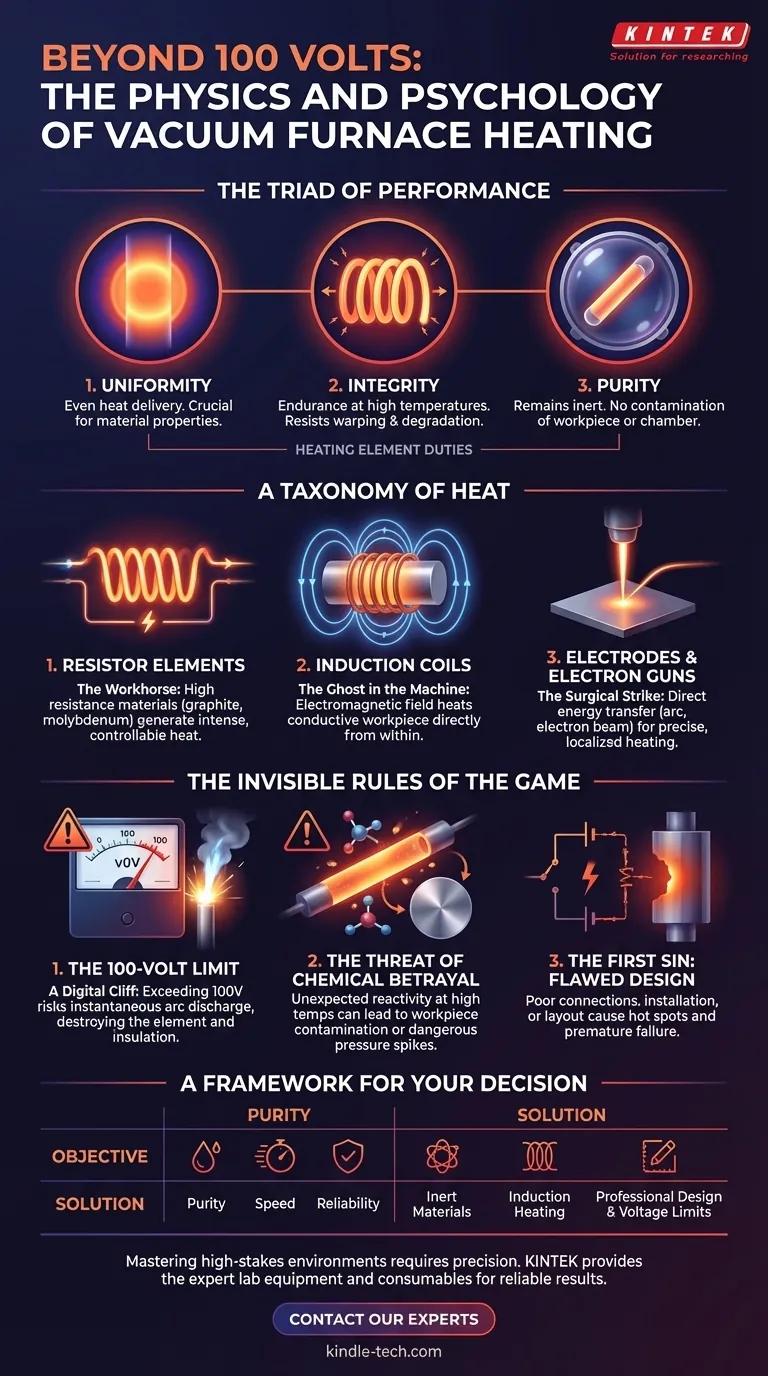
The Triad of Performance
A heating element has three fundamental duties. Fulfilling them is not a matter of simply "getting hot." It’s a matter of control, endurance, and purity.
The Quest for Uniformity
The first duty is to deliver heat evenly. A temperature gradient of just a few degrees across a critical aerospace component can be the difference between a perfect part and a piece of scrap. The element's material and geometry must create a perfectly uniform thermal field, bathing the workpiece in consistent energy.
The Test of Integrity
The second duty is to endure. The element operates in a state of controlled violence, glowing at thousands of degrees for hours on end. It must resist sagging, warping, and degrading over countless cycles. This isn’t just about longevity; it's about predictable, reliable performance that you can trust.
The Vow of Purity
The third, and perhaps most critical, duty is to remain inert. In the sterile vacuum, the heating element must be a silent observer. It cannot react with the workpiece or the trace gases remaining in the chamber. Any chemical interaction is contamination—a poison that compromises the final product.
A Taxonomy of Heat
The technology used to generate this heat varies dramatically, each suited for a different purpose, much like a surgeon selects a specific instrument for a specific procedure.
The Workhorse: Resistor Elements
This is the most trusted method. Electricity passes through a material with high resistance—like graphite or molybdenum—and the resulting friction on an atomic level generates intense, stable, and highly controllable heat. They are the foundation of many high-temperature processes.
The Ghost in the Machine: Induction Coils
Induction heating is a fundamentally different approach. It uses a powerful electromagnetic field to generate current inside the conductive workpiece itself. The material heats from within, without physical contact. It is astonishingly fast and efficient, particularly for metals.
The Surgical Strike: Electrodes and Electron Guns
For the most extreme applications, direct energy is required. Electrodes can create a miniature bolt of lightning—an electric arc—to melt materials instantly. Electron guns fire a focused beam of high-energy particles, delivering precise, localized heat like a microscopic laser.
The Invisible Rules of the Game
Operating a vacuum furnace means respecting its invisible boundaries. These are not suggestions; they are hard physical limits, and crossing them carries immediate consequences.
The 100-Volt Limit: A Digital Cliff
The voltage supplied to a heating element is almost always kept below 100 volts. This seems counterintuitive—why limit the power? The answer lies in the physics of a near-vacuum.
Higher voltages can ionize the few remaining gas molecules in the chamber, triggering a glow discharge or a full arc discharge. This isn't a gradual failure; it's an instantaneous event, like flipping a switch. The uncontrolled electrical arc can vaporize the heating element and destroy the insulation, leading to costly damage and a significant safety hazard. It’s a digital cliff, not a gentle slope.
The Threat of Chemical Betrayal
The combination of extreme heat and a vacuum creates an environment where materials behave in unexpected ways. An element material that is stable at room temperature can become aggressively reactive at 1500°C. This chemical betrayal can lead to workpiece contamination at best, and a dangerous pressure spike or explosion at worst.
The First Sin: Flawed Design
Ultimately, the most common source of failure isn't exotic physics; it's human error. Poorly designed connections, improper installation, or a flawed geometric layout will create hot spots, leading to non-uniform heating and premature burnout. Expertise in design is the first line of defense against failure.
A Framework for Your Decision
Choosing the right heating element is a process of defining your primary objective.
- If your dogma is process purity: You must prioritize chemically inert materials, like high-purity graphite or specific refractory metals that will not react with your workpiece.
- If your strategy is speed: For conductive metals, induction heating is often the superior choice, delivering rapid, direct energy transfer.
- If your foundation is reliability: You must insist on professional design, flawless installation, and strict adherence to the voltage limitations to prevent electrical discharge.
The table below summarizes these choices:
| Heating Element Type | Primary Use Case | Key Characteristics |
|---|---|---|
| Resistor Elements | General High-Temp Processing | High resistance materials (graphite, molybdenum); excellent temperature control. |
| Induction Coils | Rapid Heating of Conductive Metals | Heats workpiece directly via electromagnetic fields; fast and efficient. |
| Electrodes / Electron Guns | Specialized Melting & Precision Heating | Direct energy transfer (arc or electron beam) for intense, localized heat. |
This level of nuanced decision-making, balancing physics, material science, and operational safety, is where expertise becomes indispensable. KINTEK specializes in providing the precise lab equipment and consumables your laboratory needs to master these high-stakes environments. We understand that the right component is the foundation of reliable results.
Let us help you navigate the complexities of element selection and system design to ensure your processes are pure, efficient, and safe. Contact Our Experts
Visual Guide
Related Products
- Vacuum Hot Press Furnace Heated Vacuum Press Machine Tube Furnace
- 600T Vacuum Induction Hot Press Furnace for Heat Treat and Sintering
- Vacuum Hot Press Furnace Machine Heated Vacuum Press
- Vacuum Heat Treat Furnace and Levitation Induction Melting Furnace
- 2200 ℃ Tungsten Vacuum Heat Treat and Sintering Furnace
Related Articles
- The Purity Paradox: Choosing the Heart of Your Vacuum Hot Press Furnace
- Comprehensive Guide to Vacuum Hot Press Furnace Application
- Vacuum Hot Press Furnace: A Comprehensive Guide
- Forging Perfection in a Void: The Physics of Ultra-Dense Materials
- Defeating the Void: The Quiet Power of Vacuum Hot Pressing