Blog Beyond Adhesion: The Molecular Difference Between Hot and Cold Pressing
Beyond Adhesion: The Molecular Difference Between Hot and Cold Pressing

Beyond Adhesion: The Molecular Difference Between Hot and Cold Pressing

2 hours ago

The Anatomy of a Failure

Imagine an engineer holding two pieces of a recently tested composite. It was supposed to be a single, solid component. Instead, it has delaminated—peeled apart at the seams.

The materials were correct. The pressure applied during its creation was immense. Yet, it failed.

The root cause isn't a flaw in the materials, but in the philosophy of how they were joined. The component wasn't truly unified; it was merely stuck together. This is the fundamental, and often misunderstood, difference between cold pressing and hot pressing.

Cold Pressing: The Science of Sticking

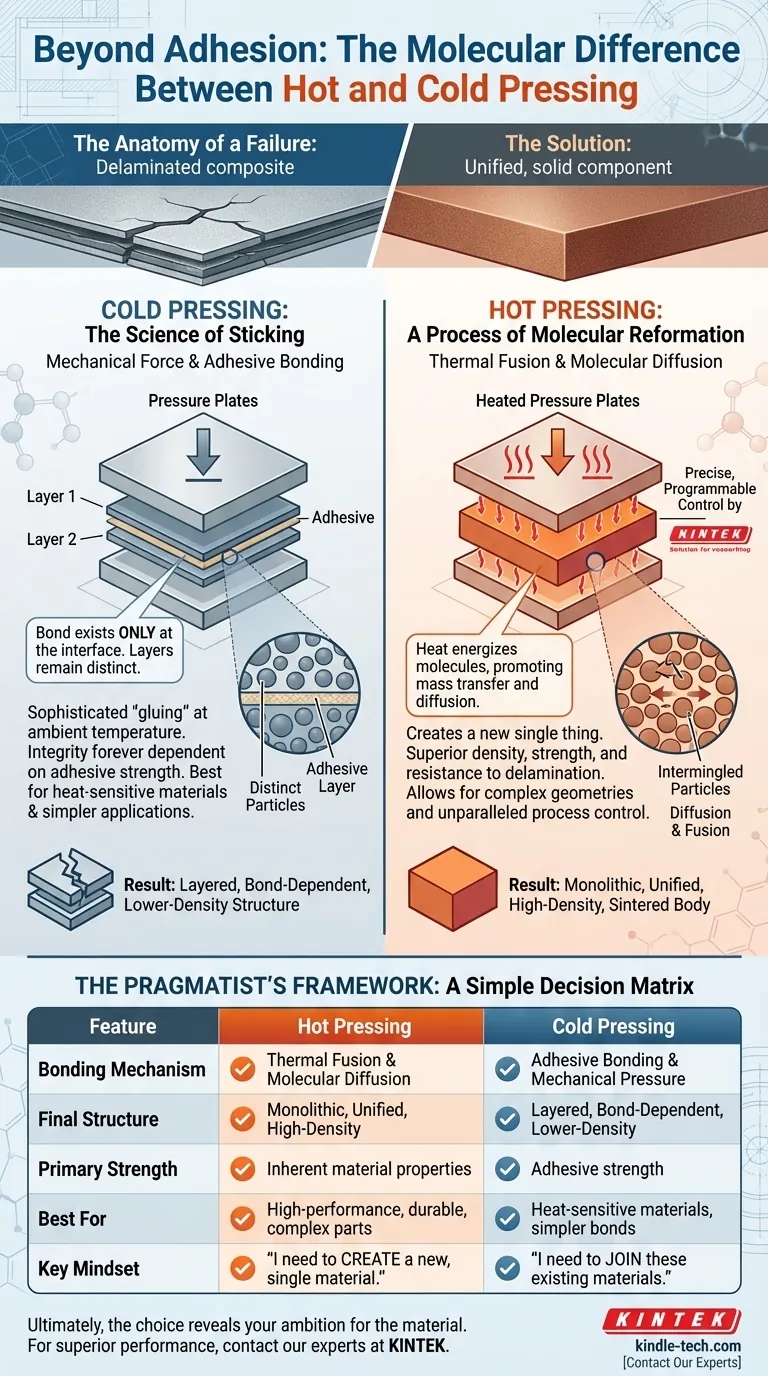
Cold pressing is an act of mechanical force. It relies on immense pressure at ambient temperature to bind layers together, typically with an adhesive.

It's a sophisticated and effective method for many applications, especially when working with heat-sensitive materials.

But psychologically, we must see it for what it is: an advanced form of gluing. The bond exists only at the interface between the layers. The individual components remain distinct entities, held together by a third-party agent. The integrity of the final product is forever dependent on the strength of that adhesive layer.

Hot Pressing: A Process of Molecular Reformation

Hot pressing operates on a completely different principle. It is not about sticking things together. It is about remaking them into a single, new thing.

By applying intense heat and pressure simultaneously, the process does something remarkable.

Heat as a Catalyst for Change

The heat makes the materials malleable, allowing them to conform to a mold with far less pressure—sometimes only a tenth of what cold pressing requires. But its most important role is more profound.

Heat energizes the molecules, promoting mass transfer and diffusion across the boundaries of the original layers. Atoms migrate, intermingle, and form new, permanent bonds.

It’s less like gluing and more like microscopic forging. The distinct layers cease to exist, fusing into a monolithic, sintered body with a fine-grain structure and minimal internal voids.

The Tangible Results of Thermal Fusion

This fundamental difference in process leads to starkly different outcomes.

  • Superior Density and Strength: By eliminating voids and creating a unified structure, hot-pressed parts achieve densities approaching the theoretical maximum. This results in exceptional mechanical strength, rigidity, and resistance to the kind of delamination that plagued our engineer.
  • Freedom for Complex Geometries: Because the material is in a thermoplastic state, it flows. It can be pressed into intricate shapes and fine details that would be impossible to achieve by simply crushing cold, rigid layers together.
  • Unparalleled Process Control: Modern laboratory hot presses, like those developed by KINTEK, offer precise, programmable control over heating rates, temperature, and pressure. This repeatability is the bedrock of scientific research and high-performance manufacturing.

The Pragmatist's Framework: When to Bond vs. When to Fuse

The "better" method is a meaningless concept without context. The right choice is dictated by the goal, not a blanket preference. The decision is a classic engineering trade-off between ultimate performance and process constraints.

Choose Hot Pressing for Performance

When the goal is maximum strength, durability, and density, hot pressing is the only logical path. It's the choice for creating high-performance ceramics, advanced composites, and mission-critical components where failure is not an option.

Choose Cold Pressing for Simplicity and Sensitivity

When working with materials that cannot tolerate heat, or when a simple adhesive bond is sufficient for the application, cold pressing is the practical, efficient choice. It is faster, less energy-intensive, and perfectly adequate for countless applications.

A Simple Decision Matrix

Feature Hot Pressing Cold Pressing
Bonding Mechanism Thermal Fusion & Molecular Diffusion Adhesive Bonding & Mechanical Pressure
Final Structure Monolithic, Unified, High-Density Layered, Bond-Dependent, Lower-Density
Primary Strength Inherent material properties Adhesive strength
Best For High-performance, durable, complex parts Heat-sensitive materials, simpler bonds
Key Mindset "I need to create a new, single material." "I need to join these existing materials."

Ultimately, the choice reveals your ambition for the material you are creating. Are you simply assembling parts, or are you forging a new whole?

For the researchers and engineers pushing the boundaries of what's possible, the ability to control matter at a molecular level is not a luxury—it's a necessity. Having the right equipment to execute this vision is what separates a breakthrough from a delaminated failure.

If your work demands the superior performance of thermal fusion, let's discuss the right tools for the job. Contact Our Experts

Visual Guide
Beyond Adhesion: The Molecular Difference Between Hot and Cold Pressing Visual Guide

Related Products

Related Articles

Related Products

Vacuum Hot Press Furnace Machine Heated Vacuum Press

Vacuum Hot Press Furnace Machine Heated Vacuum Press

Discover the advantages of Vacuum Hot Press Furnace! Manufacture dense refractory metals & compounds, ceramics, and composites under high temp and pressure.

Warm Isostatic Press for Solid State Battery Research

Warm Isostatic Press for Solid State Battery Research

Discover the advanced Warm Isostatic Press (WIP) for semiconductor lamination. Ideal for MLCC, hybrid chips, and medical electronics. Enhance strength and stability with precision.

Heated Hydraulic Press Machine with Heated Plates for Vacuum Box Laboratory Hot Press

Heated Hydraulic Press Machine with Heated Plates for Vacuum Box Laboratory Hot Press

Enhance your lab's precision with our lab press for vacuum box. Press pills and powders with ease and precision in a vacuum environment, reducing oxidation and improving consistency. Compact and easy to use with a digital pressure gauge.

Heated Hydraulic Press Machine with Heated Plates for Vacuum Box Laboratory Hot Press

Heated Hydraulic Press Machine with Heated Plates for Vacuum Box Laboratory Hot Press

The lab press for vacuum box is a specialized piece of equipment designed for laboratory use. Its main purpose is to press pills and powders according to specific requirements.

Warm Isostatic Press WIP Workstation 300Mpa for High Pressure Applications

Warm Isostatic Press WIP Workstation 300Mpa for High Pressure Applications

Discover Warm Isostatic Pressing (WIP) - A cutting-edge technology that enables uniform pressure to shape and press powdered products at a precise temperature. Ideal for complex parts and components in manufacturing.

Automatic Heated Hydraulic Press Machine with Heated Plates for Laboratory Hot Press

Automatic Heated Hydraulic Press Machine with Heated Plates for Laboratory Hot Press

The Automatic High Temperature Heat Press is a sophisticated hydraulic hot press designed for efficient temperature control and product quality processing.

Vacuum Hot Press Furnace Machine for Lamination and Heating

Vacuum Hot Press Furnace Machine for Lamination and Heating

Experience clean and precise lamination with Vacuum Lamination Press. Perfect for wafer bonding, thin-film transformations, and LCP lamination. Order now!

Automatic Laboratory Heat Press Machine

Automatic Laboratory Heat Press Machine

Precision automatic heat press machines for labs—ideal for material testing, composites, and R&D. Customizable, safe, and efficient. Contact KINTEK today!

Manual High Temperature Heated Hydraulic Press Machine with Heated Plates for Lab

Manual High Temperature Heated Hydraulic Press Machine with Heated Plates for Lab

The High Temperature Hot Press is a machine specifically designed for pressing, sintering and processing materials in a high temperature environment. It is capable of operating in the range of hundreds of degrees Celsius to thousands of degrees Celsius for a variety of high temperature process requirements.

Automatic High Temperature Heated Hydraulic Press Machine with Heated Plates for Lab

Automatic High Temperature Heated Hydraulic Press Machine with Heated Plates for Lab

The High Temperature Hot Press is a machine specifically designed for pressing, sintering and processing materials in a high temperature environment. It is capable of operating in the range of hundreds of degrees Celsius to thousands of degrees Celsius for a variety of high temperature process requirements.

Double Plate Heating Press Mold for Lab

Double Plate Heating Press Mold for Lab

Discover precision in heating with our Double Plate Heating Mold, featuring high-quality steel and uniform temperature control for efficient lab processes. Ideal for various thermal applications.

Manual Heated Hydraulic Press Machine with Heated Plates for Laboratory Hot Press

Manual Heated Hydraulic Press Machine with Heated Plates for Laboratory Hot Press

The Manual Heat Press is a versatile piece of equipment suitable for a variety of applications, operated by a manual hydraulic system that applies controlled pressure and heat to the material placed on the piston.

Heated Hydraulic Press Machine with Integrated Manual Heated Plates for Lab Use

Heated Hydraulic Press Machine with Integrated Manual Heated Plates for Lab Use

Efficiently process heat-pressing samples with our Integrated Manual Heated Lab Press. With a heating range up to 500°C, it's perfect for various industries.

Heated Hydraulic Press Machine with Heated Plates Split Manual Laboratory Hot Press

Heated Hydraulic Press Machine with Heated Plates Split Manual Laboratory Hot Press

Efficiently prepare your samples with our Split Manual Heated Lab Press. With a pressure range up to 40T and heating plates up to 300°C, it's perfect for various industries.

Special Heat Press Mold for Lab Use

Special Heat Press Mold for Lab Use

Square, round and flat plate forming dies for hot presses.

Laboratory Hydraulic Press Lab Pellet Press Machine for Glove Box

Laboratory Hydraulic Press Lab Pellet Press Machine for Glove Box

Controlled environment lab press machine for glove box. Specialized equipment for material pressing and shaping with high precision digital pressure gauge.

Infrared Heating Quantitative Flat Plate Press Mold

Infrared Heating Quantitative Flat Plate Press Mold

Discover advanced infrared heating solutions with high-density insulation and precise PID control for uniform thermal performance in various applications.

Manual Cold Isostatic Pressing Machine CIP Pellet Press

Manual Cold Isostatic Pressing Machine CIP Pellet Press

Lab Manual Isostatic Press is a high-efficient equipment for sample preparation widely used in material research, pharmacy, ceramics, and electronic industries. It allows for precision control of the pressing process and can work in a vacuum environment.

Laboratory Manual Hydraulic Pellet Press for Lab Use

Laboratory Manual Hydraulic Pellet Press for Lab Use

Efficient Manure Lab Hydraulic Press with Safety Cover for sample preparation in material research, pharmacy, and electronic industries. Available in 15T to 60T.

Electric Lab Cold Isostatic Press CIP Machine for Cold Isostatic Pressing

Electric Lab Cold Isostatic Press CIP Machine for Cold Isostatic Pressing

Produce dense, uniform parts with improved mechanical properties with our Electric Lab Cold Isostatic Press. Widely used in material research, pharmacy, and electronic industries. Efficient, compact, and vacuum-compatible.


Leave Your Message