Blog Beyond Heat: How Creating a Vacuum Forges Superior Materials
Beyond Heat: How Creating a Vacuum Forges Superior Materials

Beyond Heat: How Creating a Vacuum Forges Superior Materials

5 hours ago

The Unseen Enemy in Metallurgy

For centuries, the story of metallurgy has been one of fire and force. A blacksmith heats metal until it glows, then hammers it into shape. But even the most skilled artisan fights an invisible battle against the very air we breathe. Oxygen, so vital to life, is a saboteur at high temperatures, reacting with metal to form a brittle, discolored scale.

This quiet, relentless process of oxidation compromises surface finish, weakens the material, and can subtly alter its most critical properties.

Our intuition tells us to add things to make something stronger. We add carbon to iron to make steel, or alloys to create supermetals. The principle of the vacuum furnace is profoundly counter-intuitive: the first step to creating the strongest, purest materials is to take something away.

You must first create nothing.

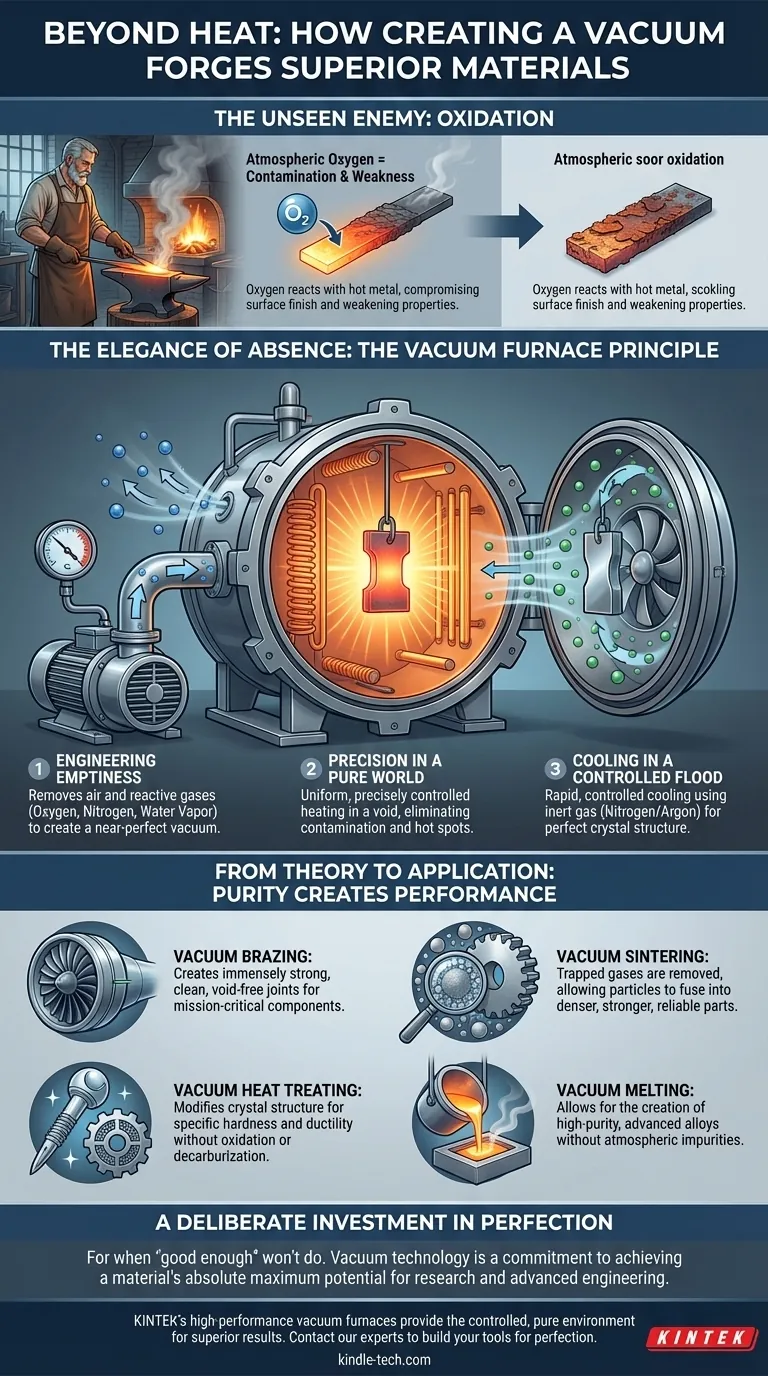
The Elegance of Absence: The Vacuum Furnace Principle

A vacuum furnace isn't just a hotter oven; it's a fundamentally different environment. Its power comes not from the intensity of its heat, but from the purity of its atmosphere.

By removing air before heating, it eliminates the variables—oxygen, nitrogen, water vapor—that cause contamination. This transforms metallurgical processes from a battle against the elements into a precisely controlled science.

Step 1: Engineering Emptiness

The process begins inside a sealed, robust chamber. A powerful system of vacuum pumps engages, pulling the air out molecule by molecule. The goal is to reduce the internal pressure to a near-perfect vacuum, creating an environment where reactive gases are almost entirely absent.

This act of engineered emptiness is the foundation for everything that follows. It prepares a pristine stage for the material’s transformation.

Step 2: Precision in a Pure World

Once the vacuum is established, internal heating elements—either powerful resistance heaters or focused induction coils—raise the temperature. In this controlled void, heat transfer is uniform and predictable. There is no atmosphere to interfere or cause hot spots.

This allows for exceptional control over the heating and soaking cycles, ensuring the entire part reaches the target temperature at the precise rate required by the metallurgical recipe.

Step 3: Cooling in a Controlled Flood

After the heating cycle, locking in the desired properties often requires rapid, controlled cooling, or quenching. The furnace chamber is backfilled with a high-pressure, non-reactive inert gas like nitrogen or argon.

A powerful fan circulates this gas, drawing heat from the part at a rate that is just as precisely controlled as the heating was. The result is a perfect crystal structure, without the shock and potential distortion of liquid quenching.

From Theory to Application: Where Purity Creates Performance

This level of control unlocks capabilities impossible in a conventional furnace. It's where the integrity of a component is not just desired, but mission-critical.

Forging Unbreakable Bonds: Vacuum Brazing

Imagine a joint inside a jet engine turbine blade. It must withstand incredible temperatures and forces. A microscopic void or impurity in the bond could lead to catastrophic failure.

Vacuum brazing ensures the filler metal flows into the joint in a pure, fluid state, creating a connection that is clean, immensely strong, and free from the internal defects that oxygen would introduce.

Building from Dust: Vacuum Sintering

Sintering creates solid parts from compacted metal powder. In a normal atmosphere, gases get trapped between the tiny particles, creating microscopic pockets of weakness in the final product.

By performing this process in a vacuum, those trapped gases are pulled away, allowing the particles to fuse into a denser, stronger, and more reliable component.

Refining the Core: Heat Treatment and Melting

For advanced alloys used in medical implants or aerospace, purity is everything. Vacuum induction melting allows for the creation of these alloys without introducing impurities from the air.

Similarly, vacuum heat treating processes like hardening and annealing modify a metal's internal crystal structure to achieve specific hardness or ductility, all without the damaging side-effect of surface decarburization—the loss of carbon that weakens steel. The part emerges from the furnace with its chemistry and its surface perfectly intact.

A Deliberate Investment in Perfection

Vacuum furnaces are not a universal solution. The complexity of their vacuum systems, the longer cycle times required to pump down the chamber, and the higher initial cost represent a significant investment.

This isn't a tool for when "good enough" will do.

It is a deliberate choice for applications where compromise is not an option. The decision to use a vacuum furnace is a commitment to achieving a material's absolute maximum potential. This commitment to uncompromising quality is what drives the engineering behind advanced laboratory systems.

For researchers and engineers pushing the boundaries of material science, having equipment that can reliably create these perfect conditions is paramount.

Key Process Primary Benefit Ideal For
Vacuum Heat Treating Precise control of hardness & strength without oxidation Enhancing material properties (hardening, annealing)
Vacuum Brazing Exceptionally clean, strong, void-free joints Joining mission-critical components (aerospace, medical)
Vacuum Sintering Stronger, higher-density parts from metal powder Producing high-purity parts from powder
Vacuum Melting High-purity, advanced alloys without impurities Developing advanced, pure alloys

When your work demands this level of material integrity, you need a furnace designed to deliver it, flawlessly. KINTEK's range of high-performance vacuum furnaces provides the controlled, pure environment necessary to achieve superior results in heat treating, brazing, sintering, and alloy development.

If your standard is perfection, we can help you build the tools to achieve it. Contact Our Experts

Visual Guide
Beyond Heat: How Creating a Vacuum Forges Superior Materials Visual Guide

Related Products

Related Articles

Related Products

Vacuum Hot Press Furnace Heated Vacuum Press Machine Tube Furnace

Vacuum Hot Press Furnace Heated Vacuum Press Machine Tube Furnace

Reduce forming pressure & shorten sintering time with Vacuum Tube Hot Press Furnace for high-density, fine-grain materials. Ideal for refractory metals.

600T Vacuum Induction Hot Press Furnace for Heat Treat and Sintering

600T Vacuum Induction Hot Press Furnace for Heat Treat and Sintering

Discover the 600T Vacuum Induction Hot Press Furnace, designed for high-temperature sintering experiments in vacuum or protected atmospheres. Its precise temperature and pressure control, adjustable working pressure, and advanced safety features make it ideal for nonmetal materials, carbon composites, ceramics, and metal powders.

Vacuum Hot Press Furnace Machine Heated Vacuum Press

Vacuum Hot Press Furnace Machine Heated Vacuum Press

Discover the advantages of Vacuum Hot Press Furnace! Manufacture dense refractory metals & compounds, ceramics, and composites under high temp and pressure.

Vacuum Heat Treat Furnace and Levitation Induction Melting Furnace

Vacuum Heat Treat Furnace and Levitation Induction Melting Furnace

Experience precise melting with our Vacuum Levitation Melting Furnace. Ideal for high melting point metals or alloys, with advanced technology for effective smelting. Order now for high-quality results.

2200 ℃ Tungsten Vacuum Heat Treat and Sintering Furnace

2200 ℃ Tungsten Vacuum Heat Treat and Sintering Furnace

Experience the ultimate refractory metal furnace with our Tungsten vacuum furnace. Capable of reaching 2200℃, perfect for sintering advanced ceramics and refractory metals. Order now for high-quality results.

Vacuum Heat Treat and Pressure Sintering Furnace for High Temperature Applications

Vacuum Heat Treat and Pressure Sintering Furnace for High Temperature Applications

Vacuum pressure sintering furnaces are designed for high temperature hot pressing applications in metal and ceramic sintering. Its advanced features ensure precise temperature control, reliable pressure maintenance, and a robust design for seamless operation.

Molybdenum Vacuum Heat Treat Furnace

Molybdenum Vacuum Heat Treat Furnace

Discover the benefits of a high-configuration molybdenum vacuum furnace with heat shield insulation. Ideal for high-purity, vacuum environments like sapphire crystal growth and heat treatment.

Graphite Vacuum Furnace IGBT Experimental Graphitization Furnace

Graphite Vacuum Furnace IGBT Experimental Graphitization Furnace

IGBT experimental graphitization furnace, a tailored solution for universities and research institutions, with high heating efficiency, user-friendliness, and precise temperature control.

Vacuum Sealed Continuous Working Rotary Tube Furnace Rotating Tube Furnace

Vacuum Sealed Continuous Working Rotary Tube Furnace Rotating Tube Furnace

Experience efficient material processing with our vacuum-sealed rotary tube furnace. Perfect for experiments or industrial production, equipped with optional features for controlled feeding and optimized results. Order now.

2200 ℃ Graphite Vacuum Heat Treat Furnace

2200 ℃ Graphite Vacuum Heat Treat Furnace

Discover the power of the KT-VG Graphite Vacuum Furnace - with a maximum working temperature of 2200℃, it's perfect for vacuum sintering of various materials. Learn more now.

Lab-Scale Vacuum Induction Melting Furnace

Lab-Scale Vacuum Induction Melting Furnace

Get precise alloy composition with our Vacuum Induction Melting Furnace. Ideal for aerospace, nuclear energy, and electronic industries. Order now for effective smelting and casting of metals and alloys.

Vacuum Heat Treat Sintering Brazing Furnace

Vacuum Heat Treat Sintering Brazing Furnace

A vacuum brazing furnace is a type of industrial furnace used for brazing, a metalworking process that joins two pieces of metal using a filler metal that melts at a lower temperature than the base metals. Vacuum brazing furnaces are typically used for high-quality applications where a strong, clean joint is required.

Ultra-High Temperature Graphite Vacuum Graphitization Furnace

Ultra-High Temperature Graphite Vacuum Graphitization Furnace

The ultra-high temperature graphitization furnace utilizes medium frequency induction heating in a vacuum or inert gas environment. The induction coil generates an alternating magnetic field, inducing eddy currents in the graphite crucible, which heats up and radiates heat to the workpiece, bringing it to the desired temperature. This furnace is primarily used for graphitization and sintering of carbon materials, carbon fiber materials, and other composite materials.

Small Vacuum Heat Treat and Tungsten Wire Sintering Furnace

Small Vacuum Heat Treat and Tungsten Wire Sintering Furnace

The small vacuum tungsten wire sintering furnace is a compact experimental vacuum furnace specially designed for universities and scientific research institutes. The furnace features a CNC welded shell and vacuum piping to ensure leak-free operation. Quick-connect electrical connections facilitate relocation and debugging, and the standard electrical control cabinet is safe and convenient to operate.

Vacuum Heat Treat Furnace with Ceramic Fiber Liner

Vacuum Heat Treat Furnace with Ceramic Fiber Liner

Vacuum furnace with polycrystalline ceramic fiber insulation liner for excellent heat insulation and uniform temperature field. Choose from 1200℃ or 1700℃ max. working temperature with high vacuum performance and precise temperature control.

Vacuum Heat Treat and Molybdenum Wire Sintering Furnace for Vacuum Sintering

Vacuum Heat Treat and Molybdenum Wire Sintering Furnace for Vacuum Sintering

A vacuum molybdenum wire sintering furnace is a vertical or bedroom structure, which is suitable for withdrawal, brazing, sintering and degassing of metal materials under high vacuum and high temperature conditions. It is also suitable for dehydroxylation treatment of quartz materials.

Vacuum Arc Induction Melting Furnace

Vacuum Arc Induction Melting Furnace

Discover the power of Vacuum Arc Furnace for melting active & refractory metals. High-speed, remarkable degassing effect, and free of contamination. Learn more now!

Vacuum Dental Porcelain Sintering Furnace

Vacuum Dental Porcelain Sintering Furnace

Get precise and reliable results with KinTek's Vacuum Porcelain Furnace. Suitable for all porcelain powders, it features hyperbolic ceramic furnace function, voice prompt, and automatic temperature calibration.

Horizontal High Temperature Graphite Vacuum Graphitization Furnace

Horizontal High Temperature Graphite Vacuum Graphitization Furnace

Horizontal Graphitization Furnace: This type of furnace is designed with the heating elements placed horizontally, allowing for uniform heating of the sample. It's well-suited for graphitizing large or bulky samples that require precise temperature control and uniformity.

Non Consumable Vacuum Arc Induction Melting Furnace

Non Consumable Vacuum Arc Induction Melting Furnace

Explore the benefits of Non-Consumable Vacuum Arc Furnace with high melting point electrodes. Small, easy to operate & eco-friendly. Ideal for laboratory research on refractory metals & carbides.


Leave Your Message