The Unseen Enemy in High-Temperature Processing
Imagine forging a critical aerospace component. You've perfected the alloy, machined the geometry to micron-level precision, and are ready for the final heat treatment. But in that last, fiery step, an invisible agent—the very air we breathe—attacks the surface, creating a microscopic layer of oxide.
This isn't just a cosmetic flaw. It's a hidden weakness, a potential origin point for fatigue, corrosion, or catastrophic failure.
The central challenge in advanced thermal processing isn't merely reaching a target temperature. It's about creating a pristine environment where the material can achieve its true potential, free from the corrupting influence of atmospheric gases. The vacuum furnace is not just a tool; it's a self-contained universe where the rules of chemistry are rewritten to favor perfection.
The Physics of Purity: Why a Vacuum Changes Everything
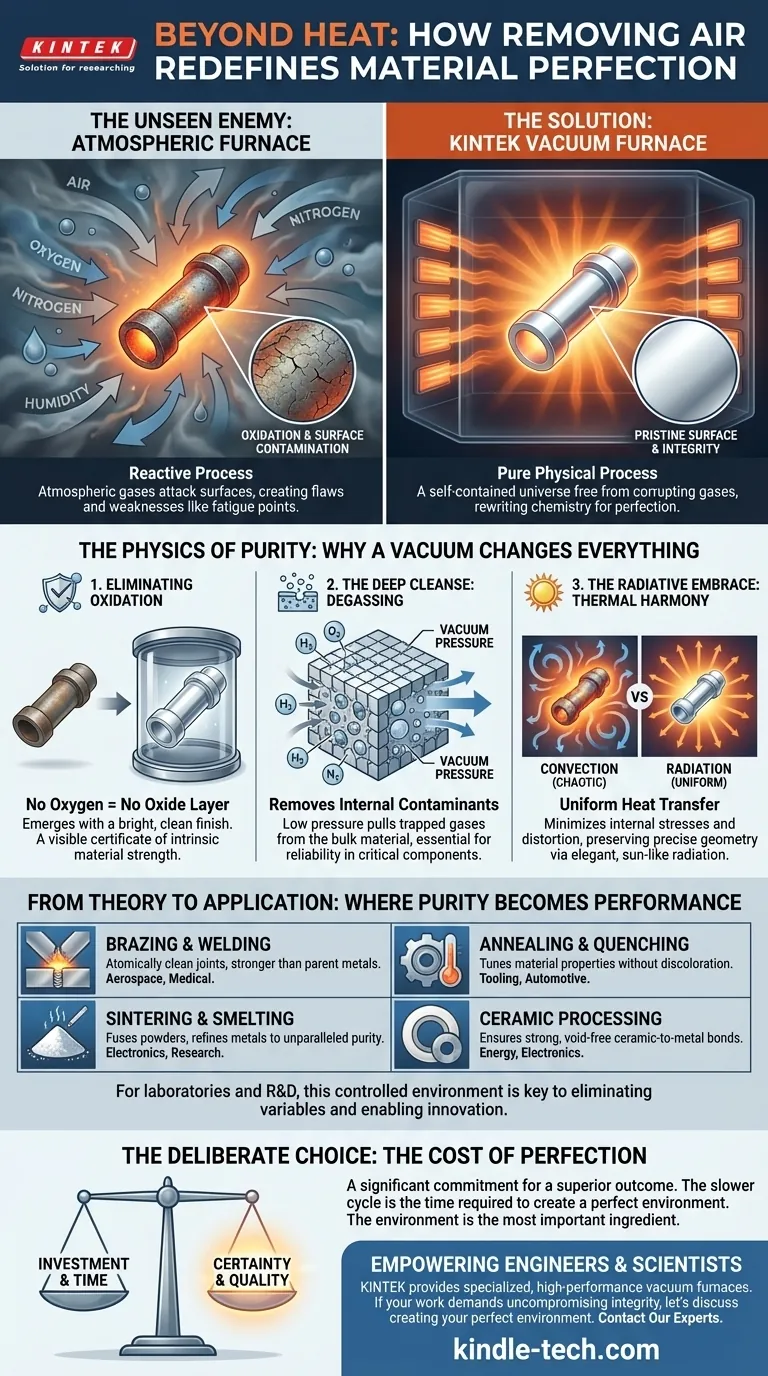
By pumping out the air before heating, a vacuum furnace fundamentally alters the process from a reactive one to a purely physical one. The genius lies in what is removed.
Eliminating Oxidation: The Pursuit of a Perfect Surface
In a conventional furnace, high heat and oxygen are catalysts for oxidation. This scale must often be machined or chemically stripped away, adding steps and introducing risk.
In a vacuum, the absence of oxygen allows the material to emerge from the heat with a bright, clean finish. This isn't vanity; it’s a visible certificate of integrity. The surface you see is the pure metal itself, not a brittle layer of its own oxides. It signals that the material's surface properties are exactly as intended.
The Deep Cleanse: Degassing for Intrinsic Strength
A material's flaws aren't always on the surface. Microscopic pockets of trapped gases—hydrogen, oxygen, nitrogen—can hide within the bulk material, waiting to become points of failure under stress.
A vacuum doesn't just protect the surface; it actively purifies the material from within. The low-pressure environment creates a powerful differential, pulling these trapped gases out of the material's lattice. This degassing process is a deep cleanse, essential for the reliability of electronics, medical implants, and aerospace components where internal purity dictates performance.
The Radiative Embrace: Achieving Thermal Harmony
Heat transfer in a conventional furnace is dominated by convection—a chaotic swirl of hot air that can lead to uneven heating.
In the void of a vacuum, heat travels primarily through radiation. This is a far more elegant and uniform method, like the warmth of the sun. Energy radiates from the heating elements and embraces the part evenly from all directions. This thermal harmony minimizes internal stresses and distortion, preserving the precise geometry of complex parts.
From Theory to Application: Where Purity Becomes Performance
This level of environmental control is not a theoretical luxury; it's the enabling technology behind many modern marvels. The decision to use a vacuum furnace is a decision to prioritize the final outcome over process simplicity.
| Application | The Vacuum Furnace's Contribution | Key Industries |
|---|---|---|
| Brazing & Welding | Creates atomically clean joints, stronger than the parent metals. | Aerospace, Medical |
| Annealing & Quenching | Tunes material properties without surface discoloration. | Tooling, Automotive |
| Sintering & Smelting | Fuses powders and refines metals to unparalleled purity levels. | Electronics, Research |
| Ceramic Processing | Ensures strong, void-free bonds in ceramic-to-metal seals. | Energy, Electronics |
In the laboratory setting, where new materials and processes are born, this control is even more critical. Researchers and engineers need an environment that eliminates variables, and the atmosphere is the single biggest variable of all.
The Deliberate Choice: Understanding the Costs of Perfection
A vacuum furnace represents a significant commitment. The equipment is more complex, the initial investment is higher, and the cycle times are longer due to the need to pump down the chamber.
But this isn't a flaw in the process; it's the price of control.
The slower cycle isn't wasted time. It's the time required to create a perfect environment. It's the deliberate, patient removal of contaminants before the critical work of heating even begins. Choosing a vacuum furnace is a strategic decision to invest in certainty and final-part quality.
The Environment Is The Most Important Ingredient
Ultimately, the most critical ingredient in advanced thermal processing is not the heat, but the absence of everything else. It is the mastery of the void that allows for the creation of materials with superior strength, purity, and performance.
For laboratories and R&D teams pushing the boundaries of material science, controlling this environment is the key to discovery and innovation. KINTEK provides the specialized, high-performance vacuum furnaces designed for this exacting work, empowering engineers and scientists to achieve results that are simply not possible in the open air.
If your work demands uncompromising material integrity, let's discuss how to create the perfect environment for your process. Contact Our Experts
Visual Guide
Related Products
- Vacuum Hot Press Furnace Heated Vacuum Press Machine Tube Furnace
- 600T Vacuum Induction Hot Press Furnace for Heat Treat and Sintering
- Vacuum Hot Press Furnace Machine Heated Vacuum Press
- Vacuum Heat Treat Furnace and Levitation Induction Melting Furnace
- 2200 ℃ Tungsten Vacuum Heat Treat and Sintering Furnace
Related Articles
- The Purity Paradox: Choosing the Heart of Your Vacuum Hot Press Furnace
- Comprehensive Guide to Vacuum Hot Press Furnace Application
- Vacuum Hot Press Furnace: A Comprehensive Guide
- Forging Perfection in a Void: The Physics of Ultra-Dense Materials
- Defeating the Void: The Quiet Power of Vacuum Hot Pressing