The Psychology of a Perfect Environment
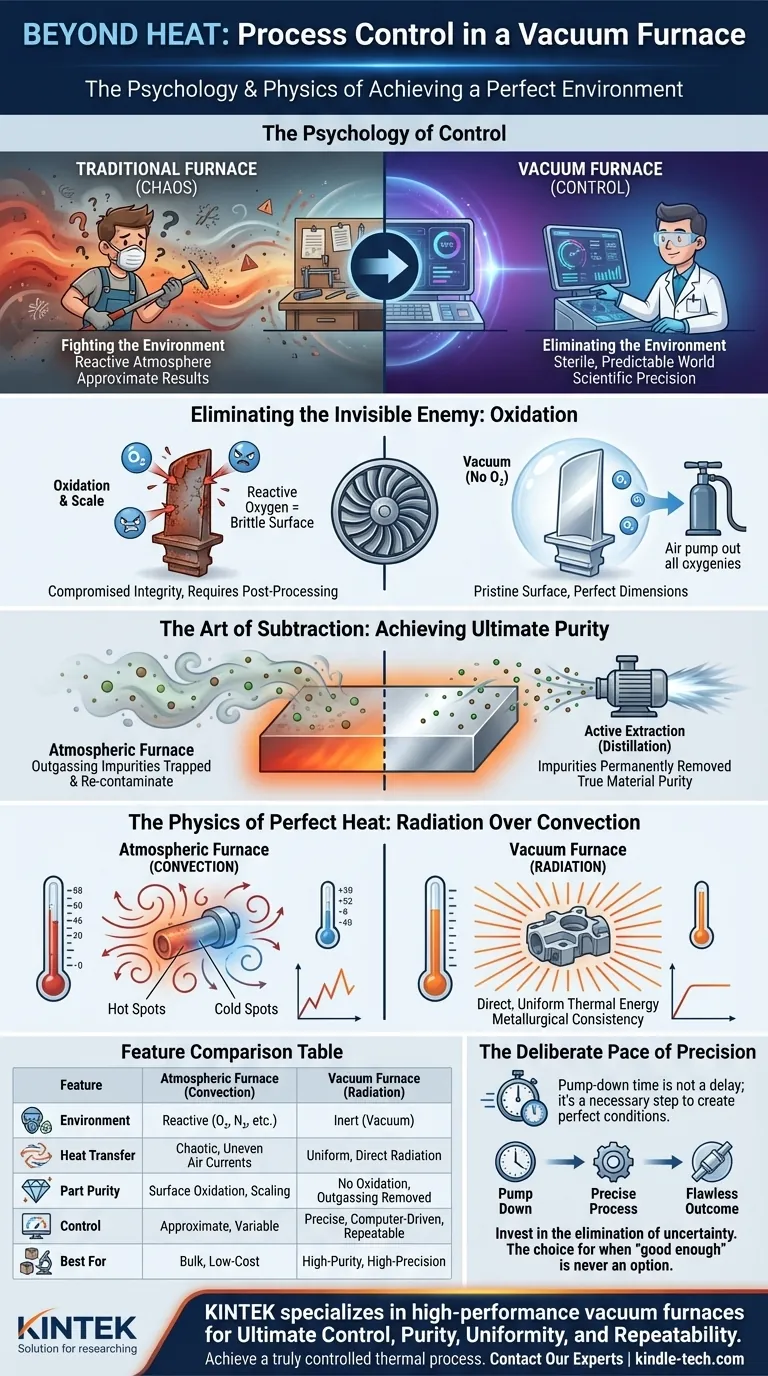
Every engineer and scientist shares a common, fundamental desire: control.
We crave the ability to eliminate variables, to isolate a process from the chaotic influence of the outside world. When dealing with materials at high temperatures, the most chaotic variable is the very air we breathe.
A traditional furnace is like trying to perform surgery in a dust storm. The atmosphere, rich with reactive oxygen and impurities, actively works against you.
A vacuum furnace operates on a different philosophy. It doesn't fight the environment; it removes it entirely. This single act transforms the process from an approximation into a science, creating a sterile, predictable world where materials can achieve their true potential.
Eliminating the Invisible Enemy: Oxidation
Imagine designing a critical aerospace component—a turbine blade that will spin at 10,000 RPM inside a jet engine. At operating temperatures, even a microscopic layer of oxide on its surface, formed during heat treatment, can become a point of catastrophic failure.
The Problem: A Reaction at the Surface
At high temperatures, metal atoms become highly energetic and eager to react. Oxygen is their perfect partner. This reaction, oxidation, creates a brittle, discolored layer of scale.
This isn't just a cosmetic issue. The scale compromises dimensional accuracy, weakens the surface, and requires aggressive, often damaging, post-processing to remove.
The Solution: Removing the Atmosphere
A vacuum furnace sidesteps this battle completely. By pumping the chamber down to a near-perfect vacuum, it physically removes the oxygen.
There is no reaction because there is nothing to react with. The result is a part that emerges from the heat cycle as bright and clean as it was when it went in, its dimensions and surface integrity perfectly preserved.
The Art of Subtraction: Achieving Ultimate Purity
True material purity isn't just about preventing contaminants from getting in; it's about actively pulling out the ones already hidden inside.
Outgassing: A Material's Hidden Impurities
Materials, especially metals, contain trapped gases and trace contaminants from their entire manufacturing history. When heated, these impurities "outgas"—they escape to the surface.
In a conventional furnace, these liberated gases have nowhere to go. They linger, potentially re-contaminating the surface.
A vacuum furnace’s pumping system acts as a powerful extractor. As impurities are released, they are immediately and permanently removed from the chamber. The process is less like baking and more like distillation.
The Physics of Perfect Heat: Radiation Over Convection
In the atmosphere, heat moves through convection—the swirling, unpredictable currents of hot air. This leads to hot spots and cold spots, causing uneven heating, internal stresses, and warping.
In the near-total absence of air, heat transfer is dominated by a much more elegant and predictable force: radiation.
Heat radiates from the heating elements and bathes the component uniformly from all directions. Every surface, whether it's the face of a large block or the intricate geometry of a complex part, receives the same thermal energy at the same time. This is the foundation of metallurgical consistency.
From Unpredictable Heating to Repeatable Science
This shift from convection to radiation allows for an incredible degree of precision. Computer-controlled cycles can execute heating and cooling ramps with unwavering accuracy, ensuring that the results from the first part are identical to the thousandth.
| Feature | Atmospheric Furnace (Convection) | Vacuum Furnace (Radiation) |
|---|---|---|
| Environment | Reactive (Oxygen, Nitrogen, etc.) | Inert (Vacuum) |
| Heat Transfer | Chaotic, uneven air currents | Uniform, direct radiation |
| Part Purity | Surface oxidation and scaling | No oxidation, outgassing removes impurities |
| Control | Approximate, subject to variables | Precise, computer-driven, repeatable |
| Best For | Bulk, low-cost treatments | High-purity, high-precision applications |
The Deliberate Pace of Precision
Objectively, a vacuum furnace has a higher initial cost and its cycles can be longer due to the time needed to pump down the chamber. But this is a misunderstanding of value.
You aren't paying for a faster heater; you are investing in the elimination of uncertainty. The pump-down time isn't a delay; it's a necessary step to create the perfect conditions for a flawless outcome. It's the difference between rushing a task and preparing diligently for it.
For laboratories and research teams where "good enough" is never an option, the choice of equipment defines the boundary of what's possible. KINTEK specializes in high-performance vacuum furnaces designed for these exact scenarios—where ultimate control over purity, uniformity, and repeatability is not a luxury, but a requirement.
Achieving a truly controlled thermal process is about creating a private universe where the laws of physics work for you, without interference. That universe begins in a vacuum.
If your work demands the highest level of material quality and process consistency, Contact Our Experts
Visual Guide
Related Products
- Vacuum Hot Press Furnace Heated Vacuum Press Machine Tube Furnace
- 600T Vacuum Induction Hot Press Furnace for Heat Treat and Sintering
- Vacuum Hot Press Furnace Machine Heated Vacuum Press
- Vacuum Heat Treat Furnace and Levitation Induction Melting Furnace
- 2200 ℃ Tungsten Vacuum Heat Treat and Sintering Furnace
Related Articles
- The Purity Paradox: Choosing the Heart of Your Vacuum Hot Press Furnace
- Comprehensive Guide to Vacuum Hot Press Furnace Application
- Vacuum Hot Press Furnace: A Comprehensive Guide
- Forging Perfection in a Void: The Physics of Ultra-Dense Materials
- Defeating the Void: The Quiet Power of Vacuum Hot Pressing