The Unseen Enemy in High-Temperature Processing
Imagine forging a turbine blade for a jet engine. The alloy is perfect, the design is flawless, and the temperature is precisely controlled. Yet, as the metal reaches a brilliant orange glow, it is silently attacked and weakened.
The culprit? The air we breathe.
At high temperatures, the oxygen in the atmosphere becomes incredibly aggressive, forming a brittle, oxide layer that compromises the material's structural integrity. We have a psychological bias toward focusing on what we add to a process—the heat, the alloys, the pressure. The greatest challenge in advanced manufacturing, however, is often about what we must strategically remove.
This is the central purpose of a vacuum furnace. It’s a tool designed not just to heat materials, but to first create a pristine, controlled void where thermal processing can occur without atmospheric interference.
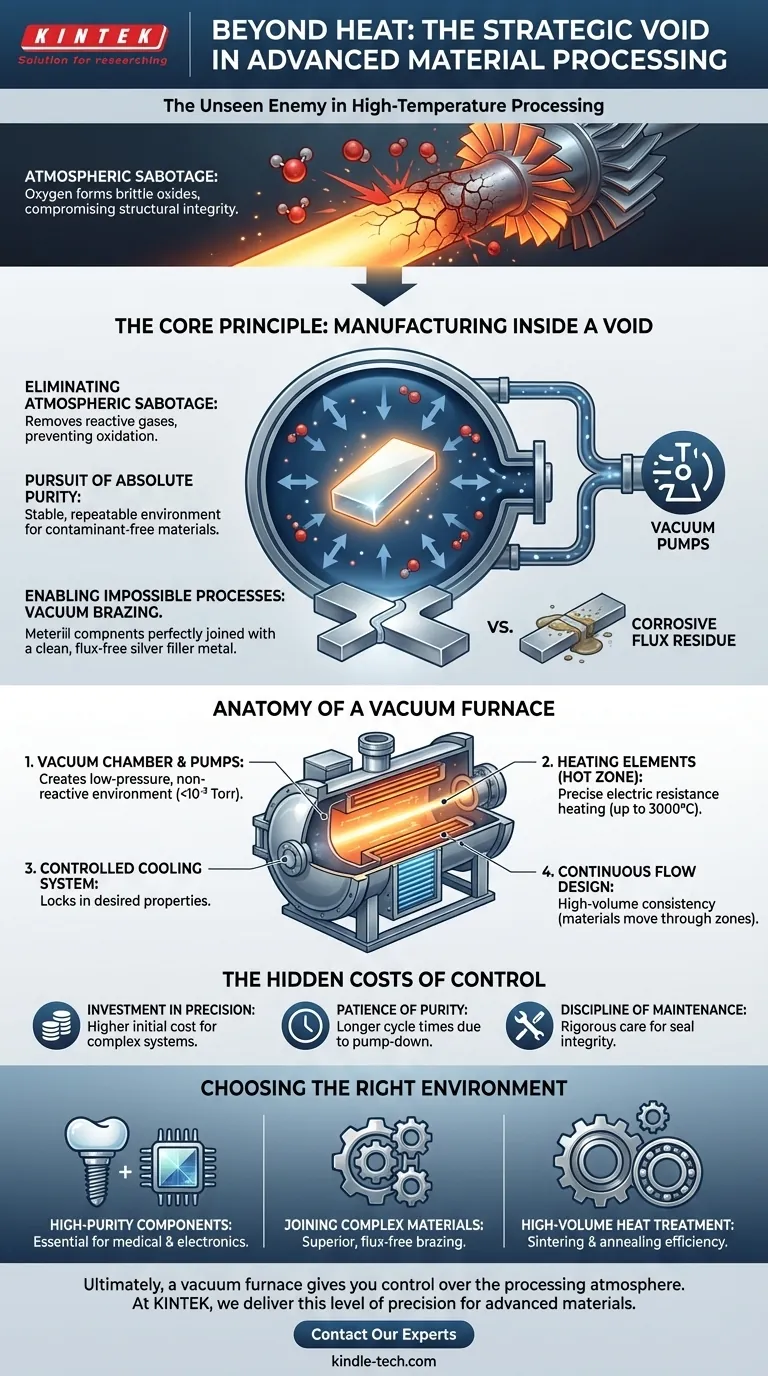
The Core Principle: Manufacturing Inside a Void
A vacuum furnace's primary advantage is the environment it creates. By removing reactive gases, it enables metallurgical processes that would be impossible in a conventional furnace.
Eliminating Atmospheric Sabotage
The main reason for creating a vacuum is to eliminate oxygen. This prevents oxidation, ensuring the finished part is clean, bright, and structurally sound. For materials in aerospace, medical, or electronics, where even microscopic flaws can lead to catastrophic failure, this is non-negotiable.
The Pursuit of Absolute Purity
A vacuum provides a stable, repeatable environment. This removes the variable of atmospheric contamination, ensuring that the material's inherent properties are preserved and enhanced. It's about achieving a level of control where the final product is a direct result of the intended process, not a victim of its environment.
Enabling Processes Impossible in Air
Certain joining techniques, like vacuum brazing, are fundamentally dependent on this technology. Brazing uses a filler metal to join components, but in a conventional furnace, this requires a chemical flux to clean the surfaces, which leaves a corrosive residue.
In a vacuum, no flux is needed. The vacuum itself ensures the surfaces are pure, allowing the filler metal to form an exceptionally strong, clean, and reliable bond.
Anatomy of a Vacuum Furnace
A vacuum furnace integrates several key systems to achieve precise control over both temperature and pressure.
| Component | Function |
|---|---|
| Vacuum Chamber & Pumps | Removes air and other gases to create a low-pressure, non-reactive environment (often below 10⁻³ Torr). |
| Heating Elements (Hot Zone) | Uses electric resistance to heat materials to precise temperatures, sometimes exceeding 3000°C. |
| Controlled Cooling System | Cools the material at a specific rate to lock in desired properties like hardness or ductility. |
| Continuous Flow Design | For high-volume production, materials move through heating and cooling zones, ensuring high consistency. |
The Hidden Costs of Control
While incredibly powerful, vacuum furnaces represent a specific set of engineering trade-offs. Understanding them is key to making the right investment.
The Investment in Precision
The complexity of the sealed chamber, vacuum pumps, and high-performance heating systems results in a significantly higher initial cost compared to atmospheric furnaces. This is the price of environmental control.
The Patience of Purity
Achieving a deep vacuum takes time. This "pump-down" period means overall cycle times are often longer than in conventional furnaces. It is a direct trade-off of speed for quality.
The Discipline of Maintenance
A vacuum system is only as good as its seals. The slightest leak can compromise an entire batch. This demands rigorous and specialized maintenance to ensure the integrity of the void.
Choosing the Right Environment for Your Material
The decision to use a vacuum furnace comes down to your non-negotiable outcomes.
- For high-purity components, like medical implants or semiconductor crystals, a vacuum furnace is essential to prevent contamination.
- For joining complex or dissimilar materials, vacuum brazing offers a superior, flux-free bond that is clean and incredibly strong.
- For high-volume heat treatment, like sintering or annealing, a continuous vacuum furnace provides unmatched repeatability and efficiency.
Ultimately, a vacuum furnace gives you control over one of the most fundamental variables in materials science: the processing atmosphere. At KINTEK, we specialize in lab equipment that delivers this level of precision. Our range of vacuum furnaces provides the controlled environment necessary for developing the world's most advanced materials.
If your process demands purity and performance where there is no margin for error, we can help you specify the right solution. Contact Our Experts
Visual Guide
Related Products
- Vacuum Hot Press Furnace Heated Vacuum Press Machine Tube Furnace
- 600T Vacuum Induction Hot Press Furnace for Heat Treat and Sintering
- Vacuum Hot Press Furnace Machine Heated Vacuum Press
- Vacuum Heat Treat Furnace and Levitation Induction Melting Furnace
- 2200 ℃ Tungsten Vacuum Heat Treat and Sintering Furnace
Related Articles
- The Purity Paradox: Choosing the Heart of Your Vacuum Hot Press Furnace
- Comprehensive Guide to Vacuum Hot Press Furnace Application
- Vacuum Hot Press Furnace: A Comprehensive Guide
- Forging Perfection in a Void: The Physics of Ultra-Dense Materials
- Defeating the Void: The Quiet Power of Vacuum Hot Pressing