Blog Beyond Max Temp: The Art of Precision in a Vacuum Furnace
Beyond Max Temp: The Art of Precision in a Vacuum Furnace

Beyond Max Temp: The Art of Precision in a Vacuum Furnace

1 hour ago

The Allure of a Single Number

When evaluating a vacuum furnace, the first question is almost always the same: "What's its maximum temperature?"

It's a natural starting point. We are psychologically wired to seek simple metrics. We judge a car by its top speed or a computer by its clock speed. We crave a single, impressive number that seems to define the limits of performance.

But in the world of materials science and precision engineering, this question is profoundly misleading. It’s like asking a surgeon the sharpest scalpel they own. The answer is irrelevant without knowing the procedure. The true value of a vacuum furnace lies not in its peak heat, but in its ability to execute a flawless thermal journey.

Temperature is a Language, Not a Number

The temperature inside a furnace is a dynamic, controlled variable—a language used to persuade materials to change their fundamental properties. The specific dialect you need depends entirely on your mission.

The Job Dictates the Tool

The process defines the required temperature profile, which in turn determines the right furnace architecture.

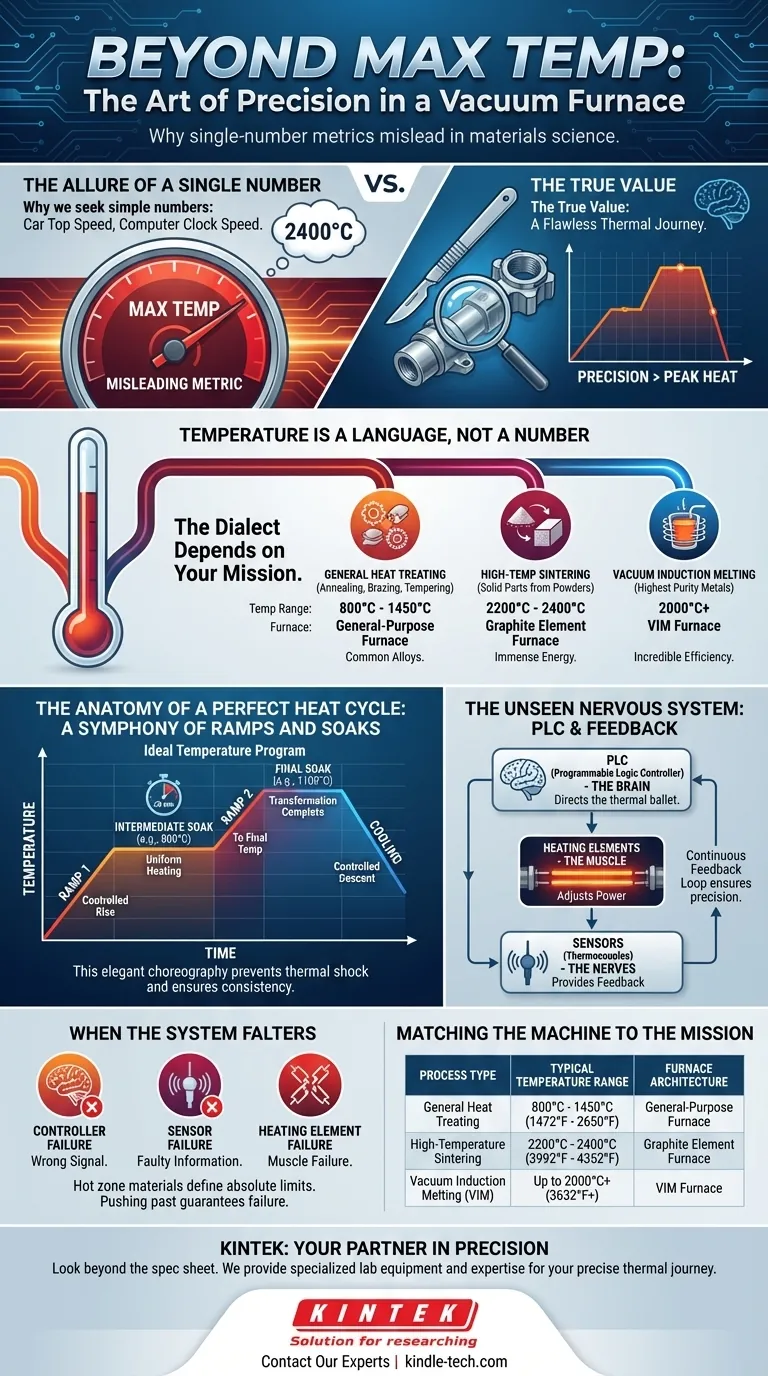
  • General Heat Treating: Processes like annealing, brazing, and tempering most common alloys typically occur between 800°C and 1450°C. A general-purpose furnace is the workhorse here.
  • High-Temperature Sintering: Creating solid parts from metal or ceramic powders requires immense energy to bond particles. This demands specialized furnaces with graphite heating elements capable of reaching 2200°C to 2400°C.
  • Vacuum Induction Melting (VIM): For achieving the highest purity in metals and alloys, VIM furnaces use electromagnetic induction to reach 2000°C or more with incredible efficiency.

Choosing a 2400°C furnace for a 1100°C brazing job isn't just overkill; it's often the wrong tool entirely, lacking the specific control or features needed for the lower-temperature task.

The Anatomy of a Perfect Heat Cycle

A material rarely goes straight to its final processing temperature. Doing so would be brutal, inducing thermal shock and creating inconsistencies. Instead, the process is an elegant choreography of heat and time.

A Symphony of Ramps and Soaks

A typical temperature program is a carefully scripted performance.

It begins with a controlled "ramp," where the temperature rises at a precise rate. It may then enter an intermediate "soak," holding at 800°C for twenty minutes to allow the heat to permeate the entire part uniformly. Only then does it ramp again to the final process temperature, say 1100°C, for a longer soak to complete the transformation.

This sequence is the difference between a perfectly treated component and a worthless piece of scrap.

The Unseen Nervous System

This thermal ballet is directed by a Programmable Logic Controller (PLC)—the furnace's brain. It constantly receives feedback from sensors like thermocouples, which act as the system's nerve endings.

This closed loop allows the PLC to minutely adjust power to the heating elements, ensuring the actual temperature follows the programmed path with unwavering precision. It’s a testament to engineering where automation achieves a level of control and repeatability that is simply superhuman.

When the System Falters

Understanding the furnace as a system also makes it easier to diagnose problems. When a furnace fails to reach its target temperature, the issue isn't abstract; it's a breakdown in a specific component.

The failure almost always lies in one of three places:

  1. The Controller: The brain isn't sending the right signal.
  2. The Sensor: The nerves are providing faulty information.
  3. The Heating Element: The muscle can no longer do the work.

The "hot zone"—the insulated chamber and its heating elements—is the heart of the furnace. Its materials define the absolute physical temperature limits. Pushing past them is not a matter of trying harder; it's a guarantee of catastrophic failure.

Matching the Machine to the Mission

The most critical step in selecting a vacuum furnace is to shift your mindset. Stop asking "how hot can it go?" and start defining the precise thermal journey your materials need to take.

This table provides a simple starting point:

Process Type Typical Temperature Range Furnace Architecture
General Heat Treating (Annealing, Brazing) 800°C - 1450°C (1472°F - 2650°F) General-Purpose Furnace
High-Temperature Sintering 2200°C - 2400°C (3992°F - 4352°F) Graphite Element Furnace
Vacuum Induction Melting (VIM) Up to 2000°C+ (3632°F+) VIM Furnace

At KINTEK, we provide the specialized lab equipment and expertise to ensure your furnace is perfectly matched to your mission. We help you look beyond the spec sheet to find a system that delivers the control, precision, and repeatability your work demands.

To ensure you get the right tool for your specific thermal process, Contact Our Experts.

Visual Guide
Beyond Max Temp: The Art of Precision in a Vacuum Furnace Visual Guide

Related Products

Related Articles

Related Products

Vacuum Hot Press Furnace Heated Vacuum Press Machine Tube Furnace

Vacuum Hot Press Furnace Heated Vacuum Press Machine Tube Furnace

Reduce forming pressure & shorten sintering time with Vacuum Tube Hot Press Furnace for high-density, fine-grain materials. Ideal for refractory metals.

600T Vacuum Induction Hot Press Furnace for Heat Treat and Sintering

600T Vacuum Induction Hot Press Furnace for Heat Treat and Sintering

Discover the 600T Vacuum Induction Hot Press Furnace, designed for high-temperature sintering experiments in vacuum or protected atmospheres. Its precise temperature and pressure control, adjustable working pressure, and advanced safety features make it ideal for nonmetal materials, carbon composites, ceramics, and metal powders.

Vacuum Hot Press Furnace Machine Heated Vacuum Press

Vacuum Hot Press Furnace Machine Heated Vacuum Press

Discover the advantages of Vacuum Hot Press Furnace! Manufacture dense refractory metals & compounds, ceramics, and composites under high temp and pressure.

Vacuum Heat Treat Furnace and Levitation Induction Melting Furnace

Vacuum Heat Treat Furnace and Levitation Induction Melting Furnace

Experience precise melting with our Vacuum Levitation Melting Furnace. Ideal for high melting point metals or alloys, with advanced technology for effective smelting. Order now for high-quality results.

2200 ℃ Tungsten Vacuum Heat Treat and Sintering Furnace

2200 ℃ Tungsten Vacuum Heat Treat and Sintering Furnace

Experience the ultimate refractory metal furnace with our Tungsten vacuum furnace. Capable of reaching 2200℃, perfect for sintering advanced ceramics and refractory metals. Order now for high-quality results.

Vacuum Heat Treat and Pressure Sintering Furnace for High Temperature Applications

Vacuum Heat Treat and Pressure Sintering Furnace for High Temperature Applications

Vacuum pressure sintering furnaces are designed for high temperature hot pressing applications in metal and ceramic sintering. Its advanced features ensure precise temperature control, reliable pressure maintenance, and a robust design for seamless operation.

Molybdenum Vacuum Heat Treat Furnace

Molybdenum Vacuum Heat Treat Furnace

Discover the benefits of a high-configuration molybdenum vacuum furnace with heat shield insulation. Ideal for high-purity, vacuum environments like sapphire crystal growth and heat treatment.

Graphite Vacuum Furnace IGBT Experimental Graphitization Furnace

Graphite Vacuum Furnace IGBT Experimental Graphitization Furnace

IGBT experimental graphitization furnace, a tailored solution for universities and research institutions, with high heating efficiency, user-friendliness, and precise temperature control.

Vacuum Sealed Continuous Working Rotary Tube Furnace Rotating Tube Furnace

Vacuum Sealed Continuous Working Rotary Tube Furnace Rotating Tube Furnace

Experience efficient material processing with our vacuum-sealed rotary tube furnace. Perfect for experiments or industrial production, equipped with optional features for controlled feeding and optimized results. Order now.

2200 ℃ Graphite Vacuum Heat Treat Furnace

2200 ℃ Graphite Vacuum Heat Treat Furnace

Discover the power of the KT-VG Graphite Vacuum Furnace - with a maximum working temperature of 2200℃, it's perfect for vacuum sintering of various materials. Learn more now.

Lab-Scale Vacuum Induction Melting Furnace

Lab-Scale Vacuum Induction Melting Furnace

Get precise alloy composition with our Vacuum Induction Melting Furnace. Ideal for aerospace, nuclear energy, and electronic industries. Order now for effective smelting and casting of metals and alloys.

Vacuum Heat Treat Sintering Brazing Furnace

Vacuum Heat Treat Sintering Brazing Furnace

A vacuum brazing furnace is a type of industrial furnace used for brazing, a metalworking process that joins two pieces of metal using a filler metal that melts at a lower temperature than the base metals. Vacuum brazing furnaces are typically used for high-quality applications where a strong, clean joint is required.

Ultra-High Temperature Graphite Vacuum Graphitization Furnace

Ultra-High Temperature Graphite Vacuum Graphitization Furnace

The ultra-high temperature graphitization furnace utilizes medium frequency induction heating in a vacuum or inert gas environment. The induction coil generates an alternating magnetic field, inducing eddy currents in the graphite crucible, which heats up and radiates heat to the workpiece, bringing it to the desired temperature. This furnace is primarily used for graphitization and sintering of carbon materials, carbon fiber materials, and other composite materials.

Small Vacuum Heat Treat and Tungsten Wire Sintering Furnace

Small Vacuum Heat Treat and Tungsten Wire Sintering Furnace

The small vacuum tungsten wire sintering furnace is a compact experimental vacuum furnace specially designed for universities and scientific research institutes. The furnace features a CNC welded shell and vacuum piping to ensure leak-free operation. Quick-connect electrical connections facilitate relocation and debugging, and the standard electrical control cabinet is safe and convenient to operate.

Vacuum Heat Treat Furnace with Ceramic Fiber Liner

Vacuum Heat Treat Furnace with Ceramic Fiber Liner

Vacuum furnace with polycrystalline ceramic fiber insulation liner for excellent heat insulation and uniform temperature field. Choose from 1200℃ or 1700℃ max. working temperature with high vacuum performance and precise temperature control.

Vacuum Heat Treat and Molybdenum Wire Sintering Furnace for Vacuum Sintering

Vacuum Heat Treat and Molybdenum Wire Sintering Furnace for Vacuum Sintering

A vacuum molybdenum wire sintering furnace is a vertical or bedroom structure, which is suitable for withdrawal, brazing, sintering and degassing of metal materials under high vacuum and high temperature conditions. It is also suitable for dehydroxylation treatment of quartz materials.

Vacuum Arc Induction Melting Furnace

Vacuum Arc Induction Melting Furnace

Discover the power of Vacuum Arc Furnace for melting active & refractory metals. High-speed, remarkable degassing effect, and free of contamination. Learn more now!

Horizontal High Temperature Graphite Vacuum Graphitization Furnace

Horizontal High Temperature Graphite Vacuum Graphitization Furnace

Horizontal Graphitization Furnace: This type of furnace is designed with the heating elements placed horizontally, allowing for uniform heating of the sample. It's well-suited for graphitizing large or bulky samples that require precise temperature control and uniformity.

Non Consumable Vacuum Arc Induction Melting Furnace

Non Consumable Vacuum Arc Induction Melting Furnace

Explore the benefits of Non-Consumable Vacuum Arc Furnace with high melting point electrodes. Small, easy to operate & eco-friendly. Ideal for laboratory research on refractory metals & carbides.

Vacuum Dental Porcelain Sintering Furnace

Vacuum Dental Porcelain Sintering Furnace

Get precise and reliable results with KinTek's Vacuum Porcelain Furnace. Suitable for all porcelain powders, it features hyperbolic ceramic furnace function, voice prompt, and automatic temperature calibration.


Leave Your Message