The Psychology of Compromise in Manufacturing
In engineering, we often accept a sequence of compromises. We take a raw material, shape it, and then treat it to finalize its properties.
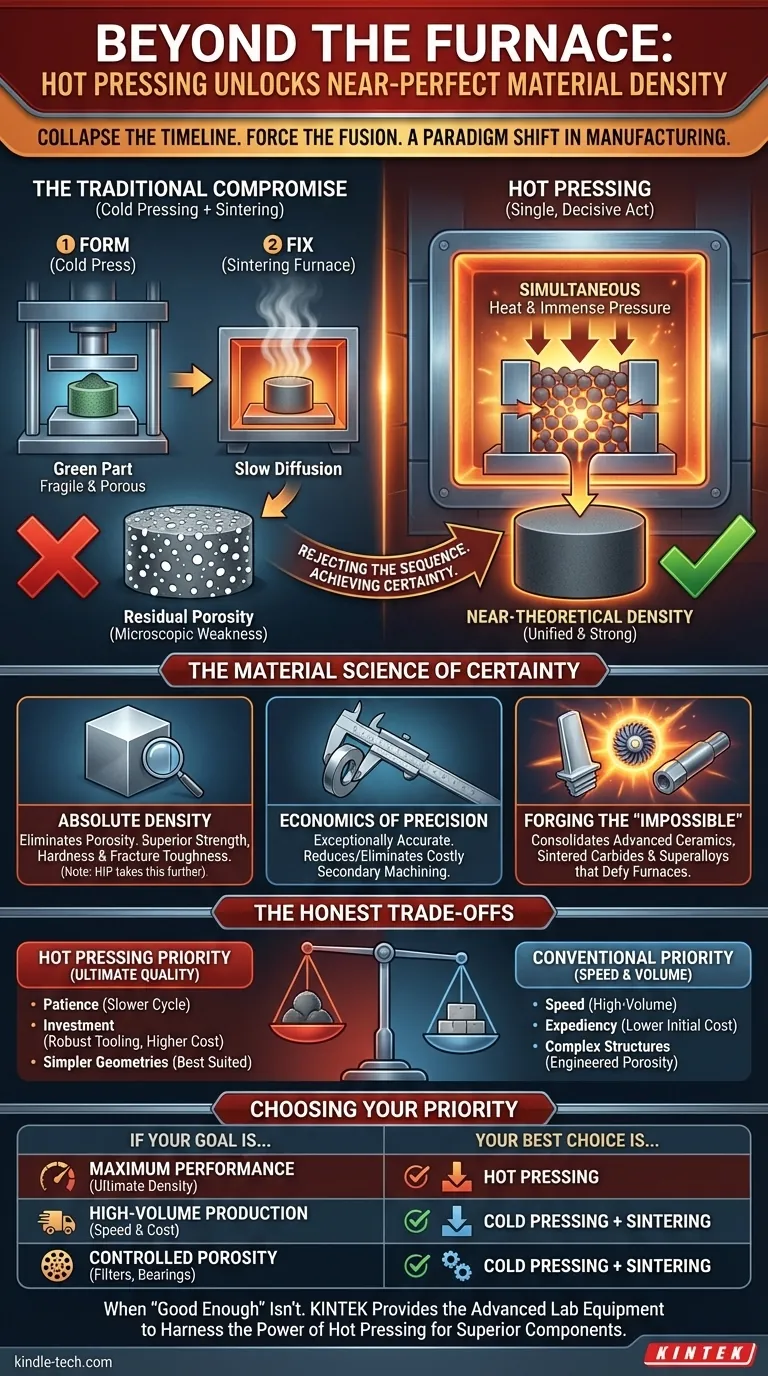
Powder metallurgy is a classic example. We press a fine powder into a fragile "green" part—an object that holds the promise of its final form but possesses none of its strength. Then, we carefully move this delicate piece to a furnace for sintering.
This second step, sintering, is a battle against physics. We use heat to coax individual particles to bond, slowly closing the microscopic gaps between them. It's an effective process, but it is fundamentally a compromise. It leaves behind residual porosity, a hidden map of microscopic voids that can become future points of failure.
This two-step logic—form, then fix—is efficient. But what if the process itself is the source of imperfection?
Collapsing the Timeline: A New Philosophy
Hot pressing isn't just an improvement on this sequence; it's a rejection of it.
Instead of shaping a part and then heating it, hot pressing does both in a single, decisive action. Powder is placed into a die, and then heat and immense pressure are applied simultaneously.
This changes everything.
The elevated temperature makes the material particles pliable and receptive. The mechanical pressure then forces them together, physically collapsing the voids that heat alone struggles to close. The particles don't just gently fuse; they are forged into a unified, dense mass.
This isn't merely a process optimization. It's a paradigm shift from a sequential, two-stage hope for density to a single, deterministic act of creation.
The Material Science of Certainty
By collapsing the process, hot pressing delivers a new level of quality and predictability in the final component. The benefits are not incremental; they are transformative.
The Pursuit of Absolute Density
The most significant outcome is the near-complete elimination of porosity. A void is a stress concentrator, an inherent weakness. By achieving near-theoretical density, hot pressing produces parts with vastly superior mechanical properties—higher strength, hardness, and fracture toughness.
This principle is taken even further with a related technique, Hot Isostatic Pressing (HIP), where gas applies uniform pressure from all directions, squeezing out the last traces of micro-porosity to create a truly solid component.
The Economics of Precision
Because the part is compacted and sintered in one contained step, its final dimensions are exceptionally accurate. This precision isn't just a technical achievement; it's an economic one. It drastically reduces or eliminates the need for costly and time-consuming secondary machining, saving both material and labor.
Forging the "Impossible" Materials
Perhaps the most romantic aspect of hot pressing is its ability to create components from materials that resist conventional methods.
Advanced ceramics, sintered carbides, and certain superalloys have such high melting points and poor particle adhesion that heat alone is not enough to consolidate them. They defy the furnace. Hot pressing provides the necessary mechanical force to overcome their reluctance, enabling the creation of ultra-hard tools and high-performance components that were previously out of reach.
The Honest Trade-Offs
This level of performance comes with deliberate trade-offs. Choosing hot pressing is a strategic decision that prioritizes ultimate quality over other factors.
- Patience Over Speed: Hot pressing is methodical. Heating the die, applying pressure, and cooling the assembly takes longer than high-speed cold pressing. It's a choice for applications where material integrity cannot be rushed.
- Investment Over Expediency: The tooling must withstand extreme heat and pressure simultaneously, requiring robust materials like graphite or specialized alloys. The initial investment is higher because the equipment is built for a more demanding task.
- Performance Over Complexity: The process is best suited for simpler geometries. For parts with intricate internal structures, like self-lubricating bearings that rely on engineered porosity, traditional cold pressing remains the superior method.
Choosing Your Priority
The decision between hot pressing and conventional methods boils down to a single question: What is your primary goal?
| If Your Goal Is... | Then Your Best Choice Is... |
|---|---|
| Maximum Performance | Hot Pressing (for ultimate density and strength) |
| High-Volume Production | Cold Pressing + Sintering (for speed and cost-efficiency) |
| Controlled Porosity | Cold Pressing + Sintering (for filters, bearings) |
Ultimately, hot pressing is the tool for when "good enough" isn't. It's for applications where reliability is non-negotiable and material performance is paramount.
Achieving this level of material integrity in a research or production environment requires equipment that can precisely control these extreme conditions. At KINTEK, we provide the advanced lab equipment and consumables necessary to harness the power of processes like hot pressing, enabling you to turn challenging materials into superior components.
If your work demands the highest standards of density and strength, we have the tools to help you achieve them. Contact Our Experts
Visual Guide
Related Products
- Automatic Heated Hydraulic Press Machine with Heated Plates for Laboratory Hot Press 25T 30T 50T
- Manual High Temperature Heated Hydraulic Press Machine with Heated Plates for Lab
- Touchscreen Automatic Vacuum Heat Press
- 30T 40T Split Automatic Heated Hydraulic Press Machine with Heated Plates for Laboratory Hot Press
- Vacuum Hot Press Furnace Machine Heated Vacuum Press
Related Articles
- Why Your Composite and Polymer Parts Keep Failing: The Secret Is Simultaneous Heat and Pressure
- The Physics of Flawless Materials: Deconstructing the Hydraulic Hot Press
- Precision Under Pressure: The Physics and Psychology of the Hydraulic Hot Press
- Hydraulic Hot Press: Principles, Components, Features, Advantages, and Applications
- Comprehensive Guide to Hydraulic Hot Press: Function, Features and Applications