The Tyranny of the Void
Imagine a critical component failing. Not from a visible crack, but from an invisible enemy: a microscopic void, a tiny pocket of nothingness left over from its creation. In the world of high-performance ceramics, this isn't just a material flaw; it's a catastrophic failure waiting to happen.
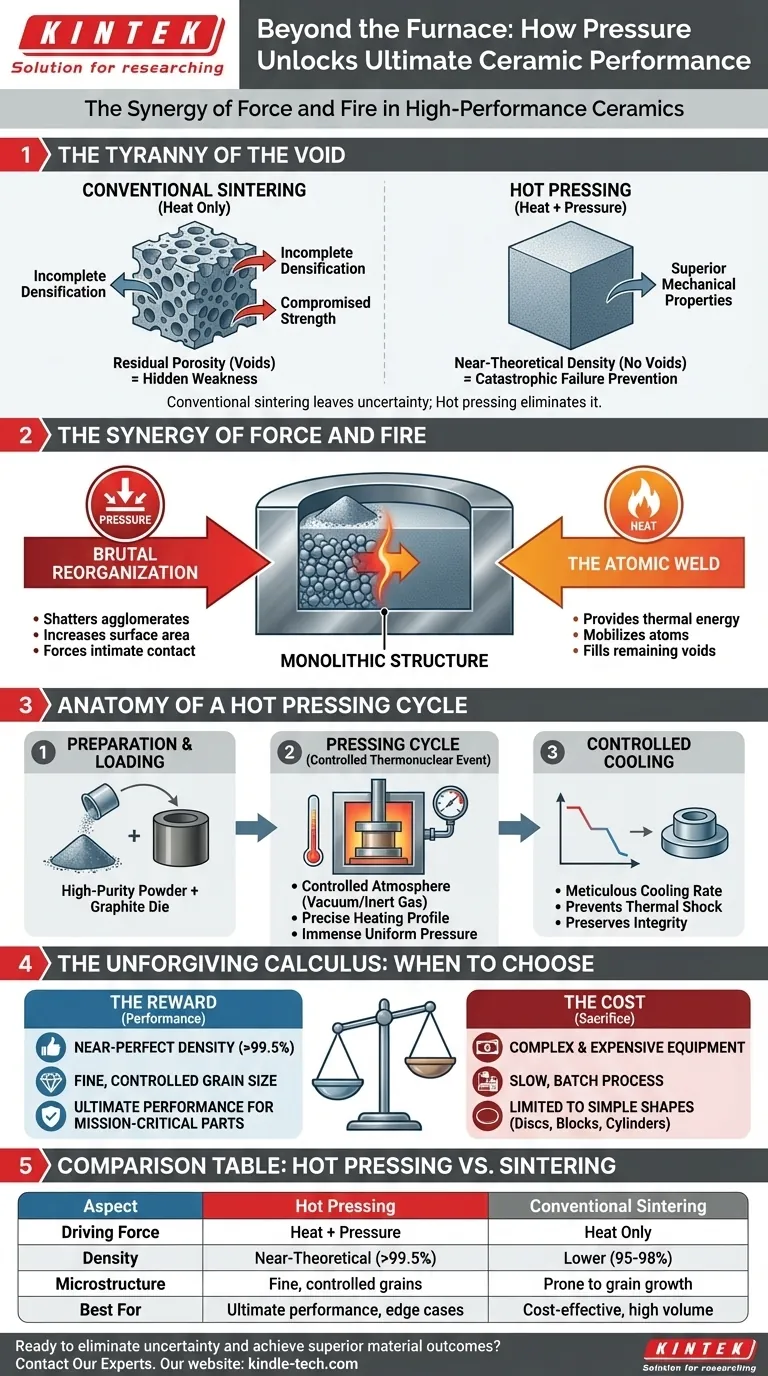
The fundamental challenge in creating ceramics from powder is eliminating these voids. Conventional sintering, which relies on heat alone, is a patient process. It coaxes atoms to slowly diffuse and bridge the gaps between particles. But it's often an incomplete victory, leaving behind residual porosity that compromises strength, hardness, and reliability.
This is the tyranny of the void. It introduces an element of uncertainty, a hidden weakness. For applications where failure is not an option—from aerospace components to ballistic armor—that uncertainty is unacceptable.
The Synergy of Force and Fire
Hot pressing is the decisive answer to this problem. It doesn't just coax atoms; it commands them. By combining extreme heat with immense mechanical pressure, it fundamentally changes the physics of densification.
This synergy is what makes the process so powerful. Heat provides the energy, but pressure is the catalyst that makes the process brutally efficient.
Pressure: A Brutal Reorganization
The first role of pressure is mechanical. It forces the individual ceramic powder particles into intimate, undeniable contact.
- It shatters weak particle agglomerates, breaking down clumps that would otherwise create large pores.
- It dramatically increases the surface area where particles touch, creating superhighways for atomic diffusion.
This pressure-assisted mechanism allows densification to happen at lower temperatures and in significantly less time than conventional sintering. It's a physical reorganization at the micro-level, setting the stage for a perfect atomic bond.
Heat: The Atomic Weld
While pressure arranges the particles, heat provides the thermal energy for the final act. At elevated temperatures, atoms become mobile. They vibrate with enough energy to move across the newly-formed particle boundaries, filling the last remaining voids.
The result isn't just a collection of fused particles. It's a solid, monolithic structure—a material forged into its strongest possible state.
Anatomy of a Hot Pressing Cycle
Executing this process requires meticulous control. It's less like baking and more like a controlled thermonuclear event on a miniature scale.
-
Preparation and Loading: The journey begins with high-purity ceramic powder, which is loaded into a die. This die is almost always made of high-purity graphite, a remarkable material that maintains its strength and chemical stability even at blistering temperatures.
-
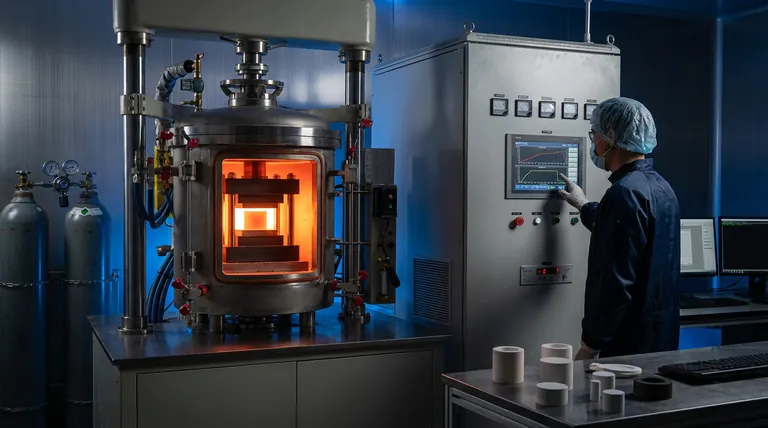
The Pressing Cycle: The loaded die enters a specialized furnace. The atmosphere is carefully controlled—often a vacuum or inert gas like argon—to prevent any unwanted chemical reactions. As the temperature rises according to a precise profile, a plunger applies immense, uniform pressure.
-
Controlled Cooling: After a "soak" time at peak temperature and pressure, the cooling process begins. This phase is just as critical as the heating. Cooling too quickly will induce thermal shock, shattering the newly formed part. The rate must be perfectly managed to preserve the component's integrity.
The Unforgiving Calculus: When to Choose Hot Pressing
This level of performance comes at a cost. The decision to use hot pressing is a strategic one, driven by a clear understanding of the trade-offs.
The Reward: Near-Perfect Density and Microstructure
The primary benefit is achieving a ceramic with near-theoretical density. This absence of porosity directly translates to superior mechanical properties: higher strength, greater hardness, and improved fracture toughness.
Furthermore, because the process is faster and occurs at lower temperatures, it suppresses excessive grain growth. A finer, more uniform grain structure is a cornerstone of high-performance materials, further enhancing their resilience.
The Cost: A Deliberate Sacrifice
Hot pressing is not for every application. The equipment is complex and expensive. The process itself is slow, operating in batches, which makes it unsuitable for mass production.
Perhaps the biggest limitation is geometry. The uniaxial pressure means parts are generally limited to simple shapes like discs, blocks, and cylinders.
| Aspect | Hot Pressing | Conventional Sintering |
|---|---|---|
| Driving Force | Heat + High Pressure | Heat Only |
| Resulting Density | Near-Theoretical ( >99.5%) | Typically Lower (95-98%) |
| Microstructure | Fine, controlled grain size | Prone to grain growth |
| Best For | Ultimate performance, mission-critical parts | Cost-effective, high-volume production |
| Key Limitation | High cost, low throughput, simple shapes | Residual porosity, limited performance ceiling |
Ultimately, hot pressing is a tool for engineers and scientists who need to push the boundaries of material science. It's the choice you make when you are designing for the edge cases, where performance is paramount and the cost of failure is far greater than the cost of production.
The precision required to master this process of atomic forging demands equipment built for the task. The systems that enable this level of control over temperature, pressure, and atmosphere are what turn theoretical models into high-performance realities. If you are ready to eliminate uncertainty and achieve superior material outcomes in your laboratory, Contact Our Experts.
Visual Guide
Related Products
- Automatic Heated Hydraulic Press Machine with Heated Plates for Laboratory Hot Press 25T 30T 50T
- Manual High Temperature Heated Hydraulic Press Machine with Heated Plates for Lab
- Touchscreen Automatic Vacuum Heat Press
- 30T 40T Split Automatic Heated Hydraulic Press Machine with Heated Plates for Laboratory Hot Press
- Vacuum Hot Press Furnace Machine Heated Vacuum Press
Related Articles
- Why Your Composite and Polymer Parts Keep Failing: The Secret Is Simultaneous Heat and Pressure
- The Physics of Flawless Materials: Deconstructing the Hydraulic Hot Press
- Precision Under Pressure: The Physics and Psychology of the Hydraulic Hot Press
- Hydraulic Hot Press: Principles, Components, Features, Advantages, and Applications
- Comprehensive Guide to Hydraulic Hot Press: Function, Features and Applications