The Invisible Variable
An aerospace engineer is developing a new alloy. The first batch is perfect—strong, light, flawless. The second, processed under what seem to be identical conditions, is brittle. The third cracks during testing.
The materials are the same. The temperatures are the same. The timing is the same.
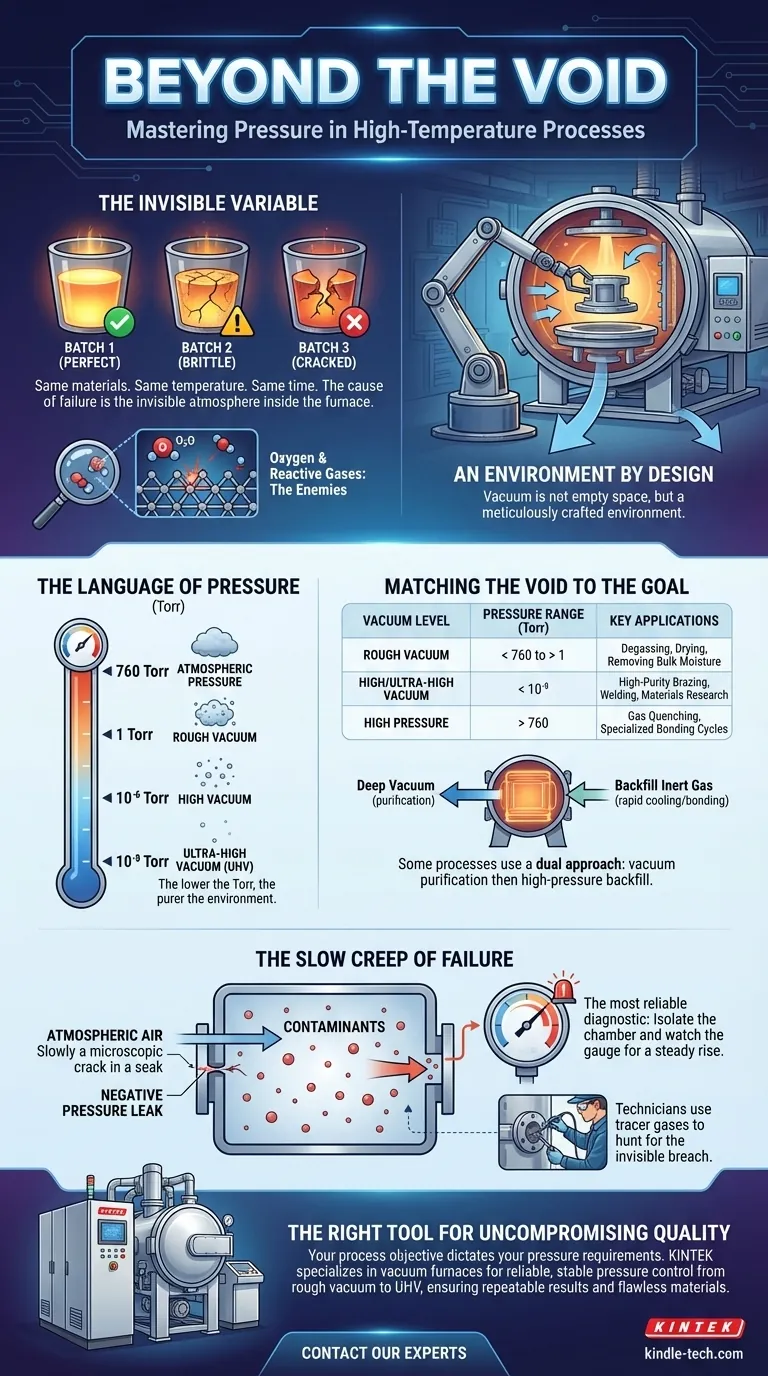
The cause of failure isn't something you can see. It's the invisible atmosphere—or lack thereof—inside the furnace chamber. In high-temperature material science, success and failure are often measured in Torr.
An Environment by Design
We tend to think of a "vacuum" as empty space. But in a vacuum furnace, it's the opposite. It is a meticulously crafted environment, engineered by deliberately removing specific molecules.
The primary enemy at high temperatures is oxygen. Even trace amounts will react with metals, creating oxides that compromise structural integrity. Creating a vacuum is the act of systematically removing this and other reactive gases.
The pressure inside the furnace isn't a setting; it's the very foundation of the chemical stage you are setting for your process.
The Language of Pressure
This environment is measured in Torr. Standard atmospheric pressure is about 760 Torr. Every incremental drop below that value represents a cleaner, more controlled workspace.
- A Rough Vacuum might be 1 Torr.
- A High Vacuum might be 10⁻⁶ Torr.
- An Ultra-High Vacuum (UHV) can be less than 10⁻⁸ Torr, a space with vanishingly few molecules left to cause trouble.
The lower the Torr, the purer the environment.
Matching the Void to the Goal
The required level of vacuum is dictated entirely by the sensitivity of your work. Using a UHV system for a simple drying process is overkill; trying to braze a critical component in a rough vacuum is a recipe for failure.
| Vacuum Level | Pressure Range (Torr) | Key Applications | Core Objective |
|---|---|---|---|
| Rough Vacuum | < 760 to > 1 | Degassing, Drying, Removing Bulk Moisture | Remove the obvious |
| High/Ultra-High Vacuum | < 10⁻⁸ | High-Purity Brazing, Welding, Materials Research | Remove the invisible |
| High Pressure | > 760 | Gas Quenching, Specialized Bonding Cycles | Introduce a controlled gas |
Some advanced processes even use a dual approach: first pulling a deep vacuum to purify the chamber, then backfilling it with a specific inert gas to a pressure above atmospheric level for rapid cooling or bonding. This transforms the furnace from a vacuum chamber into a high-purity pressure vessel.
The Slow Creep of Failure
The single greatest threat to a vacuum process is an imperceptible leak. A furnace doesn't just need to reach a target pressure; it must hold it.
The Anatomy of a Leak
A negative pressure leak is the furnace's silent saboteur. Atmospheric air, with all its reactive contaminants, is slowly drawn into the chamber through a microscopic flaw in a seal or weld.
The vacuum pumps work harder to compensate, but they are fighting a losing battle. The environment is slowly being poisoned, and the pressure gauge reading begins to drift, refusing to stabilize at its target. This drift is the first sign that your process is already compromised.
The Psychology of Denial
It’s easy to dismiss a minor pressure fluctuation. Perhaps it's just the material outgassing. But this small anomaly is often a symptom of a systemic problem. Ignoring it is a gamble that rarely pays off.
The most reliable diagnostic is to isolate the chamber and watch the gauge. A steady rise in pressure confirms your enemy: a leak. Technicians then become detectives, using tracer gases like helium or hydrogen to hunt for the invisible breach from the outside.
The Right Tool for Uncompromising Quality
Your process objective dictates your pressure requirements, which in turn dictates your equipment. You cannot achieve the molecular purity needed for advanced materials research with a furnace only capable of a rough vacuum.
The integrity of your work depends on the integrity of your tools. For processes where every molecule counts, the ability of your furnace to achieve and maintain a stable vacuum is not just a feature—it's the entire point.
KINTEK specializes in precision lab equipment, including vacuum furnaces engineered for reliable, stable pressure control across the full spectrum, from rough vacuum to UHV. Our systems are built to provide the pristine, controlled environments that modern research and manufacturing demand, ensuring your results are repeatable and your materials are flawless.
If inconsistent pressure is compromising your work, let's ensure your equipment is a solution, not a variable. Contact Our Experts.
Visual Guide
Related Products
- Vacuum Hot Press Furnace Heated Vacuum Press Machine Tube Furnace
- 600T Vacuum Induction Hot Press Furnace for Heat Treat and Sintering
- Vacuum Hot Press Furnace Machine Heated Vacuum Press
- Vacuum Heat Treat Furnace and Levitation Induction Melting Furnace
- 2200 ℃ Tungsten Vacuum Heat Treat and Sintering Furnace
Related Articles
- The Purity Paradox: Choosing the Heart of Your Vacuum Hot Press Furnace
- Comprehensive Guide to Vacuum Hot Press Furnace Application
- Vacuum Hot Press Furnace: A Comprehensive Guide
- Forging Perfection in a Void: The Physics of Ultra-Dense Materials
- Defeating the Void: The Quiet Power of Vacuum Hot Pressing