Blog Beyond the Weld: The Physics and Psychology of Vacuum Furnace Brazing
Beyond the Weld: The Physics and Psychology of Vacuum Furnace Brazing

Beyond the Weld: The Physics and Psychology of Vacuum Furnace Brazing

1 day ago

A Single Point of Failure

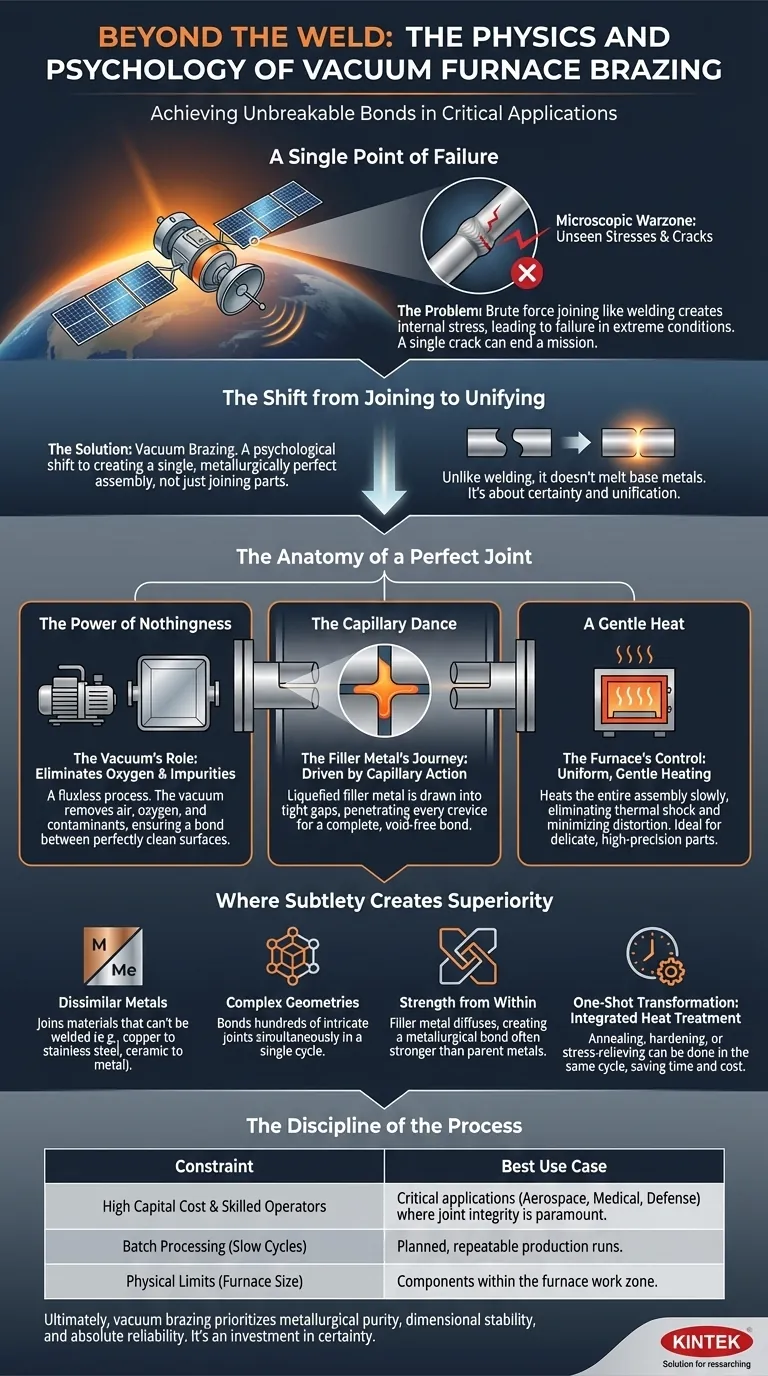
Imagine a satellite in orbit. It endures brutal thermal cycles, swinging from scorching heat to cryogenic cold. Deep within, a tiny fuel line, joined by a conventional weld, carries volatile propellant. Over time, unseen internal stresses from the welding process—a microscopic warzone of expanded and contracted metal—give way. A hairline crack forms. The mission fails.

This scenario isn't just about a failed weld; it's about the limitations of a certain mindset. We often think of joining metal as an act of force: melting, fusing, and forcing a bond. But in applications where failure is not an option, the most robust solution is often one of subtraction, not addition.

It's about creating a bond in the absence of everything that could possibly compromise it.

The Shift from Joining to Unifying

Vacuum furnace brazing represents a psychological shift from merely "joining" components to creating a single, unified, and metallurgically perfect assembly.

Unlike welding, it never melts the base metals. Instead, it uses a precise, controlled environment to introduce a filler metal that flows into the joints with the subtle, irresistible pull of capillary action.

The result is less like a patch and more like a seamless, integrated connection woven into the very structure of the parent materials. It's a process chosen not for its speed, but for its certainty.

The Anatomy of a Perfect Joint

To appreciate the elegance of this method, you have to understand how its core elements work in concert to achieve what brute force cannot.

The Power of Nothingness: The Vacuum's Role

The process takes place inside a vacuum chamber, but the vacuum isn't a passive stage. It's the most critical active ingredient. By removing virtually all the air, it eliminates oxygen—the primary catalyst for the formation of oxides that contaminate and weaken a joint.

This creates a fluxless process. No corrosive chemical fluxes are needed to clean the surfaces because the vacuum itself is the ultimate purifier. It pulls impurities and trapped gases from the metal, ensuring the bond forms between two perfectly clean surfaces.

The Capillary Dance: The Filler Metal's Journey

A carefully selected filler metal, with a melting point lower than the components, is placed near the joint. As the furnace heats the entire assembly uniformly, this filler metal liquefies.

It's here that the quiet magic happens. The liquid metal is drawn into the tight gaps between the parts by capillary action—the same physical law that allows trees to draw water up to their highest leaves. This natural force ensures the filler penetrates every crevice of the joint, creating a complete, void-free bond that is impossible to achieve with manual methods.

A Gentle Heat: The Furnace's Control

Localized heating, like that from a welding torch, is a violent event. It creates immense thermal gradients, leaving behind a legacy of internal stress and distortion.

A vacuum furnace, by contrast, heats the entire assembly slowly and uniformly. Every part, thick or thin, reaches the brazing temperature at the same time. This gentle, encompassing heat eliminates thermal shock and minimizes distortion, making it ideal for delicate, high-precision components where maintaining tolerances is non-negotiable.

Where Subtlety Creates Superiority

This disciplined approach yields powerful advantages that open up new possibilities in design and engineering.

Designing the Impossible

  • Dissimilar Metals: It allows for the robust joining of materials that can't be welded together, like copper to stainless steel or ceramic to metal.
  • Complex Geometries: Intricate assemblies with hundreds or even thousands of joints, like compact heat exchangers or delicate sensor arrays, can be bonded simultaneously in a single, perfect cycle.
  • Delicate Components: Thin-walled or fragile parts that would be destroyed by welding can be joined without distortion.

Strength from Within

The bond created through vacuum brazing isn't just a surface connection. The filler metal diffuses slightly into the base materials, creating a metallurgical bond that is often stronger than the parent metals themselves. The resulting joints are clean, smooth, and free of the residual flux and oxides that invite corrosion and failure.

The One-Shot Transformation

The controlled heating and cooling cycle is more than just a joining process; it's a heat treatment opportunity. Operations like annealing, hardening, or stress-relieving can be integrated directly into the brazing cycle. This eliminates entire steps from the manufacturing process, saving time, reducing costs, and improving the final properties of the assembly.

The Discipline of the Process

This level of perfection comes with a set of trade-offs that demand a deliberate, strategic approach. It is not a universal solution.

Constraint Implication Best Use Case
High Capital Cost Vacuum furnaces are a significant investment requiring skilled operators. Critical applications in aerospace, medical, and defense where joint integrity is paramount.
Batch Processing The process is slow, with long cycles for pump-down, heating, and cooling. Planned, repeatable production runs, not for one-off repairs or rapid prototyping.
Physical Limits Components are limited by the size of the furnace chamber. Components that fit within the available furnace work zone.

Ultimately, choosing vacuum furnace brazing is a decision to prioritize metallurgical purity, dimensional stability, and absolute reliability over speed and low upfront cost.

It’s an investment in certainty. Achieving this level of metallurgical control requires not just the right process, but also flawless, reliable equipment. At KINTEK, we provide the specialized laboratory furnaces and consumables that enable engineers and scientists to turn these complex principles into tangible, high-performance realities.

If your work demands joints that are as strong and perfect as the materials they unite, we can provide the tools to achieve it. Contact Our Experts

Visual Guide
Beyond the Weld: The Physics and Psychology of Vacuum Furnace Brazing Visual Guide

Related Products

Related Articles

Related Products

Vacuum Hot Press Furnace Heated Vacuum Press Machine Tube Furnace

Vacuum Hot Press Furnace Heated Vacuum Press Machine Tube Furnace

Reduce forming pressure & shorten sintering time with Vacuum Tube Hot Press Furnace for high-density, fine-grain materials. Ideal for refractory metals.

600T Vacuum Induction Hot Press Furnace for Heat Treat and Sintering

600T Vacuum Induction Hot Press Furnace for Heat Treat and Sintering

Discover the 600T Vacuum Induction Hot Press Furnace, designed for high-temperature sintering experiments in vacuum or protected atmospheres. Its precise temperature and pressure control, adjustable working pressure, and advanced safety features make it ideal for nonmetal materials, carbon composites, ceramics, and metal powders.

Vacuum Hot Press Furnace Machine Heated Vacuum Press

Vacuum Hot Press Furnace Machine Heated Vacuum Press

Discover the advantages of Vacuum Hot Press Furnace! Manufacture dense refractory metals & compounds, ceramics, and composites under high temp and pressure.

Vacuum Heat Treat Furnace and Levitation Induction Melting Furnace

Vacuum Heat Treat Furnace and Levitation Induction Melting Furnace

Experience precise melting with our Vacuum Levitation Melting Furnace. Ideal for high melting point metals or alloys, with advanced technology for effective smelting. Order now for high-quality results.

2200 ℃ Tungsten Vacuum Heat Treat and Sintering Furnace

2200 ℃ Tungsten Vacuum Heat Treat and Sintering Furnace

Experience the ultimate refractory metal furnace with our Tungsten vacuum furnace. Capable of reaching 2200℃, perfect for sintering advanced ceramics and refractory metals. Order now for high-quality results.

Vacuum Heat Treat and Pressure Sintering Furnace for High Temperature Applications

Vacuum Heat Treat and Pressure Sintering Furnace for High Temperature Applications

Vacuum pressure sintering furnaces are designed for high temperature hot pressing applications in metal and ceramic sintering. Its advanced features ensure precise temperature control, reliable pressure maintenance, and a robust design for seamless operation.

Molybdenum Vacuum Heat Treat Furnace

Molybdenum Vacuum Heat Treat Furnace

Discover the benefits of a high-configuration molybdenum vacuum furnace with heat shield insulation. Ideal for high-purity, vacuum environments like sapphire crystal growth and heat treatment.

Graphite Vacuum Furnace IGBT Experimental Graphitization Furnace

Graphite Vacuum Furnace IGBT Experimental Graphitization Furnace

IGBT experimental graphitization furnace, a tailored solution for universities and research institutions, with high heating efficiency, user-friendliness, and precise temperature control.

Vacuum Sealed Continuous Working Rotary Tube Furnace Rotating Tube Furnace

Vacuum Sealed Continuous Working Rotary Tube Furnace Rotating Tube Furnace

Experience efficient material processing with our vacuum-sealed rotary tube furnace. Perfect for experiments or industrial production, equipped with optional features for controlled feeding and optimized results. Order now.

2200 ℃ Graphite Vacuum Heat Treat Furnace

2200 ℃ Graphite Vacuum Heat Treat Furnace

Discover the power of the KT-VG Graphite Vacuum Furnace - with a maximum working temperature of 2200℃, it's perfect for vacuum sintering of various materials. Learn more now.

Lab-Scale Vacuum Induction Melting Furnace

Lab-Scale Vacuum Induction Melting Furnace

Get precise alloy composition with our Vacuum Induction Melting Furnace. Ideal for aerospace, nuclear energy, and electronic industries. Order now for effective smelting and casting of metals and alloys.

Vacuum Heat Treat Sintering Brazing Furnace

Vacuum Heat Treat Sintering Brazing Furnace

A vacuum brazing furnace is a type of industrial furnace used for brazing, a metalworking process that joins two pieces of metal using a filler metal that melts at a lower temperature than the base metals. Vacuum brazing furnaces are typically used for high-quality applications where a strong, clean joint is required.

Ultra-High Temperature Graphite Vacuum Graphitization Furnace

Ultra-High Temperature Graphite Vacuum Graphitization Furnace

The ultra-high temperature graphitization furnace utilizes medium frequency induction heating in a vacuum or inert gas environment. The induction coil generates an alternating magnetic field, inducing eddy currents in the graphite crucible, which heats up and radiates heat to the workpiece, bringing it to the desired temperature. This furnace is primarily used for graphitization and sintering of carbon materials, carbon fiber materials, and other composite materials.

Small Vacuum Heat Treat and Tungsten Wire Sintering Furnace

Small Vacuum Heat Treat and Tungsten Wire Sintering Furnace

The small vacuum tungsten wire sintering furnace is a compact experimental vacuum furnace specially designed for universities and scientific research institutes. The furnace features a CNC welded shell and vacuum piping to ensure leak-free operation. Quick-connect electrical connections facilitate relocation and debugging, and the standard electrical control cabinet is safe and convenient to operate.

Vacuum Heat Treat Furnace with Ceramic Fiber Liner

Vacuum Heat Treat Furnace with Ceramic Fiber Liner

Vacuum furnace with polycrystalline ceramic fiber insulation liner for excellent heat insulation and uniform temperature field. Choose from 1200℃ or 1700℃ max. working temperature with high vacuum performance and precise temperature control.

Vacuum Heat Treat and Molybdenum Wire Sintering Furnace for Vacuum Sintering

Vacuum Heat Treat and Molybdenum Wire Sintering Furnace for Vacuum Sintering

A vacuum molybdenum wire sintering furnace is a vertical or bedroom structure, which is suitable for withdrawal, brazing, sintering and degassing of metal materials under high vacuum and high temperature conditions. It is also suitable for dehydroxylation treatment of quartz materials.

Vacuum Arc Induction Melting Furnace

Vacuum Arc Induction Melting Furnace

Discover the power of Vacuum Arc Furnace for melting active & refractory metals. High-speed, remarkable degassing effect, and free of contamination. Learn more now!

Vacuum Dental Porcelain Sintering Furnace

Vacuum Dental Porcelain Sintering Furnace

Get precise and reliable results with KinTek's Vacuum Porcelain Furnace. Suitable for all porcelain powders, it features hyperbolic ceramic furnace function, voice prompt, and automatic temperature calibration.

Horizontal High Temperature Graphite Vacuum Graphitization Furnace

Horizontal High Temperature Graphite Vacuum Graphitization Furnace

Horizontal Graphitization Furnace: This type of furnace is designed with the heating elements placed horizontally, allowing for uniform heating of the sample. It's well-suited for graphitizing large or bulky samples that require precise temperature control and uniformity.

Non Consumable Vacuum Arc Induction Melting Furnace

Non Consumable Vacuum Arc Induction Melting Furnace

Explore the benefits of Non-Consumable Vacuum Arc Furnace with high melting point electrodes. Small, easy to operate & eco-friendly. Ideal for laboratory research on refractory metals & carbides.


Leave Your Message