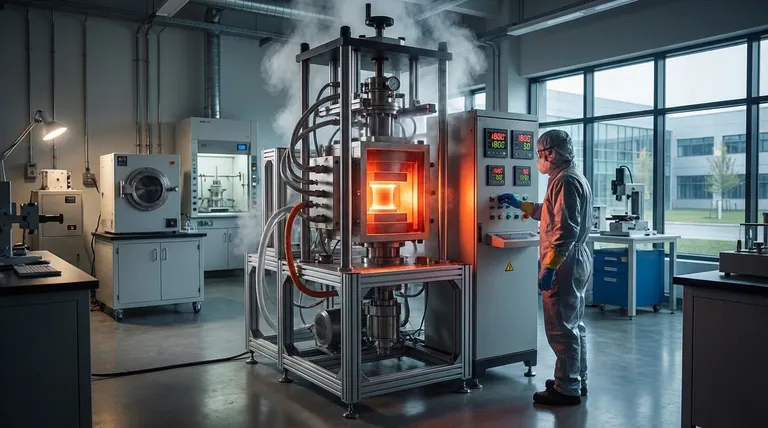
The Allure of Absolute Density
Imagine an engineer tasked with creating a perfectly dense ceramic component. Not just strong, but theoretically perfect. A material with no voids, no weaknesses—the kind of component that could define the performance of a next-generation satellite or a critical medical implant.
For this pursuit of perfection, hot pressing is often the chosen path. It promises to squeeze matter into its ideal state through immense heat and pressure.
But this singular focus on density is a psychological trap. In solving for one variable, a cascade of other, often more difficult, problems are introduced. Hot pressing isn’t a simple manufacturing step; it’s a negotiation with the laws of physics and economics.
The Tyranny of the Clock and the Budget
The most immediate challenges of hot pressing are not found in material science, but on the balance sheet and the calendar. It forces us to confront the uncomfortable reality that even the most advanced processes are bound by practical constraints.
A Process Measured in Hours, Not Minutes
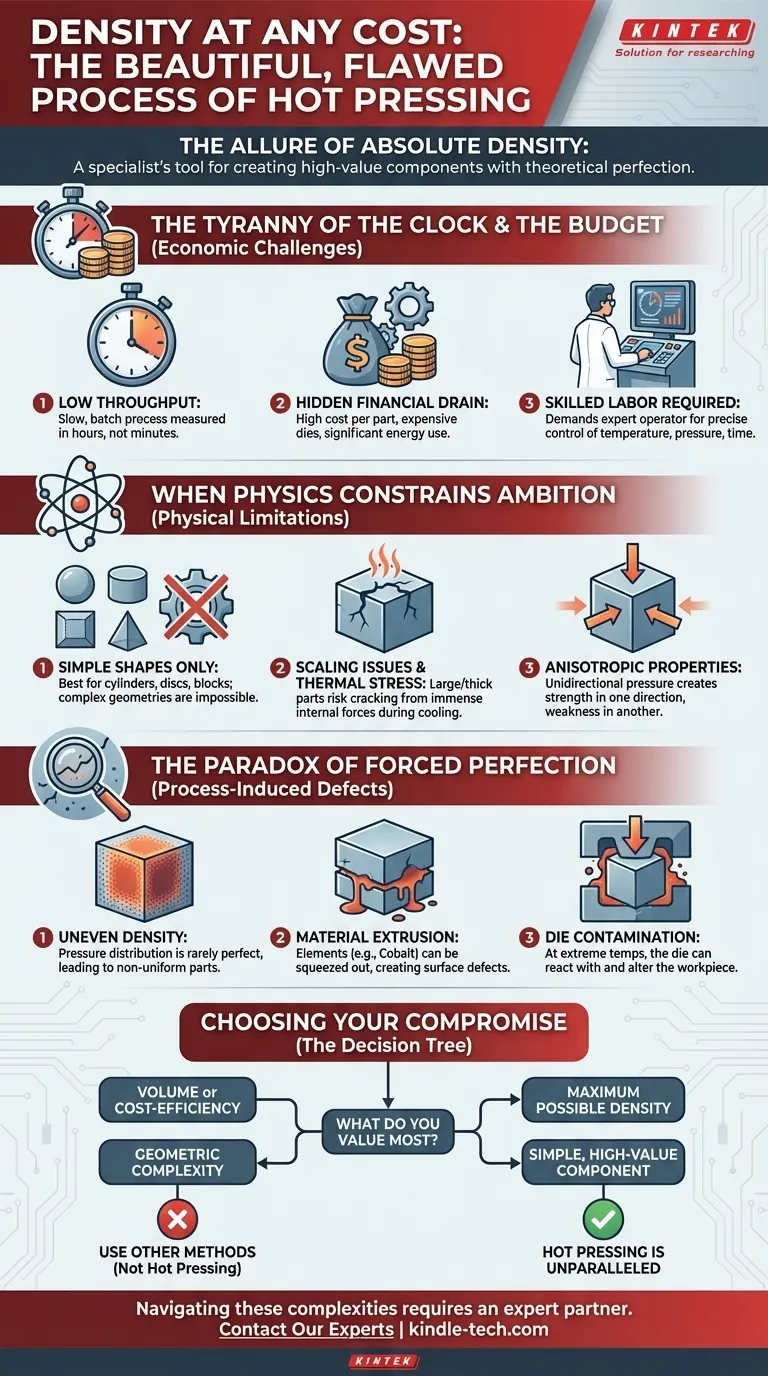
Unlike mass-production methods, hot pressing is inherently slow. Each part, or a very small batch, is meticulously heated and compressed within a single die. This deliberate pace results in extremely low throughput. It’s a process for creating a masterpiece, not for stocking a warehouse.
The Hidden Financial Drain
The costs accumulate quietly but relentlessly. The specialized molds and dies, subjected to extreme thermal and mechanical stress, have a brutally short service life. Fabricating them is expensive. Running the process consumes significant energy. It's a method where the cost per part is high, and intentionally so.
The Artisan in the Lab Coat
Hot pressing is not a "set and forget" operation. It demands an operator with a deep, intuitive feel for the interplay of temperature, pressure, and time. A slight miscalculation in heating or cooling rates can introduce catastrophic stress, turning a high-value component into scrap. This reliance on human skill makes consistency a challenge and highlights the need for exceptionally stable, reliable equipment that can execute an operator's commands with flawless precision.
When Physics Constrains Ambition
Beyond economics, hot pressing imposes fundamental physical limits that can frustrate even the most ambitious designs. The process dictates the form, not the other way around.
Trapped in a Simple Shape
The die is the master. The process is best suited for producing simple geometries like cylinders, discs, or blocks. Complex, asymmetrical shapes with intricate features are often impossible. You are limited to the shapes you can effectively press from a single direction.
The Crushing Weight of Scale
While it can produce parts with a large diameter, creating components that are both large and thick is a monumental challenge. During the slow cooling cycle, immense thermal stresses build up within the material. In a large billet, these forces can easily cause the part to crack itself apart, requiring equipment with unparalleled temperature uniformity.
Strength in One Direction, Weakness in Another
The unidirectional pressure used in hot pressing can align the grain structure of the material, creating an anisotropic microstructure. This means the finished part might be incredibly strong along one axis but surprisingly weak along another. You achieve a high-density part, but its performance becomes conditional and direction-dependent—a dangerous flaw in many high-performance applications.
The Paradox of Forced Perfection
The most fascinating limitations are the ones born from the process itself. The very act of forcing material into a dense state can introduce new, more subtle imperfections.
An Uneven Compromise
Pressure is rarely distributed perfectly. The material directly under the press ram becomes denser than the material near the edges of the die. The final product is dense on average, but not uniformly dense. The quest for homogeneity ends in a state of structured inconsistency.
The Material's Own Rebellion
Sometimes, the material fights back. Under intense heat and pressure, certain elements can be literally squeezed out. In some alloys, for example, cobalt can be extruded to the surface, depleting the material and creating a rough, pockmarked finish that is difficult to machine later.
Contamination from the Vessel
At extreme temperatures, the die itself can become a source of contamination, reacting with and altering the workpiece. For sensitive materials like ITO sputtering targets, the process can also create an uneven distribution of oxygen, directly compromising the performance of the final thin film. Success depends heavily on using high-purity, non-reactive molds and consumables.
Choosing Your Compromise
Hot pressing is not a flawed process; it's a specialist's tool defined by its trade-offs. The decision to use it hinges on a single question: What do you value most?
- If your goal is volume or cost-efficiency, other methods are far superior.
- If your design requires geometric complexity, hot pressing is a dead end.
- But if your goal is achieving maximum possible density in a simple, high-value component—and you are prepared to invest in the operational mastery and equipment to manage its challenges—then it remains an unparalleled choice.
Navigating these complexities requires more than just data sheets; it requires a partner who understands the nuances of the process. If you're weighing these trade-offs for your next project, our team is here to help. Contact Our Experts
Visual Guide
Related Products
- Automatic Heated Hydraulic Press Machine with Heated Plates for Laboratory Hot Press 25T 30T 50T
- Manual High Temperature Heated Hydraulic Press Machine with Heated Plates for Lab
- Touchscreen Automatic Vacuum Heat Press
- 30T 40T Split Automatic Heated Hydraulic Press Machine with Heated Plates for Laboratory Hot Press
- Vacuum Hot Press Furnace Machine Heated Vacuum Press
Related Articles
- Why Your Composite and Polymer Parts Keep Failing: The Secret Is Simultaneous Heat and Pressure
- The Physics of Flawless Materials: Deconstructing the Hydraulic Hot Press
- Precision Under Pressure: The Physics and Psychology of the Hydraulic Hot Press
- Hydraulic Hot Press: Principles, Components, Features, Advantages, and Applications
- Comprehensive Guide to Hydraulic Hot Press: Function, Features and Applications