Blog Designing for Emptiness: The Physics of Material Choice in Vacuum Furnaces
Designing for Emptiness: The Physics of Material Choice in Vacuum Furnaces

Designing for Emptiness: The Physics of Material Choice in Vacuum Furnaces

5 hours ago

The Paradox of an Empty Space

In a perfectly clean room, the biggest source of contamination is often the people working inside it. A similar paradox exists inside a vacuum furnace. You create a near-perfect void to achieve ultimate purity, only to discover the furnace itself can become the primary contaminant.

This isn't a failure of design, but a fundamental challenge of physics. When you combine extreme heat with a near-total absence of air, materials behave in strange ways. The central engineering problem is not just containing thousands of degrees of heat, but ensuring the materials containing it don't poison the very process they are meant to enable.

The Invisible Enemy: Outgassing

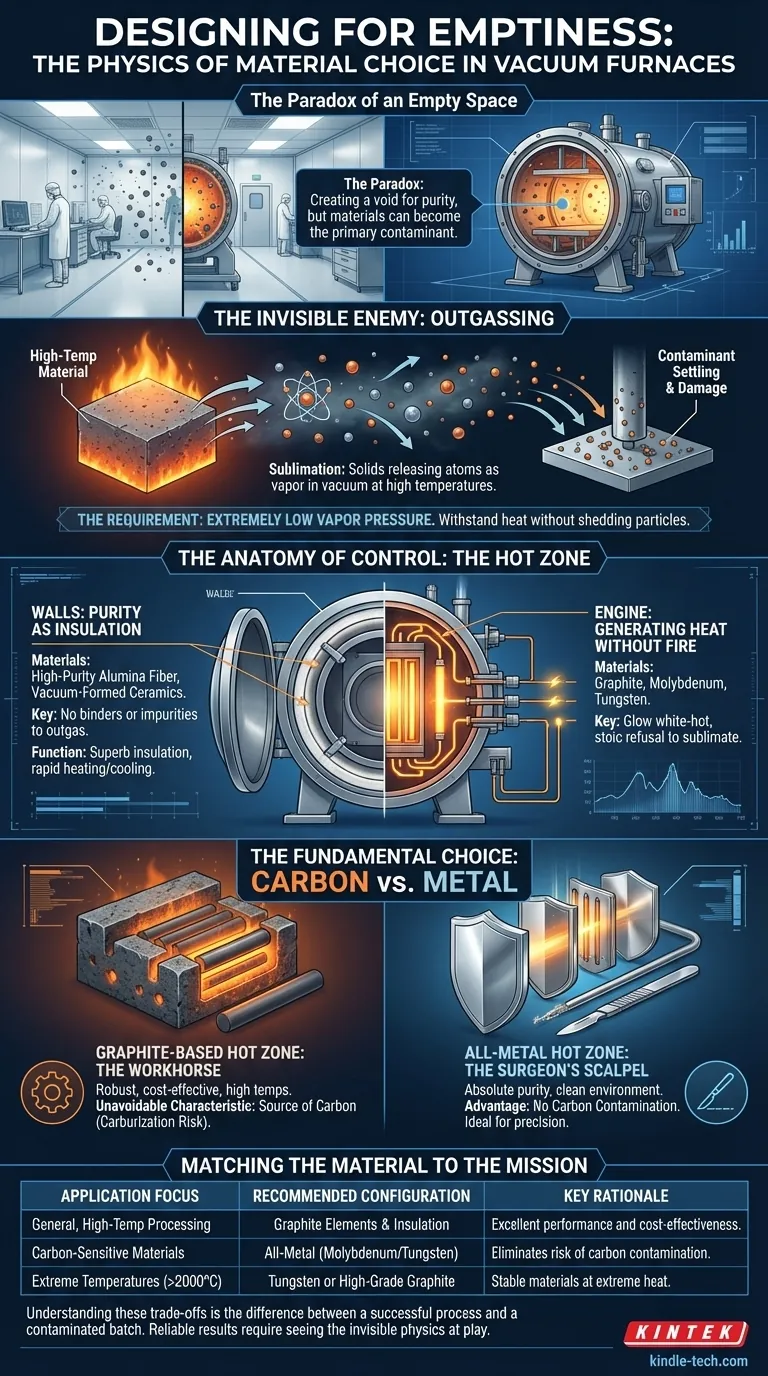
In the vacuum of a furnace, solids don't always stay solid. At high temperatures, atoms can escape directly from a solid surface and become a gas, a process called sublimation or "outgassing."

This vapor of unwanted atoms acts like a contaminant, settling on the surface of the components being treated. It can ruin sensitive alloys, compromise electronic components, or alter chemical properties.

Therefore, the materials chosen to build the furnace's core must possess one almost supernatural quality: an extremely low vapor pressure. They must be able to withstand hellish temperatures without shedding particles into the void.

The Anatomy of Control: The Hot Zone

The "hot zone" is the heart of the furnace. It's an insulated chamber where the heating elements and the workload reside. Its design is a masterclass in material science, focused entirely on heat management and purity.

The Walls: Purity as Insulation

The insulation lining the hot zone isn’t just about stopping heat; it's about creating a pristine environment.

  • Materials: High-purity alumina fiber, vacuum-formed ceramics, and other advanced composites are the standard.
  • Key Property: The term "high-purity" is critical. Any binders, glues, or impurities within the ceramic fiber would be the first things to outgas, defeating the purpose of the vacuum.
  • Function: These materials offer superb thermal insulation with low heat storage, allowing for rapid heating and cooling cycles without cracking or degrading.

The Engine: Generating Heat Without Fire

Since there's no oxygen for combustion, heating is done electrically. The materials used for these heating elements are the true heroes of the system.

The three most common choices are:

  • Graphite
  • Molybdenum
  • Tungsten

These elements are prized not just for their ability to glow white-hot without melting, but for their stoic refusal to sublimate. They remain stable, releasing almost no particles even at temperatures that would vaporize lesser materials.

The Fundamental Choice: Carbon vs. Metal

The most significant decision in configuring a vacuum furnace is the choice between a graphite-based hot zone and an all-metal one. This choice is less about performance and more about the "fingerprint" each material leaves behind.

The Case for Graphite: The Workhorse

A hot zone with graphite heating elements and graphite fiber insulation is robust, cost-effective, and capable of reaching very high temperatures. It's the powerful workhorse for a huge range of general-purpose applications.

But it has one unavoidable characteristic: it is a source of carbon. For most processes, this is irrelevant. But if your workload is sensitive to carbon—a phenomenon known as carburization—then even a few stray carbon atoms can be disastrous.

The Case for All-Metal: The Surgeon's Scalpel

For processes demanding absolute purity, an all-metal hot zone is the only option.

Here, the heating elements and radiation shields (which serve as insulation) are made of molybdenum or, for extreme temperatures, tungsten. This design creates a "clean" heating environment, free from the risk of carbon contamination. It’s the surgeon's scalpel, chosen for applications where precision and purity are paramount.

Matching the Material to the Mission

The right choice is never about which material is "best," but which is right for your specific goal.

Application Focus Recommended Hot Zone Configuration Key Rationale
General, High-Temp Processing Graphite Elements & Insulation Excellent performance and cost-effectiveness.
Carbon-Sensitive Materials All-Metal (Molybdenum/Tungsten) Eliminates the risk of carbon contamination.
Extreme Temperatures (>2000°C) Tungsten Elements or High-Grade Graphite Only materials stable at these temperatures.

Understanding these trade-offs is the difference between a successful process and a contaminated, failed batch. It requires seeing the invisible physics at play inside the void you’ve so carefully created.

Navigating these material science decisions is critical to achieving reliable results in your lab. At KINTEK, we provide the specialized vacuum furnaces and expertise needed to align equipment capabilities perfectly with your process goals. If you're unsure whether a graphite or all-metal hot zone is right for your application, we can help clarify the choice. Contact Our Experts

Visual Guide
Designing for Emptiness: The Physics of Material Choice in Vacuum Furnaces Visual Guide

Related Products

Related Articles

Related Products

Vacuum Hot Press Furnace Heated Vacuum Press Machine Tube Furnace

Vacuum Hot Press Furnace Heated Vacuum Press Machine Tube Furnace

Reduce forming pressure & shorten sintering time with Vacuum Tube Hot Press Furnace for high-density, fine-grain materials. Ideal for refractory metals.

600T Vacuum Induction Hot Press Furnace for Heat Treat and Sintering

600T Vacuum Induction Hot Press Furnace for Heat Treat and Sintering

Discover the 600T Vacuum Induction Hot Press Furnace, designed for high-temperature sintering experiments in vacuum or protected atmospheres. Its precise temperature and pressure control, adjustable working pressure, and advanced safety features make it ideal for nonmetal materials, carbon composites, ceramics, and metal powders.

Vacuum Hot Press Furnace Machine Heated Vacuum Press

Vacuum Hot Press Furnace Machine Heated Vacuum Press

Discover the advantages of Vacuum Hot Press Furnace! Manufacture dense refractory metals & compounds, ceramics, and composites under high temp and pressure.

Vacuum Heat Treat Furnace and Levitation Induction Melting Furnace

Vacuum Heat Treat Furnace and Levitation Induction Melting Furnace

Experience precise melting with our Vacuum Levitation Melting Furnace. Ideal for high melting point metals or alloys, with advanced technology for effective smelting. Order now for high-quality results.

Vacuum Heat Treat and Pressure Sintering Furnace for High Temperature Applications

Vacuum Heat Treat and Pressure Sintering Furnace for High Temperature Applications

Vacuum pressure sintering furnaces are designed for high temperature hot pressing applications in metal and ceramic sintering. Its advanced features ensure precise temperature control, reliable pressure maintenance, and a robust design for seamless operation.

2200 ℃ Tungsten Vacuum Heat Treat and Sintering Furnace

2200 ℃ Tungsten Vacuum Heat Treat and Sintering Furnace

Experience the ultimate refractory metal furnace with our Tungsten vacuum furnace. Capable of reaching 2200℃, perfect for sintering advanced ceramics and refractory metals. Order now for high-quality results.

Molybdenum Vacuum Heat Treat Furnace

Molybdenum Vacuum Heat Treat Furnace

Discover the benefits of a high-configuration molybdenum vacuum furnace with heat shield insulation. Ideal for high-purity, vacuum environments like sapphire crystal growth and heat treatment.

Graphite Vacuum Furnace IGBT Experimental Graphitization Furnace

Graphite Vacuum Furnace IGBT Experimental Graphitization Furnace

IGBT experimental graphitization furnace, a tailored solution for universities and research institutions, with high heating efficiency, user-friendliness, and precise temperature control.

Vacuum Sealed Continuous Working Rotary Tube Furnace Rotating Tube Furnace

Vacuum Sealed Continuous Working Rotary Tube Furnace Rotating Tube Furnace

Experience efficient material processing with our vacuum-sealed rotary tube furnace. Perfect for experiments or industrial production, equipped with optional features for controlled feeding and optimized results. Order now.

2200 ℃ Graphite Vacuum Heat Treat Furnace

2200 ℃ Graphite Vacuum Heat Treat Furnace

Discover the power of the KT-VG Graphite Vacuum Furnace - with a maximum working temperature of 2200℃, it's perfect for vacuum sintering of various materials. Learn more now.

Lab-Scale Vacuum Induction Melting Furnace

Lab-Scale Vacuum Induction Melting Furnace

Get precise alloy composition with our Vacuum Induction Melting Furnace. Ideal for aerospace, nuclear energy, and electronic industries. Order now for effective smelting and casting of metals and alloys.

Vacuum Heat Treat Sintering Brazing Furnace

Vacuum Heat Treat Sintering Brazing Furnace

A vacuum brazing furnace is a type of industrial furnace used for brazing, a metalworking process that joins two pieces of metal using a filler metal that melts at a lower temperature than the base metals. Vacuum brazing furnaces are typically used for high-quality applications where a strong, clean joint is required.

Ultra-High Temperature Graphite Vacuum Graphitization Furnace

Ultra-High Temperature Graphite Vacuum Graphitization Furnace

The ultra-high temperature graphitization furnace utilizes medium frequency induction heating in a vacuum or inert gas environment. The induction coil generates an alternating magnetic field, inducing eddy currents in the graphite crucible, which heats up and radiates heat to the workpiece, bringing it to the desired temperature. This furnace is primarily used for graphitization and sintering of carbon materials, carbon fiber materials, and other composite materials.

Small Vacuum Heat Treat and Tungsten Wire Sintering Furnace

Small Vacuum Heat Treat and Tungsten Wire Sintering Furnace

The small vacuum tungsten wire sintering furnace is a compact experimental vacuum furnace specially designed for universities and scientific research institutes. The furnace features a CNC welded shell and vacuum piping to ensure leak-free operation. Quick-connect electrical connections facilitate relocation and debugging, and the standard electrical control cabinet is safe and convenient to operate.

Vacuum Heat Treat Furnace with Ceramic Fiber Liner

Vacuum Heat Treat Furnace with Ceramic Fiber Liner

Vacuum furnace with polycrystalline ceramic fiber insulation liner for excellent heat insulation and uniform temperature field. Choose from 1200℃ or 1700℃ max. working temperature with high vacuum performance and precise temperature control.

Vacuum Heat Treat and Molybdenum Wire Sintering Furnace for Vacuum Sintering

Vacuum Heat Treat and Molybdenum Wire Sintering Furnace for Vacuum Sintering

A vacuum molybdenum wire sintering furnace is a vertical or bedroom structure, which is suitable for withdrawal, brazing, sintering and degassing of metal materials under high vacuum and high temperature conditions. It is also suitable for dehydroxylation treatment of quartz materials.

Vacuum Arc Induction Melting Furnace

Vacuum Arc Induction Melting Furnace

Discover the power of Vacuum Arc Furnace for melting active & refractory metals. High-speed, remarkable degassing effect, and free of contamination. Learn more now!

Horizontal High Temperature Graphite Vacuum Graphitization Furnace

Horizontal High Temperature Graphite Vacuum Graphitization Furnace

Horizontal Graphitization Furnace: This type of furnace is designed with the heating elements placed horizontally, allowing for uniform heating of the sample. It's well-suited for graphitizing large or bulky samples that require precise temperature control and uniformity.

Non Consumable Vacuum Arc Induction Melting Furnace

Non Consumable Vacuum Arc Induction Melting Furnace

Explore the benefits of Non-Consumable Vacuum Arc Furnace with high melting point electrodes. Small, easy to operate & eco-friendly. Ideal for laboratory research on refractory metals & carbides.

Vacuum Dental Porcelain Sintering Furnace

Vacuum Dental Porcelain Sintering Furnace

Get precise and reliable results with KinTek's Vacuum Porcelain Furnace. Suitable for all porcelain powders, it features hyperbolic ceramic furnace function, voice prompt, and automatic temperature calibration.


Leave Your Message