The Illusion of Control
In manufacturing, we are obsessed with control. We control temperatures, pressures, and timings down to the microsecond. Yet, for most thermal processes, we ignore the most chaotic variable in the room: the air itself.
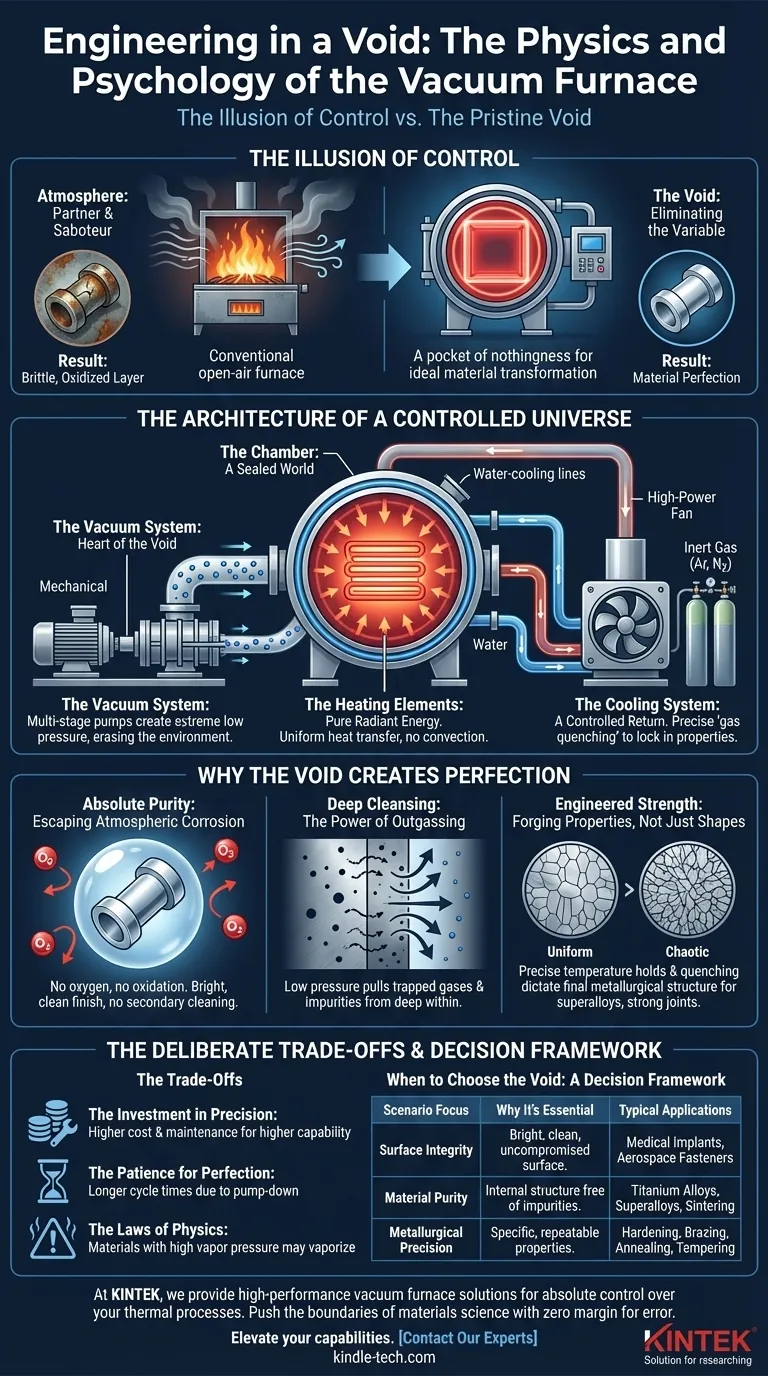
Atmosphere is both a partner and a saboteur. It provides the oxygen for combustion, but that same oxygen attacks a metal's surface at high temperatures, forming a brittle, discolored oxide layer. This is the quiet compromise we make every day—we accept a little bit of corruption for the convenience of heating in the open.
But for a mission-critical jet engine turbine blade or a biocompatible medical implant, there is no room for compromise. A microscopic surface flaw is a potential point of catastrophic failure. To achieve true material perfection, you can't just manage the atmosphere. You must eliminate it.
This is the engineering romance of the vacuum furnace: it’s not just a tool for heating things; it's a machine built to create a pocket of nothingness, a pristine void where materials can be transformed into their ideal state.
The Architecture of a Controlled Universe
A vacuum furnace is a system designed to achieve one profound goal: to create and maintain an environment free from atmospheric influence. Each component is a testament to this pursuit.
The Chamber: A Sealed World
The process begins inside a robust, double-walled steel chamber. It's more than a box; it's a vessel engineered to withstand immense external atmospheric pressure while containing extreme internal heat. Water-cooled walls act as a thermal barrier, separating the fierce interior from the world outside.
The Vacuum System: The Heart of the Void
This is where the magic happens. A multi-stage series of pumps works in sequence. First, rugged mechanical pumps remove the bulk of the air. Then, high-vacuum pumps like diffusion or Roots pumps take over, capturing the remaining stray molecules until the internal pressure is a tiny fraction of the atmosphere outside. This is the deliberate, patient process of erasing the environment.
The Heating Elements: Pure Radiant Energy
Inside this void, heat transfer becomes incredibly pure. With no air to cause convection or contamination, electric heating elements glow, bathing the material in uniform, unobstructed radiant energy. This allows for extraordinarily precise and even heating, eliminating the hot spots that plague conventional furnaces.
The Cooling System: A Controlled Return
After reaching its peak temperature, the material must be cooled at a precise rate to lock in its desired properties. The furnace can be backfilled with a high-purity inert gas like argon or nitrogen, which is then circulated by a high-power fan. This "gas quenching" extracts heat rapidly and uniformly, a process as controlled as the heating that preceded it.
Why the Void Creates Perfection
Removing the atmosphere isn't just about preventing a negative outcome (oxidation). It actively enables positive transformations that are impossible otherwise.
Absolute Purity: Escaping Atmospheric Corrosion
This is the most obvious benefit. In a vacuum, there is no oxygen to react with the metal's surface. The result is a bright, clean finish straight out of the furnace, with no need for secondary cleaning. The material's surface integrity is perfectly preserved.
Deep Cleansing: The Power of Outgassing
The low-pressure environment creates a powerful force. It literally pulls volatile contaminants—trapped gases, oils, and other impurities—from deep within the material itself. This process, known as outgassing, is a form of purification that ensures the final product has exceptional internal quality.
Engineered Strength: Forging Properties, Not Just Shapes
The combination of pristine heating, precise temperature holds (soaking), and controlled gas quenching gives engineers an unparalleled ability to dictate the final metallurgical structure. This is how you create superalloys with specific grain structures for aerospace or achieve perfectly brazed joints stronger than the parent materials.
The Deliberate Trade-Offs
A vacuum furnace represents a choice. It’s a decision to trade convenience for ultimate control, which comes with clear considerations.
- The Investment in Precision: These are complex, high-precision systems. Their initial cost and maintenance are higher than atmospheric furnaces because you are investing in a higher tier of capability.
- The Patience for Perfection: The cycle time is longer. The "pump-down" phase—the time it takes to create the vacuum—is a necessary preamble to the thermal process. It is the price paid for a perfect environment.
- The Laws of Physics: Some materials with high vapor pressures (like zinc or cadmium) can vaporize in a vacuum at high temperatures. The tool must be matched to the material's fundamental properties.
When to Choose the Void: A Decision Framework
The choice becomes clear when the cost of imperfection is too high.
| Scenario Focus | Why a Vacuum Furnace is Essential | Typical Applications |
|---|---|---|
| Surface Integrity | You need a bright, clean, and uncompromised surface without secondary cleaning. | Medical Implants, Aerospace Fasteners, Molds |
| Material Purity | The internal structure must be free of trapped gases and impurities. | Titanium Alloys, Superalloys, Sintering |
| Metallurgical Precision | You need to achieve specific, repeatable material properties through controlled heating and quenching. | Hardening, Brazing, Annealing, Tempering |
This level of control is not a luxury; it is a fundamental requirement for pushing the boundaries of materials science. The challenges of modern engineering demand materials that are not just strong, but perfectly formed, inside and out.
At KINTEK, we understand that your laboratory's success depends on the precision and reliability of your equipment. We provide high-performance vacuum furnace solutions designed to give you absolute control over your thermal processes, helping you eliminate contamination, purify sensitive materials, and achieve repeatable, superior results. For applications where there is no margin for error, a vacuum environment is the only answer.
If your work demands the highest standard of material integrity, let's explore how the right vacuum furnace can elevate your capabilities. Contact Our Experts
Visual Guide
Related Products
- Vacuum Hot Press Furnace Heated Vacuum Press Machine Tube Furnace
- 600T Vacuum Induction Hot Press Furnace for Heat Treat and Sintering
- Vacuum Hot Press Furnace Machine Heated Vacuum Press
- Vacuum Heat Treat Furnace and Levitation Induction Melting Furnace
- 2200 ℃ Tungsten Vacuum Heat Treat and Sintering Furnace
Related Articles
- The Purity Paradox: Choosing the Heart of Your Vacuum Hot Press Furnace
- Comprehensive Guide to Vacuum Hot Press Furnace Application
- Vacuum Hot Press Furnace: A Comprehensive Guide
- Forging Perfection in a Void: The Physics of Ultra-Dense Materials
- Defeating the Void: The Quiet Power of Vacuum Hot Pressing