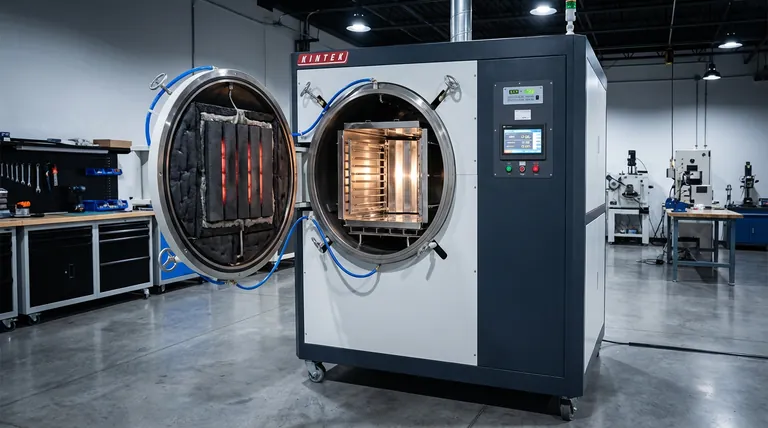
The Crucible and the Void
Imagine a single turbine blade inside a jet engine. It spins thousands of times per minute, enduring temperatures that would melt steel and forces that could tear metal apart. Its survival is not an accident; it's the result of a process perfected in an environment of extreme heat and near-perfect emptiness.
That environment is a vacuum furnace.
At its heart, a vacuum furnace is a simple concept: a superheated chamber with all the air removed. But the elegance of this tool lies in a fundamental, often overlooked, decision: what to build the chamber's core out of. This choice creates a cascade of consequences, dictating what can be made, how pure it will be, and how much it will cost.
It’s a story of two materials: graphite and molybdenum.
The Anatomy of an Invisible Battle
A vacuum furnace isn't a single object but a system of nested zones, each fighting a battle against heat and chemical reactions. The most important zone is the "hot zone"—the insulated inner sanctum where the magic happens.
The materials of the hot zone—its heating elements and insulation—don't just create heat; they define the chemical purity of the entire environment. This leads to two distinct design philosophies.
The Workhorse: The Case for Graphite
Graphite is the default champion of high-temperature processing. It’s strong, incredibly resistant to thermal shock, and relatively inexpensive.
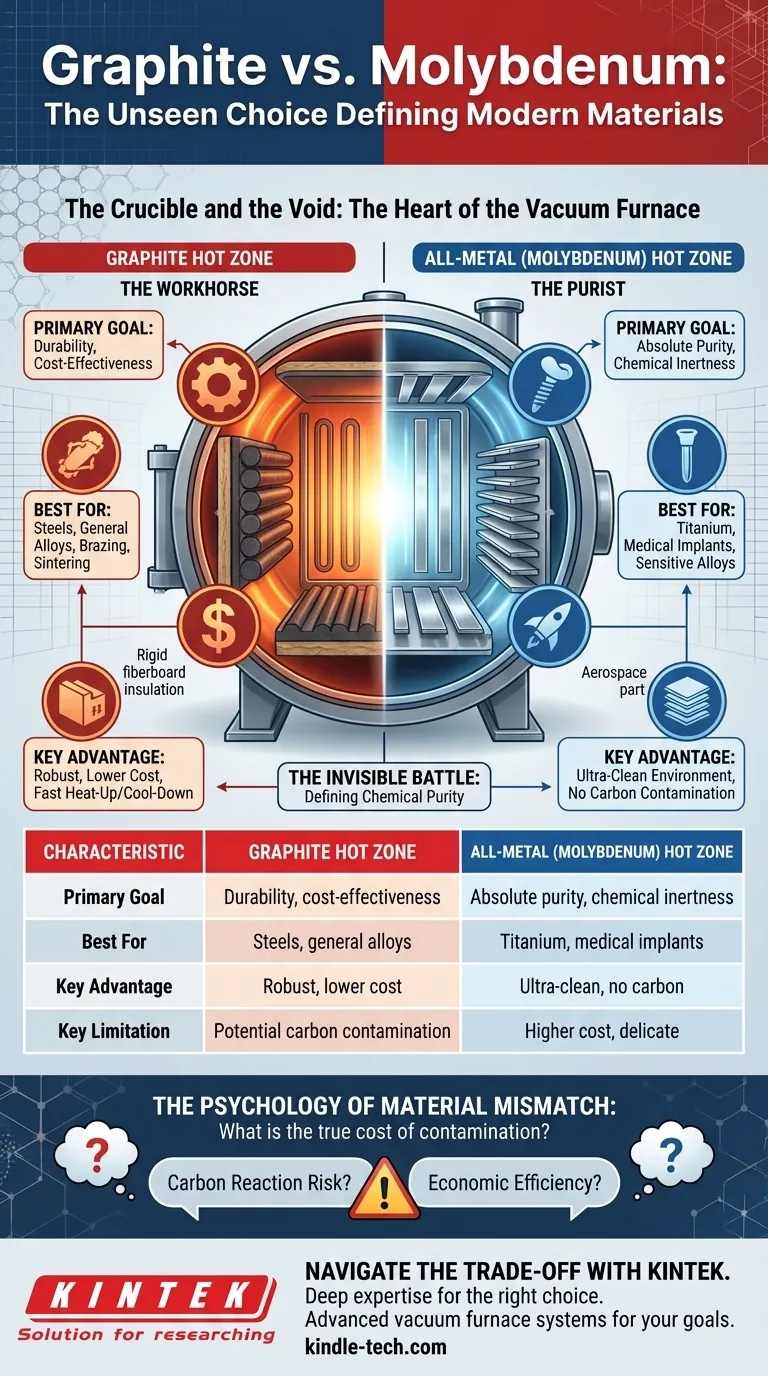
A graphite hot zone uses graphite heating elements and rigid graphite fiberboard or soft felt for insulation. This all-graphite system is a robust, reliable, and cost-effective workhorse. It is the pragmatic foundation for the vast majority of heat-treating processes for steels, alloys, and general-purpose components.
It represents the engineering mindset of prioritizing durability and economy. For most jobs, it is the perfect solution.
The Purist: The Case for All-Metal
But what if "almost perfect" isn't good enough?
For certain applications—medical implants, aerospace-grade titanium, or specific nickel-based superalloys—even the slightest trace of carbon from a graphite furnace is not a minor impurity. It's a potential point of failure.
This is where refractory metals come in. An "all-metal" hot zone, typically built from molybdenum or, for even higher temperatures, tungsten, offers an ultra-clean environment. Molybdenum strips act as heating elements, and layers of the same metal serve as radiation shields.
This approach is more expensive and mechanically delicate. But it is the only choice when absolute chemical purity is non-negotiable. It reflects a mindset obsessed with perfection, because the application demands nothing less.
The Silent Guardian: Containing the Fire
Surrounding the hot zone is a layer of insulation, an unsung hero made of materials like high-purity alumina fiber or hollow aluminum oxide plates.
This layer's job is to contain immense thermal energy, preventing it from escaping to the outer vacuum chamber. Its low heat storage is also what allows for rapid heating and cooling cycles—a crucial factor for efficiency and process control. It works in the background, ensuring the heart of the furnace can do its job effectively.
The Psychology of a Material Mismatch
The choice between graphite and all-metal is not merely technical; it’s a judgment call about risk. The most significant error in vacuum heat treatment is not a process error, but a material mismatch.
Placing a material that reacts with carbon inside a graphite furnace can be catastrophic. Conversely, using an expensive all-metal furnace for a simple steel part is economically inefficient.
The decision hinges on a single question: What is the true cost of contamination?
This is where a deep understanding of metallurgy meets the psychology of risk management. The temptation to use a more robust, cheaper system can be high, but overlooking the need for purity can invalidate an entire production run of high-value parts.
| Characteristic | Graphite Hot Zone | All-Metal (Molybdenum) Hot Zone |
|---|---|---|
| Primary Goal | Durability, cost-effectiveness | Absolute purity, chemical inertness |
| Best For | Steels, general alloys, brazing, sintering | Titanium, medical implants, sensitive alloys |
| Key Advantage | Robust, lower cost, fast heat-up/cool-down | Ultra-clean environment, no carbon contamination |
| Key Limitation | Potential for carbon contamination | Higher cost, more delicate, slower cooling |
Understanding this trade-off is the key to mastering high-temperature material processing. It’s about choosing the right tool not just for the job, but for the underlying philosophy of the final product. Is it built to be a durable workhorse or a flawless purist?
Navigating these material trade-offs requires more than a datasheet; it requires deep expertise. The materials that make the furnace are just as critical as the materials you put inside it. At KINTEK, we provide both the advanced vacuum furnace systems and the specialized knowledge to ensure your choice is the right one.
Whether you need a cost-effective graphite system for general laboratory use or an ultra-clean all-metal furnace for sensitive R&D, we can help you align your equipment with your goals. Contact Our Experts
Visual Guide
Related Products
- Vacuum Hot Press Furnace Heated Vacuum Press Machine Tube Furnace
- 600T Vacuum Induction Hot Press Furnace for Heat Treat and Sintering
- Vacuum Hot Press Furnace Machine Heated Vacuum Press
- Vacuum Heat Treat Furnace and Levitation Induction Melting Furnace
- 2200 ℃ Tungsten Vacuum Heat Treat and Sintering Furnace
Related Articles
- The Purity Paradox: Choosing the Heart of Your Vacuum Hot Press Furnace
- Comprehensive Guide to Vacuum Hot Press Furnace Application
- Vacuum Hot Press Furnace: A Comprehensive Guide
- Forging Perfection in a Void: The Physics of Ultra-Dense Materials
- Defeating the Void: The Quiet Power of Vacuum Hot Pressing



















