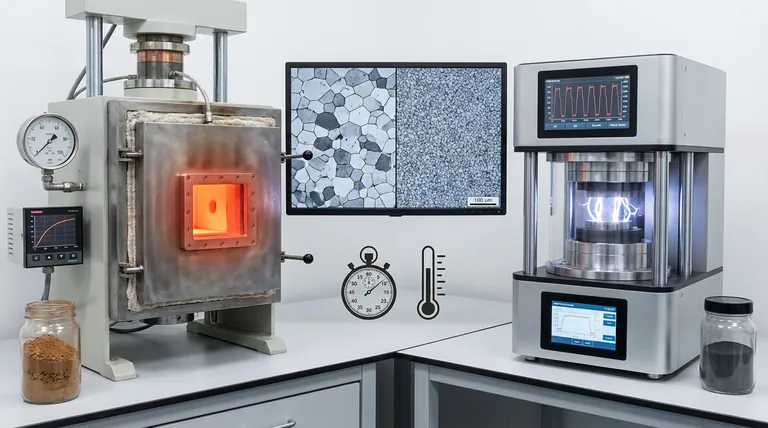
The Material Scientist's Paradox
Imagine a researcher aiming to forge a new ceramic alloy. The goal is a material with unprecedented strength, a property that hinges on keeping its internal crystalline grains infinitesimally small—at the nano-scale.
The challenge is a fundamental paradox. To fuse the ceramic powder into a solid block, you need immense heat. Yet, that very heat is the enemy of fine grains. Given enough time at high temperatures, small grains are cannibalized by larger ones, and the material's unique properties are lost forever.
This is the tyranny of time and temperature in materials science. The solution lies not just in applying heat and pressure, but in how you apply them. This is the core difference between two powerful techniques: conventional Hot Pressing (HP) and Spark Plasma Sintering (SPS).
The Soul of the Machine: Two Philosophies of Heat
At first glance, HP and SPS seem similar. Both use a die, pressure, and heat to consolidate powders. But they operate on fundamentally different philosophies of heat delivery, a difference that dictates everything that follows.
The Conventional Hot Press: A Patient Siege
A hot press works like a sophisticated kiln. The entire die assembly, containing the powder, is placed inside a furnace.
Heating elements surrounding the assembly slowly raise the temperature of the chamber. Heat methodically soaks in from the outside—through the furnace walls, into the die, and finally, into the powder.
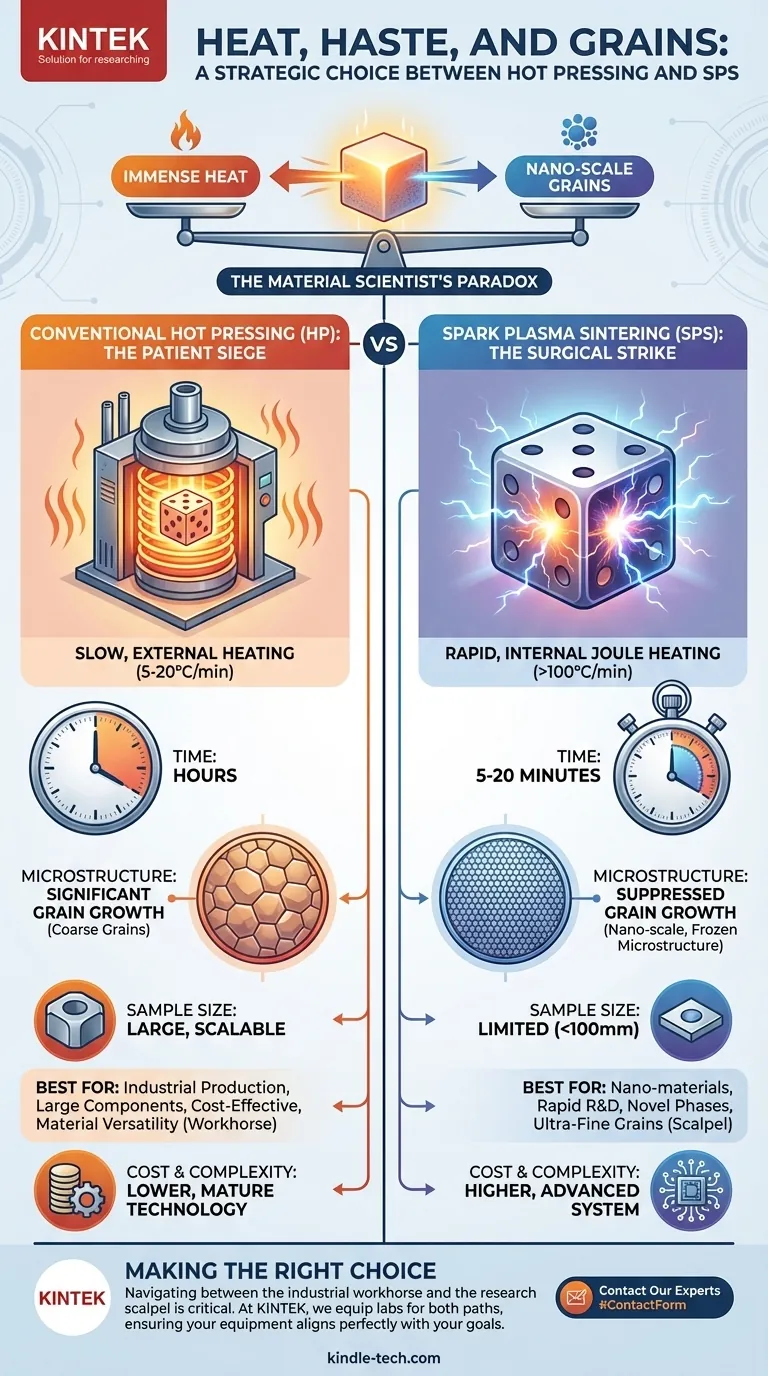
This process is a slow, steady siege. It is reliable, stable, and highly scalable. But its defining characteristic is its patience, with heating rates of just 5-20°C per minute.
Spark Plasma Sintering: A Surgical Strike
Spark Plasma Sintering (SPS), also known as Field-Assisted Sintering Technology (FAST), is entirely different. It doesn't heat the sample from the outside. It turns the tooling—and often the sample itself—into the heater.
A massive, pulsed DC current is passed directly through the conductive graphite die. This generates intense and immediate Joule heating from within. The energy is delivered precisely where it's needed most: at the contact points between powder particles.
The result is a surgical strike of thermal energy, with heating rates that can exceed hundreds of degrees Celsius per minute. This is not a slow siege; it's a lightning raid.
The Consequences of Speed
This difference in approach—a patient siege versus a surgical strike—has profound consequences for the material.
Time: The Ultimate Currency
A typical hot press cycle can take several hours from start to finish.
An SPS cycle is finished in 5 to 20 minutes.
This isn't just an efficiency gain. It's a paradigm shift. For researchers, it means the ability to run multiple experiments in a single day, dramatically accelerating the pace of discovery.
Temperature: Precision Over Power
Because SPS delivers heat internally and efficiently, it often achieves full densification at a lower overall temperature than a hot press. The energy isn't wasted heating a large furnace chamber; it's focused on the sintering action itself.
Microstructure: Winning the Race Against Grain Growth
This is the most critical advantage of speed. The long, high-temperature soak during hot pressing leads to inevitable and significant grain growth.
The extreme velocity of the SPS cycle gives grains almost no time to grow. By minimizing the material's exposure to high temperatures, SPS effectively "freezes" the fine, nano-scale microstructure in place. It allows scientists to outrun the thermodynamic drive for grain coarsening, creating materials that are simply not possible with slower methods.
A Question of Strategy, Not Superiority
SPS is not a universal replacement for hot pressing. The choice between them is a strategic one that reveals your primary objective. It's a classic trade-off between a proven workhorse and a high-performance specialist tool.
| Parameter | Hot Pressing (HP) | Spark Plasma Sintering (SPS) |
|---|---|---|
| Heating Method | Slow, external furnace heating | Rapid, internal Joule heating via pulsed DC current |
| Sintering Time | Several hours | 5 to 20 minutes |
| Grain Growth | Significant | Suppressed, preserving nano-structures |
| Sample Size | Highly scalable, ideal for large components | Limited to smaller, simple geometries (<100mm) |
| Cost & Complexity | Lower cost, mature, robust technology | Higher cost, more complex system |
| Best For | Large parts, cost-effective production, material versatility | Nano-materials, ultra-fine grains, rapid R&D, novel phases |
When to Choose the Workhorse (HP)
If your goal is to produce large, reliable components or to work with a wide variety of materials (including insulators) in a cost-effective, established process, hot pressing is the pragmatic and powerful choice. It is the backbone of industrial powder metallurgy.
When to Choose the Scalpel (SPS)
If your goal is discovery—preserving nano-scale features, creating novel materials with ultra-fine grains, or exploring non-equilibrium phases—SPS is the superior instrument. It prioritizes microstructural fidelity and speed above all else.
Making the Right Choice
Ultimately, the decision between these technologies is a decision about your priorities. Are you optimizing for scale and cost, or for microstructural perfection and speed?
Navigating this choice between the industrial workhorse and the research scalpel is critical. At KINTEK, we specialize in equipping labs for both paths, ensuring your equipment aligns perfectly with your goals. For expert guidance on selecting the right sintering technology for your specific application, Contact Our Experts.
Visual Guide
Related Products
- Warm Isostatic Press for Solid State Battery Research
- Automatic High Temperature Heated Hydraulic Press Machine with Heated Plates for Lab
- Heated Hydraulic Press Machine with Heated Plates Split Manual Laboratory Hot Press
- Manual Heated Hydraulic Press Machine with Heated Plates for Laboratory Hot Press
- Heated Hydraulic Press Machine with Heated Plates for Vacuum Box Laboratory Hot Press
Related Articles
- WIP – Warm Isostatic Press Equipment: Design, Features, and Benefits
- Beyond the Spec Sheet: Mastering the Thermal Dynamics of Warm Isostatic Pressing
- Warm Isostatic Pressing An Overview of the Process and Equipment
- Warm Isostatic Pressing: An Advanced Manufacturing Technology
- Choosing the Right Warm Isostatic Press: Key Factors to Consider