Blog Heat, Purity, and Control: The Invisible Engineering Inside a Vacuum Furnace
Heat, Purity, and Control: The Invisible Engineering Inside a Vacuum Furnace

Heat, Purity, and Control: The Invisible Engineering Inside a Vacuum Furnace

3 hours ago

The Paradox of Extreme Heat in a Cold Vacuum

Imagine the task: strengthening a critical aerospace turbine blade or annealing a medical implant. The goal is absolute structural integrity and purity. The enemy is the very air we breathe; at the required temperatures, oxygen would aggressively attack and ruin the material.

The solution is a paradox of engineering: create blistering heat inside a perfect void.

A vacuum furnace doesn't burn fuel. It operates on a principle of controlled violence. It's a sealed chamber where electrical energy is transformed into radiant heat, all within an environment meticulously stripped of air. It’s less like an oven and more like a contained, miniature sun.

The Principle: Controlled Electrical Resistance

The system is fundamentally a powerful, precision-controlled electric heater. The physics is elegant and direct.

From Current to Glow: Joule's Law at Work

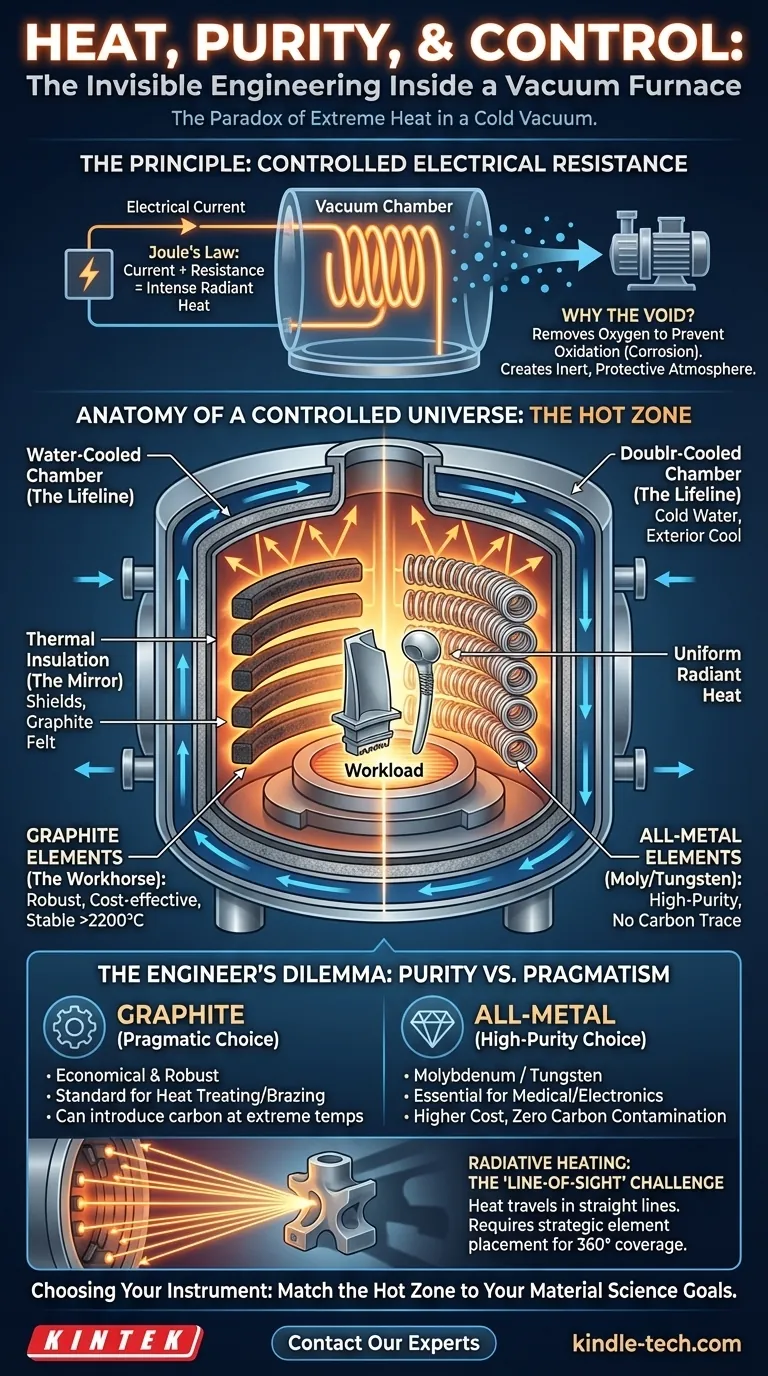
When a high electrical current is passed through a material, it encounters resistance. This opposition forces the electrical energy to convert into thermal energy, a phenomenon known as Joule heating. The material glows, radiating intense heat.

Vacuum furnace designers have perfected this by using specialized heating elements that can withstand extreme temperatures without failing.

Why the Void is Non-Negotiable

Heating advanced alloys in the open air is like trying to write on paper with a lit match. Oxidation—a form of rapid corrosion—occurs almost instantly, compromising the material's surface and properties.

By removing the air, the vacuum creates an inert atmosphere. It’s a protective shield that prevents these unwanted chemical reactions, ensuring the final product is as pure as its raw components. This isn't just a feature; it's the entire point.

Anatomy of a Controlled Universe: The Hot Zone

The "hot zone" is the heart of the furnace. It is an isolated system designed to generate, contain, and uniformly distribute heat.

The Emitters: Heating Elements

These are the components that glow and radiate heat. The choice of material is a critical engineering decision, dictated by the required temperature and chemical purity of the process.

  • Graphite: The versatile workhorse. Cost-effective and stable to over 2200°C, it's the standard for most heat treating and brazing.
  • Molybdenum (Moly) / Tungsten: The purists. These metals are used in "all-metal" hot zones for high-purity applications, like medical or electronics manufacturing, where even trace carbon from graphite is unacceptable.

The Mirror: Thermal Insulation

The immense energy generated by the elements must be focused inward. This is the job of the insulation package. It can be layers of graphite felt or reflective metallic shields.

These shields act like mirrors for infrared radiation, bouncing the thermal energy back toward the workload. This not only improves energy efficiency but is crucial for maintaining precise temperature control.

The Lifeline: The Water-Cooled Chamber

The entire hot zone is housed within a double-walled steel vessel. Cold water constantly circulates between these walls, keeping the exterior of the furnace cool to the touch.

This is the furnace's self-preservation system. A loss of cooling water during operation is a catastrophic failure. Safety interlocks and backup systems are not optional; they are the guardians of the machine's integrity.

The Engineer's Dilemma: Purity vs. Pragmatism

The design of a hot zone is a story of deliberate trade-offs, balancing performance, cost, and the specific demands of the material being processed.

The Carbon Question: Graphite vs. All-Metal

A graphite hot zone is the pragmatic choice for a huge range of applications. It's robust and economical.

However, for applications demanding the highest purity, the choice is clear. At extreme temperatures, graphite can sublimate, potentially introducing carbon atoms into the process. To forge a flawless medical implant, an all-metal hot zone using molybdenum elements is the necessary, albeit more expensive, investment. Understanding this distinction is key to matching the tool to the task.

At KINTEK, we provide laboratory furnaces with both robust graphite and high-purity all-metal hot zones, ensuring your equipment precisely matches your material science goals.

The Tyranny of Line-of-Sight: Radiative Heating

In a vacuum, there is no air to circulate heat through convection. Heat transfer is dominated by thermal radiation, which travels in straight lines.

This "tyranny of line-of-sight" means that any part of the workload that cannot "see" a heating element will be colder. This is why furnace design is a geometric puzzle, with elements strategically placed to provide 360-degree coverage, ensuring every surface reaches the target temperature uniformly.

Choosing Your Instrument

Understanding how a vacuum furnace generates heat transforms it from a black box into a precision instrument. The choice between graphite and all-metal, or the configuration of heating elements, is not arbitrary. It is a direct response to the needs of your materials.

Whether your work involves general-purpose annealing or developing next-generation, high-purity alloys, the principles of resistance, radiation, and containment are universal. Getting them right is the foundation of modern materials engineering.

If you need to achieve precise, contamination-free thermal processing in your lab, let's ensure you have the right instrument for the job. Contact Our Experts

Visual Guide
Heat, Purity, and Control: The Invisible Engineering Inside a Vacuum Furnace Visual Guide

Related Products

Related Articles

Related Products

Vacuum Hot Press Furnace Heated Vacuum Press Machine Tube Furnace

Vacuum Hot Press Furnace Heated Vacuum Press Machine Tube Furnace

Reduce forming pressure & shorten sintering time with Vacuum Tube Hot Press Furnace for high-density, fine-grain materials. Ideal for refractory metals.

600T Vacuum Induction Hot Press Furnace for Heat Treat and Sintering

600T Vacuum Induction Hot Press Furnace for Heat Treat and Sintering

Discover the 600T Vacuum Induction Hot Press Furnace, designed for high-temperature sintering experiments in vacuum or protected atmospheres. Its precise temperature and pressure control, adjustable working pressure, and advanced safety features make it ideal for nonmetal materials, carbon composites, ceramics, and metal powders.

Vacuum Hot Press Furnace Machine Heated Vacuum Press

Vacuum Hot Press Furnace Machine Heated Vacuum Press

Discover the advantages of Vacuum Hot Press Furnace! Manufacture dense refractory metals & compounds, ceramics, and composites under high temp and pressure.

Vacuum Heat Treat Furnace and Levitation Induction Melting Furnace

Vacuum Heat Treat Furnace and Levitation Induction Melting Furnace

Experience precise melting with our Vacuum Levitation Melting Furnace. Ideal for high melting point metals or alloys, with advanced technology for effective smelting. Order now for high-quality results.

2200 ℃ Tungsten Vacuum Heat Treat and Sintering Furnace

2200 ℃ Tungsten Vacuum Heat Treat and Sintering Furnace

Experience the ultimate refractory metal furnace with our Tungsten vacuum furnace. Capable of reaching 2200℃, perfect for sintering advanced ceramics and refractory metals. Order now for high-quality results.

Vacuum Heat Treat and Pressure Sintering Furnace for High Temperature Applications

Vacuum Heat Treat and Pressure Sintering Furnace for High Temperature Applications

Vacuum pressure sintering furnaces are designed for high temperature hot pressing applications in metal and ceramic sintering. Its advanced features ensure precise temperature control, reliable pressure maintenance, and a robust design for seamless operation.

Molybdenum Vacuum Heat Treat Furnace

Molybdenum Vacuum Heat Treat Furnace

Discover the benefits of a high-configuration molybdenum vacuum furnace with heat shield insulation. Ideal for high-purity, vacuum environments like sapphire crystal growth and heat treatment.

Graphite Vacuum Furnace IGBT Experimental Graphitization Furnace

Graphite Vacuum Furnace IGBT Experimental Graphitization Furnace

IGBT experimental graphitization furnace, a tailored solution for universities and research institutions, with high heating efficiency, user-friendliness, and precise temperature control.

Vacuum Sealed Continuous Working Rotary Tube Furnace Rotating Tube Furnace

Vacuum Sealed Continuous Working Rotary Tube Furnace Rotating Tube Furnace

Experience efficient material processing with our vacuum-sealed rotary tube furnace. Perfect for experiments or industrial production, equipped with optional features for controlled feeding and optimized results. Order now.

2200 ℃ Graphite Vacuum Heat Treat Furnace

2200 ℃ Graphite Vacuum Heat Treat Furnace

Discover the power of the KT-VG Graphite Vacuum Furnace - with a maximum working temperature of 2200℃, it's perfect for vacuum sintering of various materials. Learn more now.

Lab-Scale Vacuum Induction Melting Furnace

Lab-Scale Vacuum Induction Melting Furnace

Get precise alloy composition with our Vacuum Induction Melting Furnace. Ideal for aerospace, nuclear energy, and electronic industries. Order now for effective smelting and casting of metals and alloys.

Vacuum Heat Treat Sintering Brazing Furnace

Vacuum Heat Treat Sintering Brazing Furnace

A vacuum brazing furnace is a type of industrial furnace used for brazing, a metalworking process that joins two pieces of metal using a filler metal that melts at a lower temperature than the base metals. Vacuum brazing furnaces are typically used for high-quality applications where a strong, clean joint is required.

Ultra-High Temperature Graphite Vacuum Graphitization Furnace

Ultra-High Temperature Graphite Vacuum Graphitization Furnace

The ultra-high temperature graphitization furnace utilizes medium frequency induction heating in a vacuum or inert gas environment. The induction coil generates an alternating magnetic field, inducing eddy currents in the graphite crucible, which heats up and radiates heat to the workpiece, bringing it to the desired temperature. This furnace is primarily used for graphitization and sintering of carbon materials, carbon fiber materials, and other composite materials.

Small Vacuum Heat Treat and Tungsten Wire Sintering Furnace

Small Vacuum Heat Treat and Tungsten Wire Sintering Furnace

The small vacuum tungsten wire sintering furnace is a compact experimental vacuum furnace specially designed for universities and scientific research institutes. The furnace features a CNC welded shell and vacuum piping to ensure leak-free operation. Quick-connect electrical connections facilitate relocation and debugging, and the standard electrical control cabinet is safe and convenient to operate.

Vacuum Heat Treat Furnace with Ceramic Fiber Liner

Vacuum Heat Treat Furnace with Ceramic Fiber Liner

Vacuum furnace with polycrystalline ceramic fiber insulation liner for excellent heat insulation and uniform temperature field. Choose from 1200℃ or 1700℃ max. working temperature with high vacuum performance and precise temperature control.

Vacuum Heat Treat and Molybdenum Wire Sintering Furnace for Vacuum Sintering

Vacuum Heat Treat and Molybdenum Wire Sintering Furnace for Vacuum Sintering

A vacuum molybdenum wire sintering furnace is a vertical or bedroom structure, which is suitable for withdrawal, brazing, sintering and degassing of metal materials under high vacuum and high temperature conditions. It is also suitable for dehydroxylation treatment of quartz materials.

Vacuum Arc Induction Melting Furnace

Vacuum Arc Induction Melting Furnace

Discover the power of Vacuum Arc Furnace for melting active & refractory metals. High-speed, remarkable degassing effect, and free of contamination. Learn more now!

Horizontal High Temperature Graphite Vacuum Graphitization Furnace

Horizontal High Temperature Graphite Vacuum Graphitization Furnace

Horizontal Graphitization Furnace: This type of furnace is designed with the heating elements placed horizontally, allowing for uniform heating of the sample. It's well-suited for graphitizing large or bulky samples that require precise temperature control and uniformity.

Non Consumable Vacuum Arc Induction Melting Furnace

Non Consumable Vacuum Arc Induction Melting Furnace

Explore the benefits of Non-Consumable Vacuum Arc Furnace with high melting point electrodes. Small, easy to operate & eco-friendly. Ideal for laboratory research on refractory metals & carbides.

Vacuum Dental Porcelain Sintering Furnace

Vacuum Dental Porcelain Sintering Furnace

Get precise and reliable results with KinTek's Vacuum Porcelain Furnace. Suitable for all porcelain powders, it features hyperbolic ceramic furnace function, voice prompt, and automatic temperature calibration.


Leave Your Message