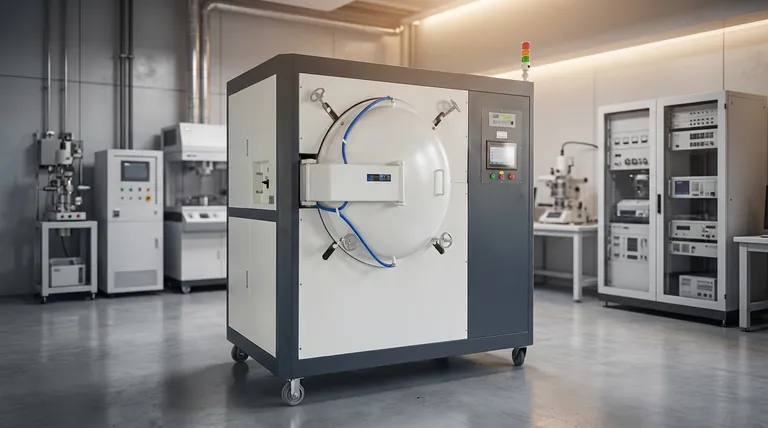
Blog Mastering the Void: How Vacuum Furnaces Forge Perfect Materials
Mastering the Void: How Vacuum Furnaces Forge Perfect Materials

Mastering the Void: How Vacuum Furnaces Forge Perfect Materials

2 hours ago

The Illusion of Control

Imagine designing a critical component for a jet engine. You've perfected the alloy composition, simulated the thermal stresses, and machined it to micron-level precision. Every variable is controlled.

Except for one we rarely think about: the air itself.

At the high temperatures required for heat treatment, the seemingly benign atmosphere becomes a reactive chemical agent. The oxygen, nitrogen, and water vapor we breathe are the invisible enemies of material purity. This is a common psychological blind spot—we focus on what we add (heat) and forget what is already there.

The purpose of a vacuum furnace is not to heat material. It is to heat material in a chemically perfect void, solving the problem of an atmosphere that refuses to be inert.

The Chemistry of an Empty Room

At high temperatures, metal atoms are energized and highly reactive. They are desperately looking for something to bond with. A conventional atmospheric furnace provides a rich cocktail of options, leading to undesirable chemical changes.

A vacuum furnace works by subtraction. By removing the atmosphere, it removes the reactants.

The Fight Against Oxidation

Oxidation is the most common adversary. At high temperatures, metals eagerly react with oxygen to form a brittle, flaky oxide layer. This is more than a surface blemish; it’s a form of high-speed corrosion that can compromise the material's strength, fatigue life, and ability to bond with other parts.

By pumping the chamber down to a near-perfect vacuum, the furnace ensures parts emerge bright and clean, exactly as they were intended to be.

The Ghost in the Machine: Degassing

Many metals contain dissolved gases like hydrogen, trapped during their initial production. When heated, these gases expand, creating microscopic voids and porosity within the material's structure. These are ghosts in the machine—hidden defects that can lead to catastrophic failure under stress.

The vacuum actively pulls these trapped gases out of the material. This process, known as degassing, is essential for components in electronics or high-vacuum systems, where even minuscule outgassing would contaminate the operating environment.

Where the Void Creates Value

The ability to control the environment at a chemical level makes vacuum furnaces indispensable in industries where "good enough" is not an option.

Forging Unbreakable Bonds: Brazing

Brazing joins two components with a filler metal. Attempting this in the presence of air is like trying to glue two dusty surfaces together. The oxide layers on the parent metals prevent the filler from wetting the surface properly, resulting in weak, incomplete joints.

Vacuum brazing occurs in a perfectly clean environment. The filler metal flows freely into the joint, creating a bond that is often as strong as the parent materials themselves. It's the standard for mission-critical assemblies in aerospace, medical, and defense.

Building from Dust: Sintering

Sintering creates a solid, dense part by heating compressed powdered materials—like ceramics or metals—until their particles fuse.

Performing this in a vacuum prevents unwanted chemical compounds from forming between particles. The result is a stronger, purer, and denser final product, crucial for high-performance ceramics and specialized metal components.

The Purity Standard: Annealing Reactive Metals

Materials like titanium and superalloys, the cornerstones of the aerospace industry, are extremely reactive at high temperatures. Annealing (softening) them in a conventional furnace would destroy their surface integrity.

A vacuum furnace is the only way to process these materials without compromising their unique properties.

The Psychology of a Process Choice

Choosing a vacuum furnace is not just a technical decision; it's a commitment to an invisible standard of quality. It comes with trade-offs that must be understood.

  • Higher Initial Cost: Vacuum pumps, robust chambers, and complex control systems make these furnaces a significant investment.
  • Slower Cycle Times: Pumping down the chamber to a vacuum and carefully backfilling it adds time to every cycle.
  • Maintenance Complexity: High-vacuum systems require specialized knowledge to maintain and troubleshoot.

This isn't a choice between fast and slow, or cheap and expensive. It's a choice based on the absolute requirements of the application. You are not just buying a furnace; you are buying certainty.

When Your Goal Is... The Atmospheric Path The Vacuum Path
High Throughput, Low Risk Practical for non-reactive materials where surface finish is less critical. Slower and more costly, but eliminates the risk of contamination.
Material Integrity Risks surface oxidation and internal gas porosity, creating hidden flaws. Guarantees material purity and structural soundness from the inside out.
Joining Critical Parts Can produce weak, unreliable brazed joints with voids and inclusions. Creates exceptionally strong, clean, and metallurgical-perfect bonds.

A Commitment to Perfection

Ultimately, the value of a vacuum furnace lies in what it removes. It creates a state of engineered nothingness to allow for the creation of perfect materials. For laboratory settings where research and production demand absolute control over every variable, this capability is not a luxury—it's fundamental.

At KINTEK, we provide the high-performance vacuum furnaces that enable researchers and engineers to master these critical processes. When your work demands a material quality that is simply not possible in our atmosphere, having the right equipment is paramount. To explore how the right vacuum environment can elevate your results, Contact Our Experts.

Visual Guide
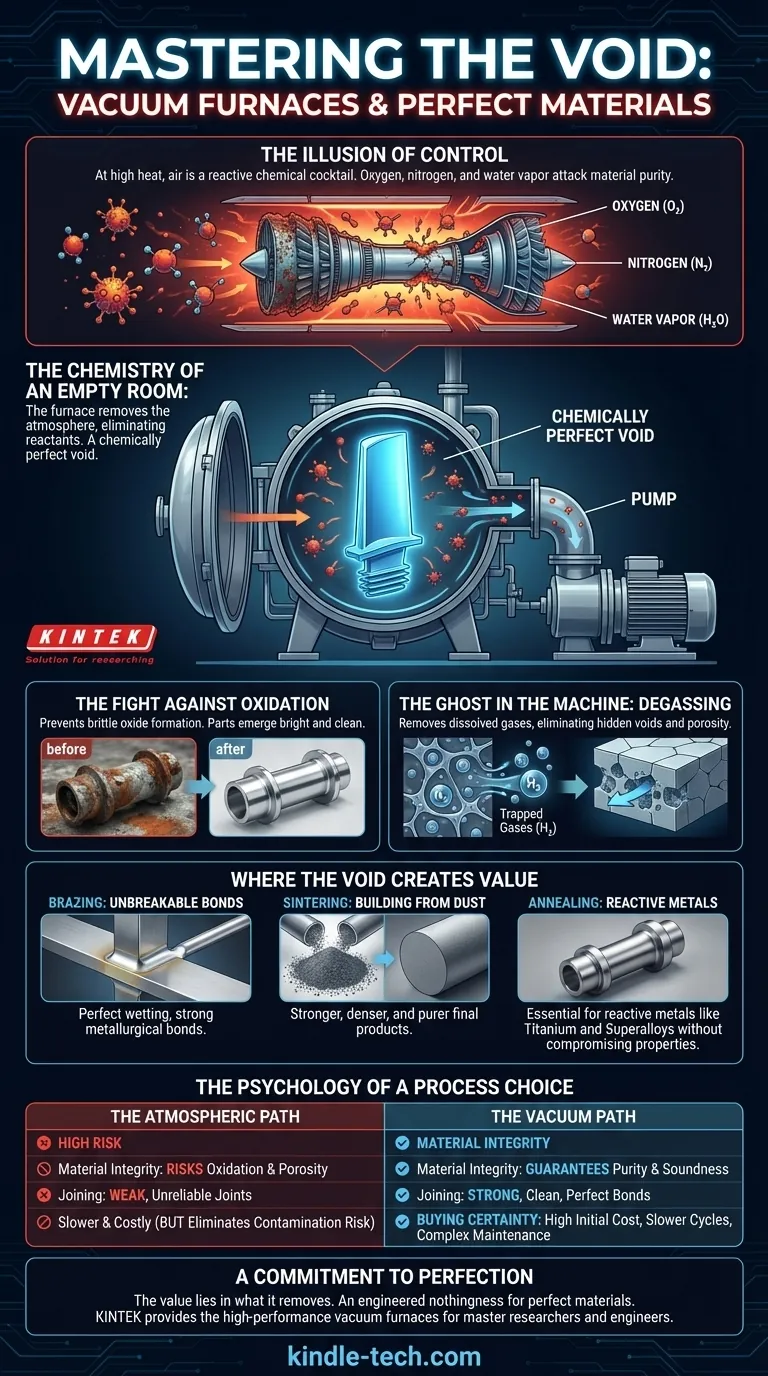
Mastering the Void: How Vacuum Furnaces Forge Perfect Materials Visual Guide

Related Products

Related Articles

Related Products

Vacuum Hot Press Furnace Heated Vacuum Press Machine Tube Furnace

Vacuum Hot Press Furnace Heated Vacuum Press Machine Tube Furnace

Reduce forming pressure & shorten sintering time with Vacuum Tube Hot Press Furnace for high-density, fine-grain materials. Ideal for refractory metals.

600T Vacuum Induction Hot Press Furnace for Heat Treat and Sintering

600T Vacuum Induction Hot Press Furnace for Heat Treat and Sintering

Discover the 600T Vacuum Induction Hot Press Furnace, designed for high-temperature sintering experiments in vacuum or protected atmospheres. Its precise temperature and pressure control, adjustable working pressure, and advanced safety features make it ideal for nonmetal materials, carbon composites, ceramics, and metal powders.

Vacuum Hot Press Furnace Machine Heated Vacuum Press

Vacuum Hot Press Furnace Machine Heated Vacuum Press

Discover the advantages of Vacuum Hot Press Furnace! Manufacture dense refractory metals & compounds, ceramics, and composites under high temp and pressure.

Vacuum Heat Treat Furnace and Levitation Induction Melting Furnace

Vacuum Heat Treat Furnace and Levitation Induction Melting Furnace

Experience precise melting with our Vacuum Levitation Melting Furnace. Ideal for high melting point metals or alloys, with advanced technology for effective smelting. Order now for high-quality results.

2200 ℃ Tungsten Vacuum Heat Treat and Sintering Furnace

2200 ℃ Tungsten Vacuum Heat Treat and Sintering Furnace

Experience the ultimate refractory metal furnace with our Tungsten vacuum furnace. Capable of reaching 2200℃, perfect for sintering advanced ceramics and refractory metals. Order now for high-quality results.

Molybdenum Vacuum Heat Treat Furnace

Molybdenum Vacuum Heat Treat Furnace

Discover the benefits of a high-configuration molybdenum vacuum furnace with heat shield insulation. Ideal for high-purity, vacuum environments like sapphire crystal growth and heat treatment.

Vacuum Heat Treat and Pressure Sintering Furnace for High Temperature Applications

Vacuum Heat Treat and Pressure Sintering Furnace for High Temperature Applications

Vacuum pressure sintering furnaces are designed for high temperature hot pressing applications in metal and ceramic sintering. Its advanced features ensure precise temperature control, reliable pressure maintenance, and a robust design for seamless operation.

Graphite Vacuum Furnace IGBT Experimental Graphitization Furnace

Graphite Vacuum Furnace IGBT Experimental Graphitization Furnace

IGBT experimental graphitization furnace, a tailored solution for universities and research institutions, with high heating efficiency, user-friendliness, and precise temperature control.

Vacuum Sealed Continuous Working Rotary Tube Furnace Rotating Tube Furnace

Vacuum Sealed Continuous Working Rotary Tube Furnace Rotating Tube Furnace

Experience efficient material processing with our vacuum-sealed rotary tube furnace. Perfect for experiments or industrial production, equipped with optional features for controlled feeding and optimized results. Order now.

2200 ℃ Graphite Vacuum Heat Treat Furnace

2200 ℃ Graphite Vacuum Heat Treat Furnace

Discover the power of the KT-VG Graphite Vacuum Furnace - with a maximum working temperature of 2200℃, it's perfect for vacuum sintering of various materials. Learn more now.

Lab-Scale Vacuum Induction Melting Furnace

Lab-Scale Vacuum Induction Melting Furnace

Get precise alloy composition with our Vacuum Induction Melting Furnace. Ideal for aerospace, nuclear energy, and electronic industries. Order now for effective smelting and casting of metals and alloys.

Vacuum Heat Treat Sintering Brazing Furnace

Vacuum Heat Treat Sintering Brazing Furnace

A vacuum brazing furnace is a type of industrial furnace used for brazing, a metalworking process that joins two pieces of metal using a filler metal that melts at a lower temperature than the base metals. Vacuum brazing furnaces are typically used for high-quality applications where a strong, clean joint is required.

Ultra-High Temperature Graphite Vacuum Graphitization Furnace

Ultra-High Temperature Graphite Vacuum Graphitization Furnace

The ultra-high temperature graphitization furnace utilizes medium frequency induction heating in a vacuum or inert gas environment. The induction coil generates an alternating magnetic field, inducing eddy currents in the graphite crucible, which heats up and radiates heat to the workpiece, bringing it to the desired temperature. This furnace is primarily used for graphitization and sintering of carbon materials, carbon fiber materials, and other composite materials.

Small Vacuum Heat Treat and Tungsten Wire Sintering Furnace

Small Vacuum Heat Treat and Tungsten Wire Sintering Furnace

The small vacuum tungsten wire sintering furnace is a compact experimental vacuum furnace specially designed for universities and scientific research institutes. The furnace features a CNC welded shell and vacuum piping to ensure leak-free operation. Quick-connect electrical connections facilitate relocation and debugging, and the standard electrical control cabinet is safe and convenient to operate.

Vacuum Heat Treat Furnace with Ceramic Fiber Liner

Vacuum Heat Treat Furnace with Ceramic Fiber Liner

Vacuum furnace with polycrystalline ceramic fiber insulation liner for excellent heat insulation and uniform temperature field. Choose from 1200℃ or 1700℃ max. working temperature with high vacuum performance and precise temperature control.

Vacuum Heat Treat and Molybdenum Wire Sintering Furnace for Vacuum Sintering

Vacuum Heat Treat and Molybdenum Wire Sintering Furnace for Vacuum Sintering

A vacuum molybdenum wire sintering furnace is a vertical or bedroom structure, which is suitable for withdrawal, brazing, sintering and degassing of metal materials under high vacuum and high temperature conditions. It is also suitable for dehydroxylation treatment of quartz materials.

Vacuum Arc Induction Melting Furnace

Vacuum Arc Induction Melting Furnace

Discover the power of Vacuum Arc Furnace for melting active & refractory metals. High-speed, remarkable degassing effect, and free of contamination. Learn more now!

Horizontal High Temperature Graphite Vacuum Graphitization Furnace

Horizontal High Temperature Graphite Vacuum Graphitization Furnace

Horizontal Graphitization Furnace: This type of furnace is designed with the heating elements placed horizontally, allowing for uniform heating of the sample. It's well-suited for graphitizing large or bulky samples that require precise temperature control and uniformity.

Non Consumable Vacuum Arc Induction Melting Furnace

Non Consumable Vacuum Arc Induction Melting Furnace

Explore the benefits of Non-Consumable Vacuum Arc Furnace with high melting point electrodes. Small, easy to operate & eco-friendly. Ideal for laboratory research on refractory metals & carbides.

Vacuum Dental Porcelain Sintering Furnace

Vacuum Dental Porcelain Sintering Furnace

Get precise and reliable results with KinTek's Vacuum Porcelain Furnace. Suitable for all porcelain powders, it features hyperbolic ceramic furnace function, voice prompt, and automatic temperature calibration.


Leave Your Message



















