The Invisible Enemy in Every Workshop
Imagine a mission-critical turbine blade, engineered to perfection. It spins thousands of times per minute at blistering temperatures. Its greatest weakness, however, might be invisible—a microscopic, brittle layer of oxide forged into its surface during heat treatment.
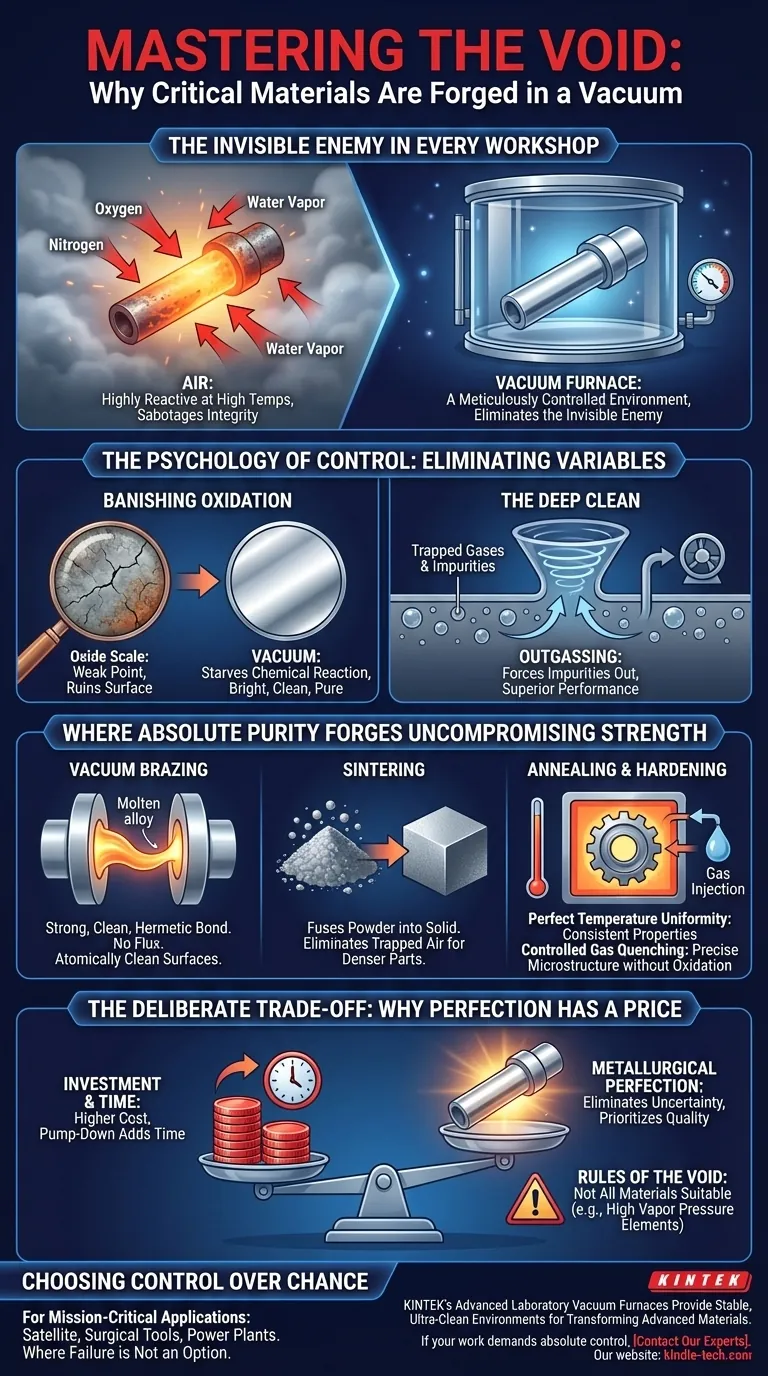
This is the fundamental challenge of metallurgy. At high temperatures, the air we breathe becomes a highly reactive agent. Oxygen, nitrogen, and water vapor—normally harmless—aggressively attack hot metals, silently sabotaging their integrity.
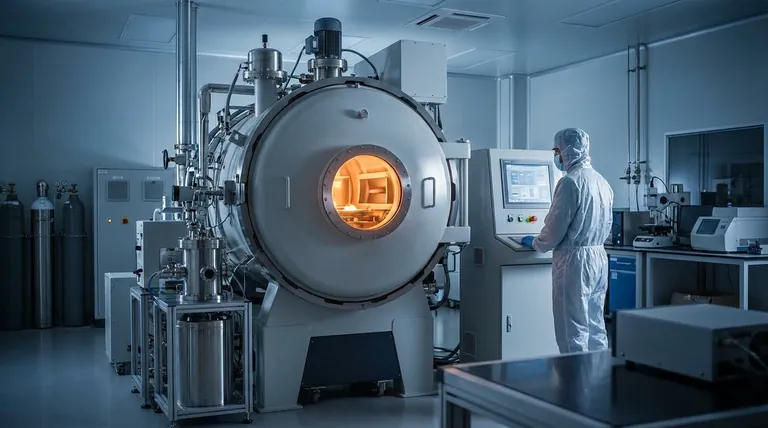
A vacuum furnace is the definitive answer to this problem. It's more than just a box that gets hot; it's a meticulously controlled environment created by systematically removing the invisible enemy. It’s a decision to impose absolute order on a chaotic chemical process.
The Psychology of Control: Eliminating Variables
The choice to use a vacuum furnace is often a psychological one, driven by an engineer's deep-seated need to eliminate variables. When failure is not an option, you cannot leave the outcome to chance.
Banishing Oxidation: The Pursuit of a Perfect Surface
When you heat metal in the open air, you are essentially inviting it to rust at an accelerated rate. This layer of oxide scale not only ruins the surface finish and alters precise dimensions but also creates a weak point where cracks can form.
By removing the atmosphere, a vacuum furnace starves this chemical reaction of its fuel. Materials emerge from the heat bright, clean, and metallurgically pure, exactly as the designer intended.
The Deep Clean: Forcing Impurities Out
A vacuum does more than just prevent contamination; it actively purifies.
The low-pressure environment creates a powerful incentive for trapped gases and volatile impurities within the material to escape. This process, known as outgassing, is like a deep clean at the molecular level. The vacuum pump system then whisks these unwanted elements away, resulting in a final product with higher purity and vastly superior performance.
Where Absolute Purity Forges Uncompromising Strength
The pristine, controlled environment of a vacuum furnace is non-negotiable for applications where material integrity dictates success or failure.
Building the Unbreakable Bond: Vacuum Brazing
Brazing joins two components into one. In a normal atmosphere, surface oxides act like a wall, preventing the brazing alloy from forming a proper bond and forcing the use of corrosive chemical fluxes.
Vacuum brazing makes this wall disappear. On atomically clean surfaces, the filler metal flows freely via capillary action, creating a joint that is incredibly strong, clean, and hermetically sealed. This is the standard for life-sustaining medical implants and critical aerospace assemblies.
From Dust to Density: Sintering
Sintering is the seemingly magical process of fusing metal or ceramic powders into a solid, high-strength part.
Its success hinges on eliminating the tiny pockets of air trapped between the powder particles. A vacuum environment removes this trapped atmosphere, allowing the particles to fuse into a denser, stronger, and more uniform final component—essential for everything from cutting tools to automotive parts.
Sculpting Microstructures: Annealing and Hardening
Heat treatment is the art of manipulating a metal's internal crystal structure to achieve specific properties like hardness or ductility. A vacuum furnace provides two crucial advantages for the artist.
- Perfect Temperature Uniformity: The entire part is heated evenly, ensuring consistent properties from edge to core.
- Controlled Gas Quenching: Rapid and repeatable cooling can be achieved by backfilling the chamber with a high-purity inert gas. This provides precise control over the final microstructure without any risk of surface oxidation.
The Deliberate Trade-Off: Why Perfection Has a Price
A vacuum furnace is a strategic tool, and its use represents a conscious trade-off. It’s a decision to prioritize metallurgical perfection over other metrics.
-
The Investment in Control: Vacuum systems are complex and require a higher initial investment than standard atmospheric furnaces. This is the price of eliminating uncertainty.
-
The Patience for Purity: Evacuating the chamber to create the vacuum—the "pump-down" phase—adds time to every cycle. It’s a deliberate choice to trade speed for quality.
-
The Rules of the Void: Not all materials are suitable. Elements with high vapor pressure (like zinc or lead) can turn into a gas under vacuum and heat, contaminating the furnace and ruining the part. The process demands the right material.
Choosing Control Over Chance
Ultimately, the decision to use a vacuum furnace is made when you cannot afford to be surprised. It's for applications where the cost of a single material failure—in a satellite, a surgical tool, or a power plant—is astronomically higher than the cost of the equipment.
For engineers and researchers navigating these high-stakes projects, the furnace's reliability defines the ceiling of what is possible. KINTEK's advanced laboratory vacuum furnaces are engineered to provide the stable, ultra-clean environments necessary to transform advanced materials into reliable, high-performance components for the most demanding applications.
If your work demands absolute control over material properties, Contact Our Experts
Visual Guide
Related Products
- Vacuum Hot Press Furnace Heated Vacuum Press Machine Tube Furnace
- 600T Vacuum Induction Hot Press Furnace for Heat Treat and Sintering
- Vacuum Hot Press Furnace Machine Heated Vacuum Press
- Vacuum Heat Treat Furnace and Levitation Induction Melting Furnace
- 2200 ℃ Tungsten Vacuum Heat Treat and Sintering Furnace
Related Articles
- The Purity Paradox: Choosing the Heart of Your Vacuum Hot Press Furnace
- Comprehensive Guide to Vacuum Hot Press Furnace Application
- Vacuum Hot Press Furnace: A Comprehensive Guide
- Forging Perfection in a Void: The Physics of Ultra-Dense Materials
- Defeating the Void: The Quiet Power of Vacuum Hot Pressing