The Unseen Enemy
Imagine a turbine blade inside a jet engine, spinning at over 10,000 RPM. The forces are immense, the temperatures hellish. Its integrity is not a suggestion; it's a physical law upon which lives depend.
Now, imagine a surgical implant, designed to fuse with human bone. It must be biocompatible, strong, and utterly reliable for decades. Failure is unthinkable.
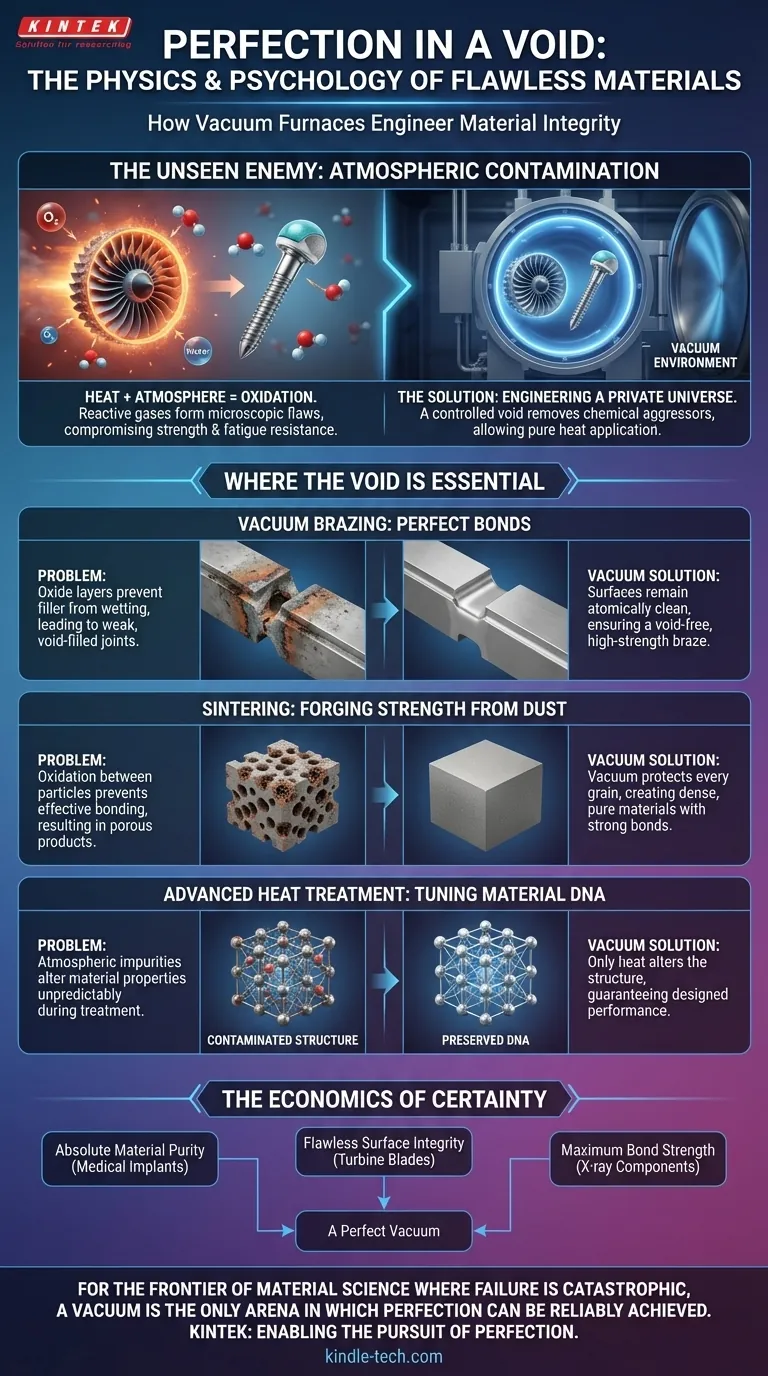
In both scenarios, the greatest threat isn't the visible stress or heat. It's an invisible enemy: the reactive gases in the air we breathe. Specifically, oxygen. During the manufacturing process, when heat is applied to forge these components into existence, that same heat makes them incredibly vulnerable to attack.
This is the alchemist's dilemma: heat can create strength, but it also invites corruption.
Heat, Energy, and a Chemical Invitation
Heating a material is, fundamentally, giving its atoms more energy. They vibrate faster, making them more receptive to forming new chemical bonds.
When this happens in a normal atmosphere, the super-abundant oxygen and water vapor molecules seize the opportunity. They aggressively bond with the metal's surface, forming a thin, brittle layer of oxide.
This isn't just a cosmetic issue like discoloration. This oxide layer is a microscopic flaw—a seed of structural weakness that can compromise the material's fatigue resistance and integrity.
You've created a hidden vulnerability before the part has even begun its service life.
Engineering a Private Universe
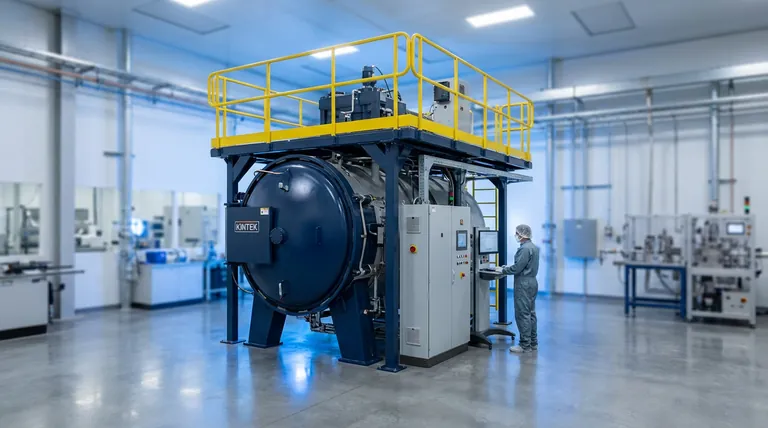
This is where the vacuum furnace enters the story. It isn't merely a box that gets hot. It is a tool for creating a controlled reality.
Its primary function is subtraction. By pumping out the atmosphere, it removes the chemical aggressors. It engineers a private universe for the workpiece, a void where heat can be applied without the risk of contamination.
The decision to use a vacuum furnace is therefore a psychological one as much as it is a technical one. It is born from a demand for absolute certainty. When you cannot afford a single, unseen flaw, you cannot leave the manufacturing environment to chance. You must control it.
Where the Void is Essential
This obsession with control is non-negotiable in several critical processes.
The Quest for Perfect Bonds: Vacuum Brazing
Joining two components so they behave as a single, monolithic piece is an engineering marvel. Brazing uses a filler metal to form this bond.
- The Problem: Any oxide layer on the surfaces acts like a contaminant, preventing the filler metal from wetting the surfaces properly. The result is a weak, incomplete bond full of voids.
- The Vacuum Solution: In a vacuum, the components remain atomically clean as they are heated. The filler metal flows perfectly into the joint, creating a bond that is often as strong as the parent materials themselves. This is essential for X-ray tubes, medical devices, and high-performance heat exchangers.
Forging Strength from Dust: Sintering
Sintering is the process of turning compacted powders—metal or ceramic—into a solid, dense object by applying heat.
- The Problem: The immense collective surface area of the fine particles is a massive target for oxidation. Any contamination between particles prevents them from bonding effectively, resulting in a porous, brittle final product.
- The Vacuum Solution: The vacuum protects every grain of powder, ensuring that the bonds formed during heating are pure and strong. This is how we create advanced materials like ceramic armor and complex parts via Metal Injection Molding (MIM).
Tuning a Material's DNA: Advanced Heat Treatment
High-performance alloys, like those used in aerospace or medical implants, are like finely-tuned recipes. Their properties—strength, ductility, fatigue resistance—depend on a precise crystalline structure.
- The Problem: Introducing foreign elements from the atmosphere during heat treatment (like annealing or tempering) contaminates this recipe. It alters the material's fundamental properties in unpredictable ways.
- The Vacuum Solution: By performing these treatments in a vacuum, you ensure that only heat is altering the crystal structure. You are preserving the material's intended DNA, guaranteeing its performance matches its design.
The Economics of Certainty
Of course, this level of control comes at a price. Vacuum furnaces represent a higher capital investment and often have longer cycle times than their atmospheric counterparts. The process of pumping down a chamber takes time.
So, the choice is not simply "which furnace is better?" The real question is, "What is the cost of failure?"
| When Your Goal Is... | The Hidden Risk Is... | The Necessary Environment Is... |
|---|---|---|
| Absolute Material Purity (Medical Implants) | Microscopic contamination altering biocompatibility | A Perfect Vacuum |
| Flawless Surface Integrity (Turbine Blades) | Surface oxidation creating stress points | A Perfect Vacuum |
| Maximum Bond Strength (X-ray Components) | Oxide layers preventing a void-free braze | A Perfect Vacuum |
| High-Volume, Low-Cost Parts (General Steel) | An acceptable, removable surface oxide layer | An Atmospheric Furnace |
For routine applications on common materials, an atmospheric furnace is often the more practical, cost-effective choice. But for the frontier of material science—where performance is paramount and failure is catastrophic—a vacuum is not a luxury. It is the only arena in which perfection can be reliably achieved.
At KINTEK, we provide the tools that enable this pursuit of perfection. Our range of laboratory equipment, including high-performance vacuum furnaces, is designed for the researchers, engineers, and scientists who understand that the greatest breakthroughs happen when you can control every variable. For applications where nothing less than perfect material integrity will suffice, we provide the controlled environment you need. Contact Our Experts
Visual Guide
Related Products
- Vacuum Hot Press Furnace Heated Vacuum Press Machine Tube Furnace
- 600T Vacuum Induction Hot Press Furnace for Heat Treat and Sintering
- Vacuum Hot Press Furnace Machine Heated Vacuum Press
- Vacuum Heat Treat Furnace and Levitation Induction Melting Furnace
- 2200 ℃ Tungsten Vacuum Heat Treat and Sintering Furnace
Related Articles
- The Purity Paradox: Choosing the Heart of Your Vacuum Hot Press Furnace
- Comprehensive Guide to Vacuum Hot Press Furnace Application
- Vacuum Hot Press Furnace: A Comprehensive Guide
- Forging Perfection in a Void: The Physics of Ultra-Dense Materials
- Defeating the Void: The Quiet Power of Vacuum Hot Pressing