The Illusion of Similarity
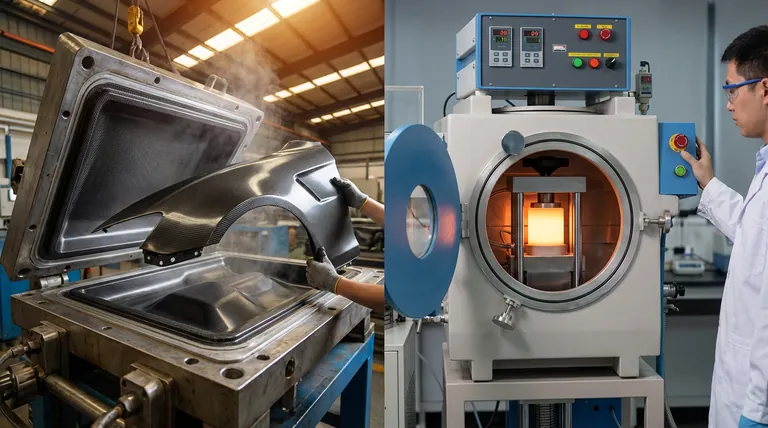
An engineer in an automotive lab carefully places a charge of Sheet Molding Compound into a massive, heated mold. Their goal is to form a perfectly curved, lightweight car fender.
Miles away, a materials scientist loads a fine ceramic powder into a simple cylindrical die. Their goal is to create a small, ultra-dense puck with zero porosity for a defense application.
Both use heat. Both use immense pressure. Yet, they are engaged in fundamentally different tasks.
The most common mistake is to focus on the tools—heat and pressure—rather than the intent. This is a psychological trap. The core difference between compression molding and hot pressing isn't in the physics they employ, but in the job they are hired to do.
One is a sculptor, the other an alchemist.
Compression Molding: The Art of Shaping Form
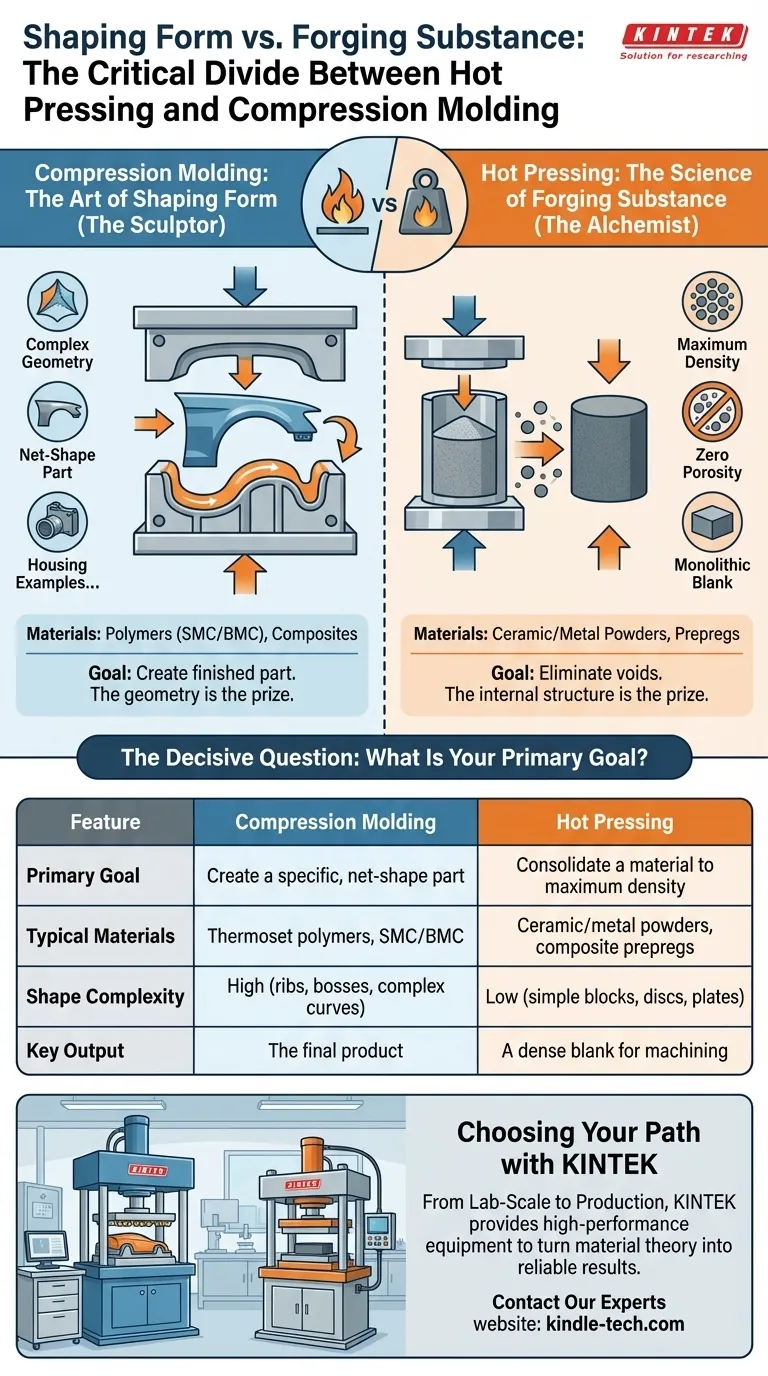
The mandate of compression molding is singular: to create a finished, net-shape part. The process's job is complete when the component emerges from the mold, ready for its final application with little to no secondary finishing.
The Process: A Sculptor's Press
Think of it as a highly sophisticated, industrial-scale waffle iron.
- A pre-measured "charge" of material (often a thermoset polymer or composite) is placed into the bottom half of a heated, open mold.
- The top half of the mold closes, applying pressure.
- Heat and pressure work together to make the material flow and fill every crevice of the mold cavity, while a chemical reaction (curing) permanently hardens it.
The output is the final product—the fender, the electrical enclosure, the appliance housing. The geometry is the prize.
The Canvas: Polymers and Composites
This method is the domain of materials like Bulk Molding Compound (BMC), Sheet Molding Compound (SMC), phenolics, and rubbers. It's built for creating large, often intricate parts where shape is paramount.
Hot Pressing: The Science of Forging Substance
Hot pressing, in contrast, is fundamentally a materials science process. It cares little for complex shapes. Its primary obsession is eliminating the empty space within a material.
Its mandate is to achieve maximum density. Porosity is the enemy.
The Process: A Materials Forge
Here, the equipment is simpler but the goal is more profound.
- A powder (ceramic, metal) or a stack of composite prepreg is placed into a simple die (e.g., a cylinder or square).
- Pressure is applied, usually from one direction (uniaxially), while the entire assembly is heated in a controlled atmosphere or vacuum.
- The combination of intense heat and pressure forces the individual particles to fuse together, squeezing out voids and creating a monolithic, dense block.
The output isn't a final product. It's a "blank" or "puck"—a simple, dense billet of perfected material that will almost always be machined later to its final dimensions. The material's internal structure is the prize.
The Elements: Advanced Powders and Prepregs
This is the go-to process for creating high-performance ceramics, consolidating metal powders, and fabricating the flat composite laminates essential for aerospace and defense. The value is not in the shape of the blank, but in its vastly superior mechanical properties—its hardness, strength, and integrity.
The Decisive Question: What Is Your Primary Goal?
Choosing the right process is a strategic decision that hinges on answering one question: Am I trying to shape a product or perfect a material?
Key Distinctions at a Glance
| Feature | Compression Molding | Hot Pressing |
|---|---|---|
| Primary Goal | Create a specific, net-shape part | Consolidate a material to maximum density |
| Typical Materials | Thermoset polymers, SMC/BMC | Ceramic/metal powders, composite prepregs |
| Shape Complexity | High (ribs, bosses, complex curves) | Low (simple blocks, discs, plates) |
| Key Output | The final product (e.g., an automotive panel) | A dense blank for subsequent machining |
Choosing Your Path: From Lab-Scale to Production
This distinction is critical. Making the wrong choice upstream leads to wasted time, incorrect equipment investments, and materials that fail to meet performance requirements.
Whether you are developing a new composite in the lab or scaling a manufacturing line, the clarity of your goal—form versus substance—dictates your path. For researchers and engineers exploring the frontiers of material science, having precise, reliable equipment is non-negotiable.
A laboratory hot press isn't just a machine; it's a tool for discovering the absolute performance limits of a new material. A lab-scale compression molding press is for proving that a complex part can be formed successfully. At KINTEK, we specialize in providing the high-performance laboratory equipment that turns material theory into tangible, reliable results.
Ultimately, the choice comes down to that simple question of intent. Are you giving a material its final shape, or are you forging its fundamental character?
Visual Guide
Related Products
- Heated Hydraulic Press Machine with Heated Plates Split Manual Laboratory Hot Press
- Automatic Heated Hydraulic Press Machine with Heated Plates for Laboratory Hot Press 25T 30T 50T
- Automatic Heated Hydraulic Press Machine with Heated Plates for Laboratory Hot Press
- Heated Hydraulic Press Machine with Heated Plates for Vacuum Box Laboratory Hot Press
- Heated Hydraulic Press Machine with Heated Plates for Vacuum Box Laboratory Hot Press
Related Articles
- How to choose a laboratory hot press
- Why Your Composite and Polymer Parts Keep Failing: The Secret Is Simultaneous Heat and Pressure
- Choosing the Right Press for Your Laboratory Needs
- More Than a Squeeze: The Physics and Psychology of the Hydraulic Hot Press
- Comprehensive Guide to Hydraulic Hot Press: Function, Features and Applications