It’s a scenario that’s all too familiar in advanced engineering. A critical metal component—perfectly designed in CAD, simulated for stress, and made from a top-tier alloy—fails during testing. Not just once, but repeatedly. A hairline fracture appears where none should exist. The part, which represents weeks of work and significant cost, is now scrap. The project timeline is in jeopardy, and your team is back to the drawing board, wondering: what did we miss?
The Cycle of Guesswork: Why "Stronger" Isn't Always the Answer
When a high-performance part fails, the troubleshooting process often becomes a frustrating cycle of expensive guesses.
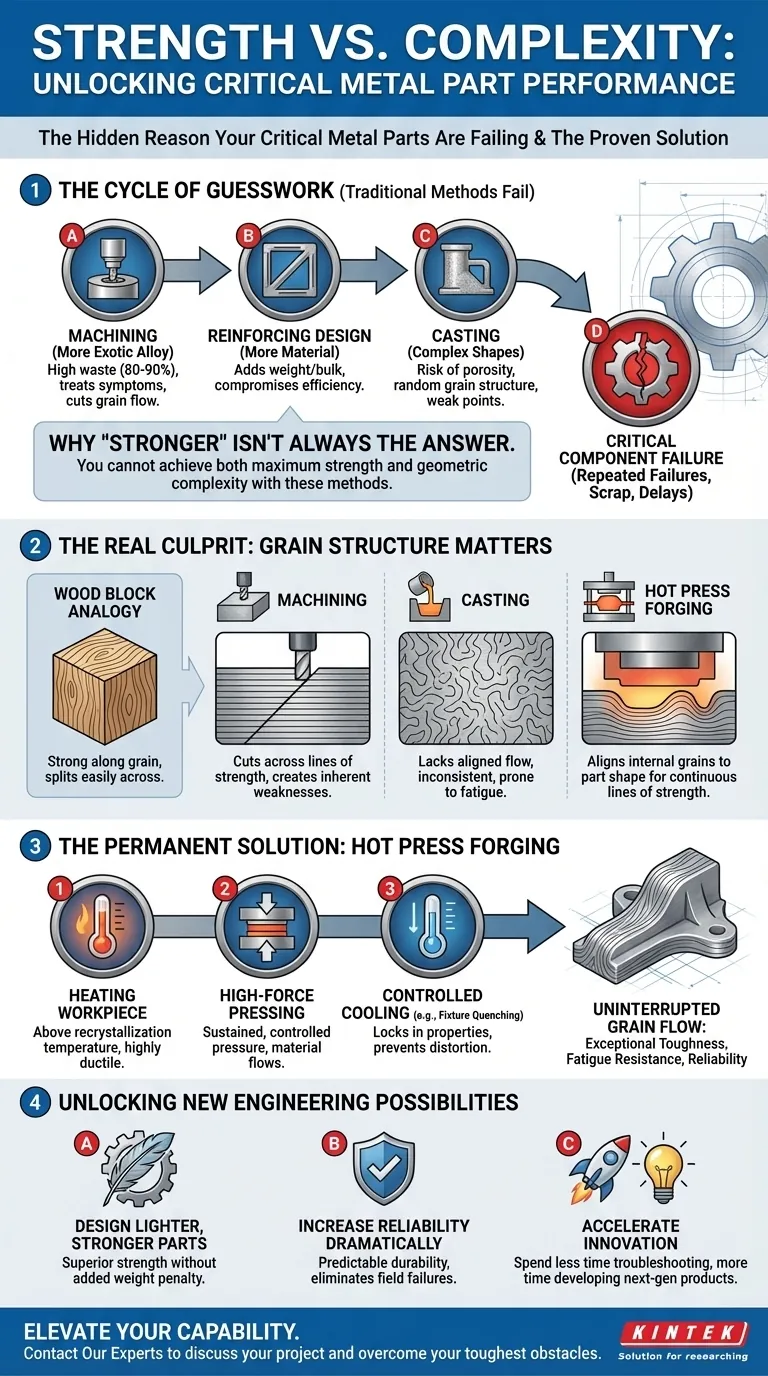
First, you might try machining the part from a solid block of an even more exotic, higher-strength alloy. The material cost skyrockets, and 80-90% of that expensive block becomes waste material on the workshop floor. Yet, the part might still fail, because you’ve only treated a symptom, not the underlying disease.
Next, perhaps you consider reinforcing the design, adding more material to thicken weak points. But this adds weight and bulk, compromising the performance goals of creating a lightweight, efficient system—a non-starter for applications in aerospace or high-performance automotive.
Finally, you might look at casting. It’s excellent for complex shapes, but for a critical, load-bearing component, the inherent risk of internal porosity and an inconsistent grain structure makes it an unacceptable gamble. A single microscopic void could be the starting point for a catastrophic failure.
Each of these "solutions" fails to deliver because they don’t address the real problem. The negative consequences pile up: project delays, spiraling R&D budgets, and a looming fear that a component might fail in the field, leading to costly recalls or reputational damage.
The Real Culprit: It's Not the Material, It's the Grain Structure
The breakthrough comes when you shift your focus from what the part is made of to how it is made. The true source of strength or weakness in a high-performance metal part isn't just its chemical composition; it's the internal grain structure forged by the manufacturing process.
Think of a block of wood. It is incredibly strong along the grain, but splits easily across it. Many conventional manufacturing processes work against the "grain" of the metal:
- Machining: When you machine a complex part from a solid block, you are essentially carving a shape out of a material with a uniform, straight-line grain structure. Inevitably, you will cut across the lines of strength, creating inherent weaknesses where stresses will concentrate.
- Casting: This process is like forming a shape from wet sand. When the metal cools, the grains form in a random, non-directional pattern. While the shape is complex, the internal structure lacks the aligned, continuous flow needed to resist high-fatigue or impact loads.
The common solutions fail because they are fundamentally at odds with the physics of the material. You cannot achieve both maximum strength and geometric complexity when your manufacturing method is actively severing the very grain flow that provides strength.
Forging Strength: The Right Tool for the Job
To solve this problem permanently, you need a process that doesn't fight the material, but instead coaxes it into a superior state. You need a method that can form a complex shape while simultaneously aligning the metal’s internal grain structure to follow the part's contours, creating continuous lines of strength.
This is the principle of hot press forging.
By heating the metal workpiece above its recrystallization temperature, it becomes highly ductile and plastic. Then, instead of the violent impact of a hammer, a hydraulic press applies immense, slow, and controlled pressure. This sustained force makes the metal flow like a viscous fluid, filling every detail of a die cavity.
Crucially, this process forces the internal grains to reorient and elongate, aligning themselves perfectly with the shape of the part. The result is a component with an uninterrupted grain flow, giving it exceptional toughness and resistance to fatigue and impact—far superior to what any machined or cast part could achieve.
This is not a happy accident; it’s a deliberate application of materials science. And executing it correctly requires purpose-built tools. You need:
- A high-force press capable of delivering sustained, precisely controlled pressure.
- A heating system that brings the workpiece to the exact malleable temperature without compromising its integrity.
- A controlled cooling process, like fixture quenching, to lock in the desired properties and prevent distortion.
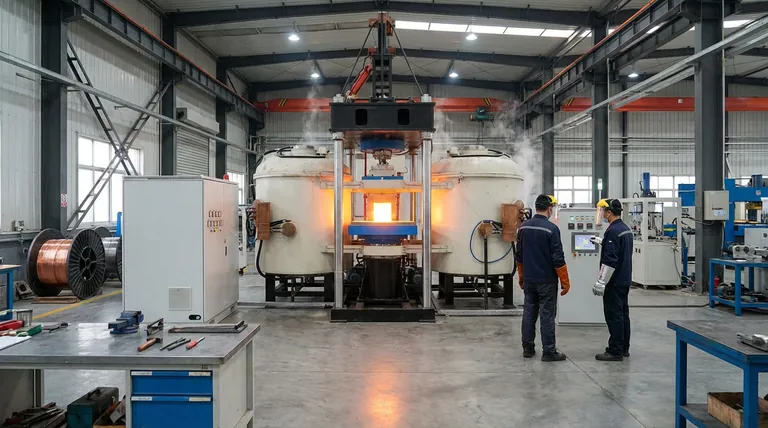
This is why we developed our line of laboratory and industrial equipment. Our systems are not just machines; they are instruments designed from a deep understanding of these principles. They provide the control and reliability necessary to transform a block of metal into a component where strength and complexity are no longer in conflict.
Beyond the Fix: Unlocking New Engineering Possibilities
Once you solve the fundamental problem of strength-versus-complexity, you don’t just fix a failing part—you unlock a new level of engineering freedom. The "impossible" designs on the whiteboard become manufacturable realities.
With a reliable hot press forging process, your teams can now:
- Design Lighter, Stronger Parts: Achieve superior strength without the penalty of added weight, pushing the boundaries of performance in aerospace, automotive, and industrial applications.
- Increase Reliability Dramatically: Move from worrying about failure rates to building components with predictable, exceptional durability, where field failures become a thing of the past.
- Accelerate Innovation: Spend less time troubleshooting manufacturing limitations and more time developing next-generation products that your competitors can't match.
Solving this persistent manufacturing challenge is about more than just one project. It's about elevating your organization's capability to innovate and deliver superior products.
Your most ambitious designs deserve a manufacturing process that can bring them to life without compromise. If you are facing challenges in creating high-performance components or are ready to explore what's possible with advanced manufacturing techniques, our team is here to help. Let's discuss the unique demands of your project and how the right equipment can overcome your toughest obstacles. Contact Our Experts.
Visual Guide
Related Products
- Special Heat Press Mold for Lab Use
- Ball Press Mold for Lab
- Automatic High Temperature Heated Hydraulic Press Machine with Heated Plates for Lab
- Manual High Temperature Heated Hydraulic Press Machine with Heated Plates for Lab
- Double Plate Heating Press Mold for Lab
Related Articles
- Beyond the Press: The Art and Science of Shaping Materials with Heat and Pressure
- Forging Perfection: The Physics and Psychology of Hot Press Molding
- Why Your Hot Press Samples Fail: The Hidden Culprit in Material R&D
- The Architecture of Atoms: Why Hot Press Forming Creates Superior Materials
- Taming the Void: The Art and Science of Hot Press Moulding