The Allure of the Peak Number
We have a psychological bias for simple, powerful metrics. The top speed of a car. The megapixel count of a camera. In materials science, it’s often the maximum temperature of a vacuum furnace.
A figure like 2200°C is impressive. It speaks of incredible power and advanced engineering. But focusing on this single number is like judging a symphony by its loudest note. It misses the point entirely.
The real story of a high-temperature process is one of control, stability, and the interplay of a complex system. Often, the component that dictates success isn't the one glowing white-hot, but the one quietly working in the background.
Deconstructing the "Hot Zone": Where Temperature is Born
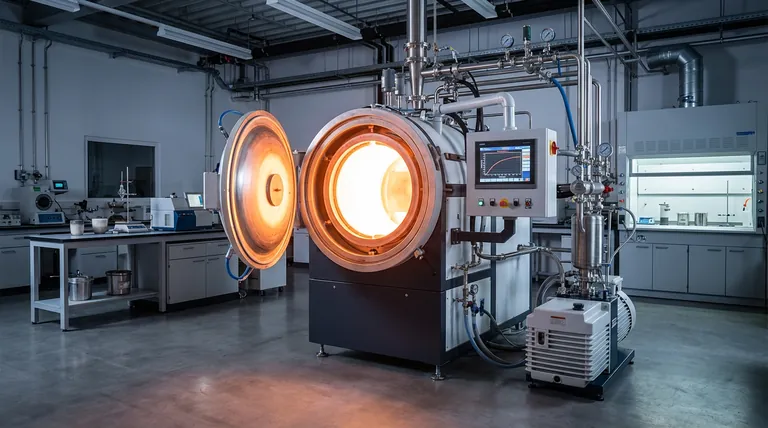
The heart of any vacuum furnace is its "hot zone"—the insulated chamber where the thermal magic happens. Its design and materials directly define the furnace's theoretical temperature ceiling.
The vacuum itself is a critical enabler. By removing air, it eliminates heat transfer via convection, allowing for immense thermal efficiency. Inside this vacuum, different heating technologies compete to push the boundaries.
| Furnace Technology | Maximum Temperature | Primary Mechanism |
|---|---|---|
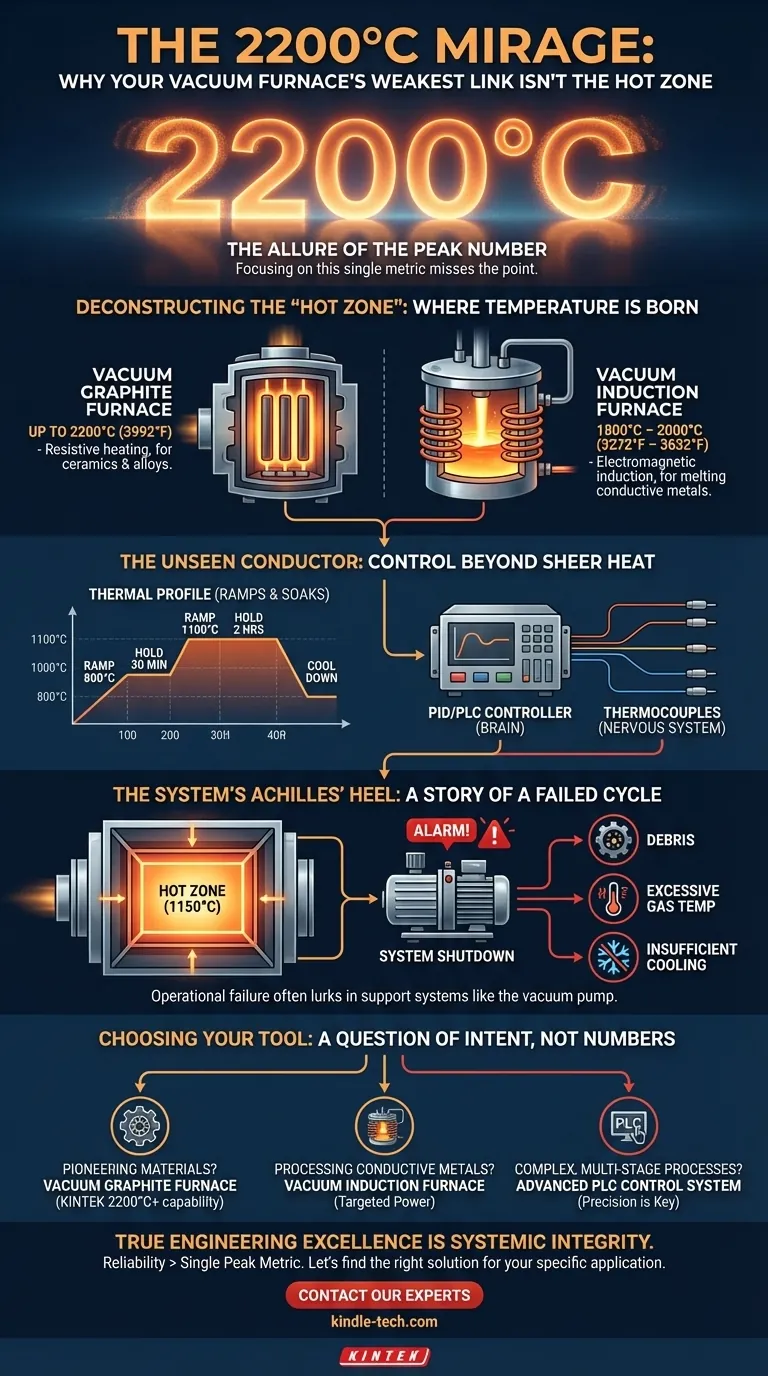
| Vacuum Graphite Furnace | Up to 2200°C (3992°F) | Resistive heating via graphite elements |
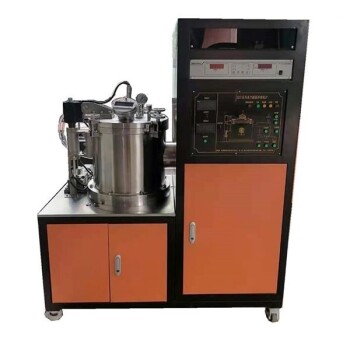
| Vacuum Induction Furnace | 1800°C - 2000°C (3272°F - 3632°F) | Electromagnetic induction in conductive materials |
A graphite furnace is the undisputed champion for peak temperature, essential for developing next-generation ceramics and alloys. An induction furnace is a powerhouse for melting and processing conductive metals with precision.
But generating heat is only the first step.
The Unseen Conductor: Control Beyond Sheer Heat
A furnace running at a flat-out maximum temperature is rarely useful. Real-world applications—annealing, brazing, sintering—demand a meticulously controlled thermal profile.
This profile is a pre-programmed journey of temperature ramps and soaks. Imagine a cycle: ramp to 800°C, hold for 30 minutes to stabilize, then a slow, precise climb to 1100°C, holding for two hours to ensure a complete phase transformation.
This is not a brute-force operation; it's a delicate performance. It relies on a nervous system of thermocouples for feedback and a brain—the PID or PLC controller—to execute the program flawlessly. The sophistication of this control system is often more critical to the outcome than a few extra degrees at the top end.
The System's Achilles' Heel: A Story of a Failed Cycle
Picture this: you're six hours into a critical ten-hour heat treatment cycle. The sample inside is irreplaceable. The hot zone is performing perfectly, holding 1150°C with unwavering stability.
Suddenly, an alarm sounds. The system shuts down, the cycle aborted.
The cause? Not a failure in the advanced graphite heating elements. The problem is far more mundane: the vacuum pump has overheated. The very component responsible for creating the environment for success has become the single point of failure.
This scenario is the hidden reality of high-temperature processing. The system is a chain, and it's only as strong as its weakest link. An overheated pump can be caused by:
- Debris: Small particles being sucked into the pump mechanism.
- Excessive Gas Temperature: Pumping extremely hot gas from the chamber.
- Insufficient Cooling: A problem with the water flow that cools the pump system.
We are psychologically drawn to the spectacle of the hot zone, but operational failure often lurks in the support systems we take for granted.
Choosing Your Tool: A Question of Intent, Not Numbers
Selecting the right furnace isn't about chasing the highest number on a spec sheet. It's about matching the entire system's capability to your scientific or industrial goal.
The right question is not "How hot can it get?" but "What do I need to achieve?"
- For pioneering new materials at the edge of thermal possibility? A Vacuum Graphite Furnace from KINTEK provides the 2200°C+ capability you need.
- For reliably melting or processing conductive metals? The targeted power of a Vacuum Induction Furnace is the superior choice.
- For complex, multi-stage processes on sensitive components? The precision of an advanced PLC control system becomes your most important feature.
True engineering excellence is found not in a single peak metric, but in the robust design of the entire system. It's an understanding that reliability during a long, steady soak at 1100°C is just as important as the ability to reach 2200°C. At KINTEK, we build our lab equipment on this principle of systemic integrity.
To ensure your process is built on a foundation of reliability, from the hot zone to the cooling circuit, let's find the right solution for your specific application. Contact Our Experts
Visual Guide
Related Products
- Vacuum Hot Press Furnace Heated Vacuum Press Machine Tube Furnace
- 600T Vacuum Induction Hot Press Furnace for Heat Treat and Sintering
- Vacuum Hot Press Furnace Machine Heated Vacuum Press
- Vacuum Heat Treat Furnace and Levitation Induction Melting Furnace
- 2200 ℃ Tungsten Vacuum Heat Treat and Sintering Furnace
Related Articles
- The Purity Paradox: Choosing the Heart of Your Vacuum Hot Press Furnace
- Comprehensive Guide to Vacuum Hot Press Furnace Application
- Vacuum Hot Press Furnace: A Comprehensive Guide
- Forging Perfection in a Void: The Physics of Ultra-Dense Materials
- Defeating the Void: The Quiet Power of Vacuum Hot Pressing