The Illusion of Simplicity
There is a psychological comfort in looking at a laboratory machine. It sits there, solid and enclosed. You press a button, and it does a job.
But this simplicity is a deception.
A vacuum furnace is often mistaken for a glorified oven—a sealed box that gets hot. If you treat it as such, your results will be inconsistent, and your materials will fail.
To an engineer, a vacuum furnace is not a box. It is a war zone. inside that chamber, a sophisticated battle is being waged against oxidation, contamination, and thermal entropy.
It is a precisely engineered ecosystem. Success doesn't come from the heat itself; it comes from how distinct systems—vacuum, thermal, and control—work in unison to create an environment that does not exist in nature.
The Vessel: Withstanding the Weight of the World
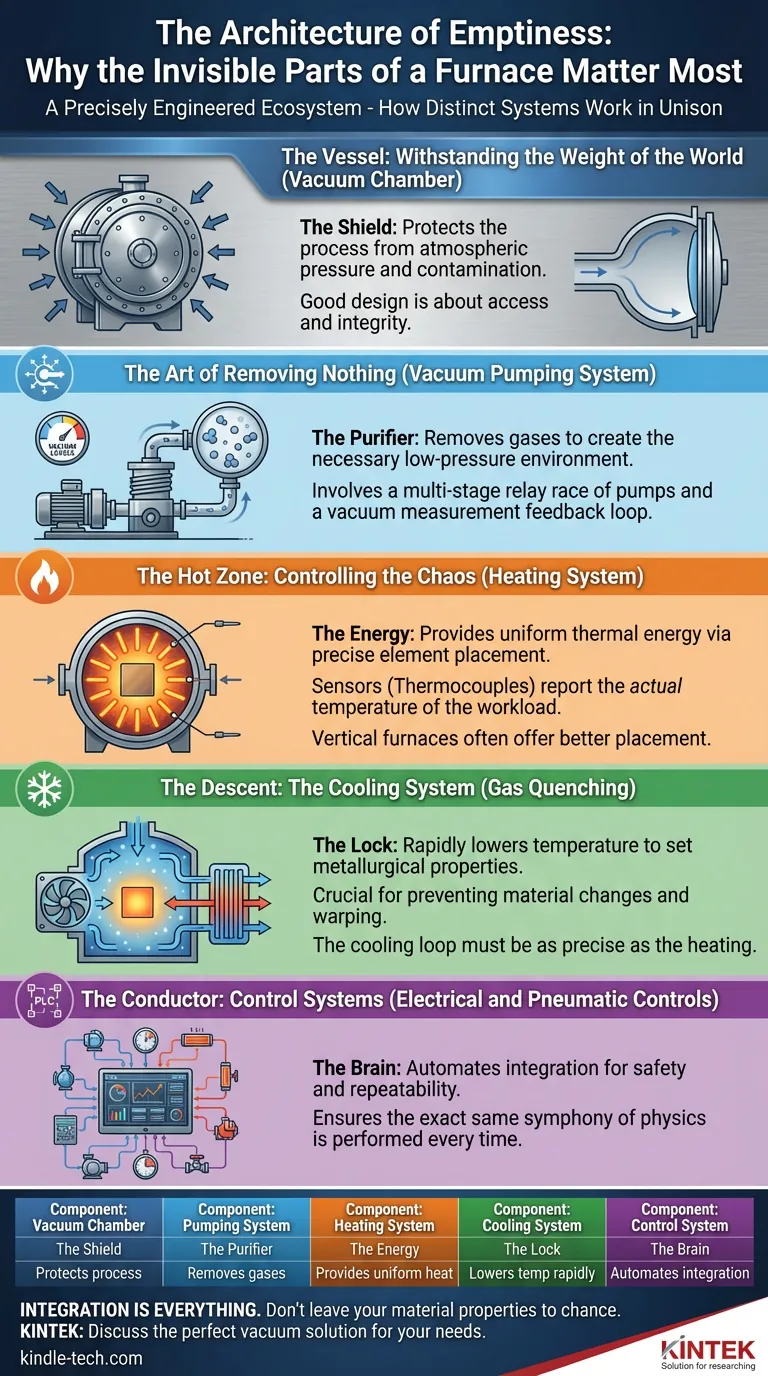
The Vacuum Chamber is the physical heart of the machine.
Its job seems passive: to hold the workload. But consider the physics. When the vacuum is pulled, the chamber must withstand immense external atmospheric pressure. It is holding back the weight of the atmosphere to protect the delicate process inside.
Good design here is about access and integrity.
- The Door: It must seal perfectly against pressure but open easily for the operator.
- The Flow: The shape isn't arbitrary; it dictates how gas flows during the critical cooling phase.
If the chamber integrity fails, the experiment is over before the heat even rises.
The Art of Removing Nothing
The defining characteristic of this machine is what isn't there.
The Vacuum Pumping System is responsible for creating the void. It removes air and gases to prevent oxidation. But "removing air" is harder than it sounds.
It requires a multi-stage approach. You cannot use a single pump to reach deep space vacuum levels. It involves a relay race of mechanical and diffusion pumps, working to strip molecules away from the workload.
This system relies on the Vacuum Measurement System. This is the feedback loop. It tells the operator if the environment is pure enough for the metallurgical magic to happen.
The Hot Zone: Controlling the Chaos
Heat is naturally chaotic. It wants to rise, to fluctuate, to spread unevenly.
The Heating System, often called the "hot zone," is designed to impose order on this chaos.
This is where the difference between a cheap furnace and a precision instrument becomes obvious.
- Heating Elements: These must be arranged to ensure every inch of the material receives the same thermal energy.
- Sensors (Thermocouples): These are the nervous system. Strategically placed, they report the actual temperature of the workload, not just the air around it.
In Vertical Furnaces, these sensors can often be placed more effectively, ensuring that the temperature reading on your screen matches the reality inside the core of the part.
The Descent: The Cooling System
Getting material hot is easy. Cooling it down—specifically, cooling it down without ruining its properties—is hard.
The Cooling System is the unsung hero of material properties. Once the heating cycle ends, the structure of the metal is vulnerable. It must be "locked in."
This is done via Gas Quenching. The system floods the chamber with inert gas (like argon or nitrogen) and circulates it via a powerful fan. It passes over a heat exchanger to strip away the heat.
If this happens too slowly, the material properties change. If it happens unevenly, the part warps. The cooling loop must be as precise as the heating loop.
The Conductor: Control Systems
If the furnace is an ecosystem, the Electrical and Pneumatic Controls are the brain.
Complex heat treatment recipes require split-second timing. The vacuum must be pulled, the heat ramped up, the temperature soaked, and the gas quenched in a specific sequence.
The control system integrates these disparate parts. It ensures repeatability.
In science and manufacturing, a result that cannot be repeated is a failure. The control system ensures that the furnace performs the exact same symphony of physics today as it did yesterday.
Summary of the Ecosystem
Here is how the systems interact to create a controlled environment:
| Component | The Role | Why It Matters |
|---|---|---|
| Vacuum Chamber | The Shield | Protects the process from atmospheric pressure and contamination. |
| Pumping System | The Purifier | Removes gases to create the necessary low-pressure environment. |
| Heating System | The Energy | Provides uniform thermal energy via precise element placement. |
| Cooling System | The Lock | Rapidly lowers temperature to set metallurgical properties. |
| Control System | The Brain | Automates integration for safety and repeatability. |
Integration is Everything
A high-performance vacuum furnace is more than the sum of its parts.
You can have the best pumps and the best heating elements, but if they aren't integrated correctly, the system fails. The interface between the cooling loop and the hot zone determines the cycle time. The logic of the control system determines the safety.
At KINTEK, we understand this engineering romance. We know that when you are treating advanced materials, you aren't just buying a machine; you are investing in a controlled outcome.
Whether you need the compact efficiency of a horizontal design or the superior uniformity of a vertical configuration, the goal remains the same: absolute control over the invisible forces inside the chamber.
Don't leave your material properties to chance.
Deepen your laboratory's capabilities with a partner who understands the intricate ecosystem of thermal processing. Contact Our Experts to discuss how KINTEK can configure the perfect vacuum solution for your needs.
Visual Guide
Related Products
- Vacuum Hot Press Furnace Heated Vacuum Press Machine Tube Furnace
- 600T Vacuum Induction Hot Press Furnace for Heat Treat and Sintering
- Vacuum Hot Press Furnace Machine Heated Vacuum Press
- Vacuum Heat Treat Furnace and Levitation Induction Melting Furnace
- 2200 ℃ Tungsten Vacuum Heat Treat and Sintering Furnace
Related Articles
- The Purity Paradox: Choosing the Heart of Your Vacuum Hot Press Furnace
- Comprehensive Guide to Vacuum Hot Press Furnace Application
- Vacuum Hot Press Furnace: A Comprehensive Guide
- Forging Perfection in a Void: The Physics of Ultra-Dense Materials
- Defeating the Void: The Quiet Power of Vacuum Hot Pressing