The Illusion of a Single Number
In engineering, we often seek absolute values. We want to know the top speed, the breaking point, or the maximum temperature.
But when asking, "What is the temperature of a vacuum furnace?", the answer is rarely a single number. It is a design constraint.
A vacuum furnace is not merely an oven; it is a controlled environment designed to manipulate the properties of matter. The temperature capability is entirely dependent on what you are trying to achieve—be it simple annealing or complex atomic bonding.
For the engineer, the question isn't "How hot can it get?" It is "How hot must it get to change the structure of this specific material?"
The Hierarchy of Heat
The maximum temperature of a furnace is dictated by its anatomy—specifically, the materials used in its "hot zone" (heating elements and insulation). We can categorize these systems based on the threshold of thermal endurance.
1. General-Purpose Heat Treating (The Workhorses)
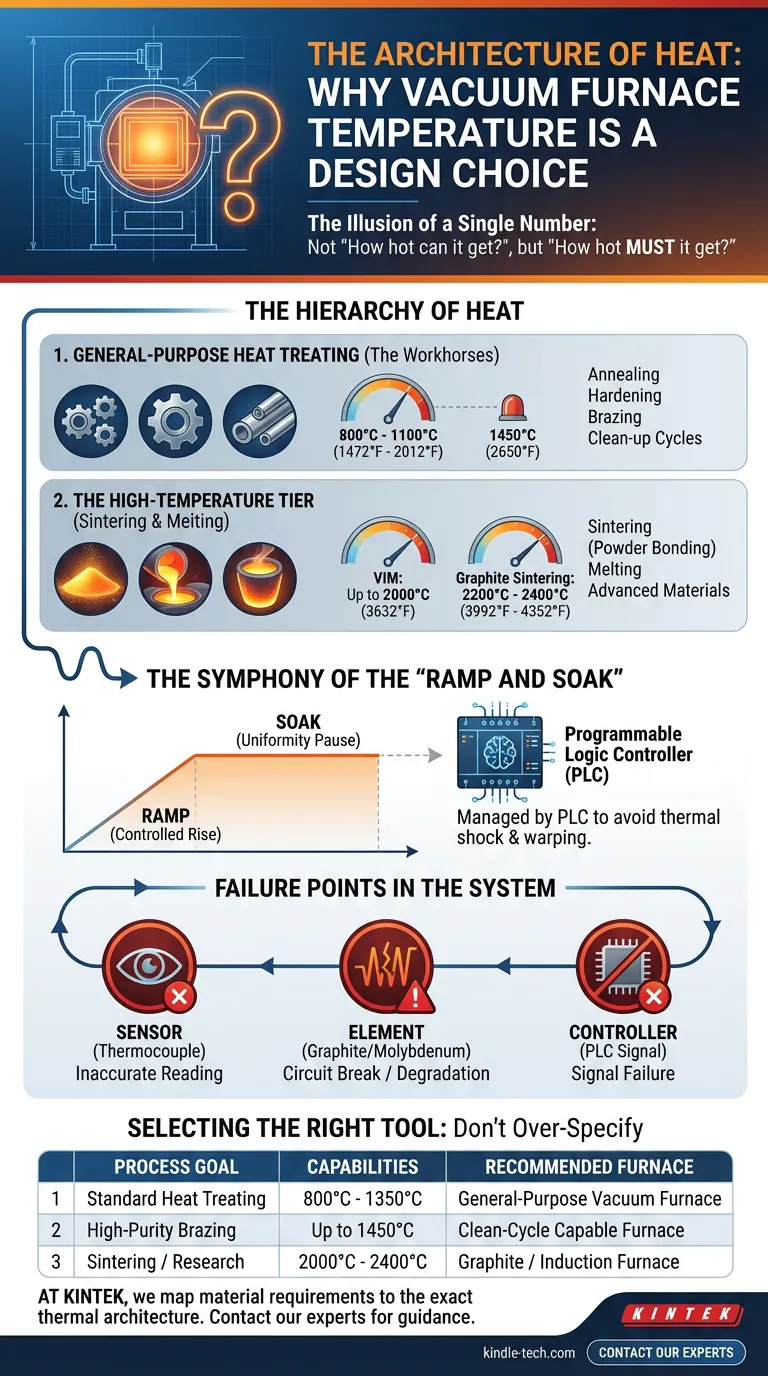
For the vast majority of industrial applications, extreme heat is unnecessary. Processes like annealing, hardening, and brazing usually occur between 800°C and 1100°C (1472°F - 2012°F).
Furnaces designed for this range typically cap out at 1450°C (2650°F). This overhead allows for:
- Running high-temperature "clean-up" cycles to burn off contaminants.
- Processing specialized alloys without straining the system.
2. The High-Temperature Tier (Sintering & Melting)
When we move from treating metals to creating them, the requirements shift. Sintering—the process of bonding powder particles into solids—requires energy levels that would destroy a standard furnace.
These specialized units, often utilizing graphite heating elements, operate in a different stratosphere:
- Vacuum Induction Melting (VIM): Up to 2000°C (3632°F).
- Graphite Sintering Furnaces: Between 2200°C and 2400°C (3992°F - 4352°F).
The Symphony of the "Ramp and Soak"
Heat is not a switch you flip; it is a profile you manage.
If you heat a material too quickly, it experiences thermal shock. If you heat it unevenly, it warps. Therefore, a vacuum furnace cycle is a carefully choreographed sequence known as the Ramp and Soak.
- The Ramp: The controlled rise in temperature.
- The Soak: A pause at a specific temperature (e.g., holding at 800°C for 20 minutes). This allows the core of the material to catch up with the surface temperature, ensuring uniformity.
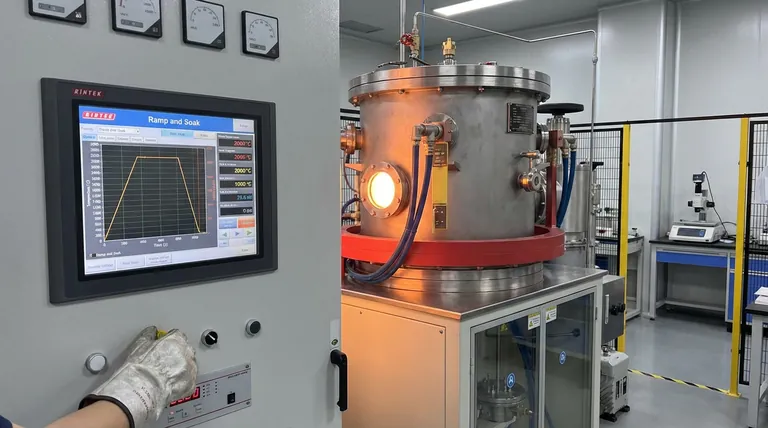
This is managed by a Programmable Logic Controller (PLC). This computer is the brain of the operation, reading data from thermocouples and adjusting power output in milliseconds to trace the temperature profile exactly.
Failure Points in the System
Reaching 2000°C in a vacuum is a fight against physics. It creates a high-stress environment where the margin for error is non-existent.
When a furnace fails to hit its target, it is usually a breakdown in the feedback loop.
- The Sensor (Thermocouple): If the eye cannot see the temperature accurately, the brain (PLC) cannot control it.
- The Element: Graphite or molybdenum heating elements degrade over time. A break in the circuit means zero heat.
- The Controller: Rarely, the thermostat itself fails to send the signal to draw power.
Understanding these failure points is just as important as knowing the maximum temperature. It is the difference between a successful cycle and a ruined batch.
Selecting the Right Tool
There is a psychological comfort in buying the most powerful tool available. However, in laboratory equipment, over-specification is inefficient.
You do not need a 2400°C sintering furnace to anneal steel at 900°C. You need a system tuned to your reality.
| Process Goal | Required Capabilities | Recommended Furnace Type |
|---|---|---|
| Standard Heat Treating | 800°C - 1350°C | General-Purpose Vacuum Furnace |
| High-Purity Brazing | Up to 1450°C | Clean-Cycle Capable Furnace |
| Sintering / Research | 2000°C - 2400°C | Graphite / Induction Furnace |
At KINTEK, we understand that precision is valuable. We don't just supply equipment; we help you map your material requirements to the exact thermal architecture required to achieve them.
Whether you need the reliability of a standard heat treatment cycle or the extreme capabilities of a high-vacuum sintering process, our experts are ready to guide the selection.
Visual Guide
Related Products
- Vacuum Hot Press Furnace Heated Vacuum Press Machine Tube Furnace
- 600T Vacuum Induction Hot Press Furnace for Heat Treat and Sintering
- Vacuum Hot Press Furnace Machine Heated Vacuum Press
- Vacuum Heat Treat Furnace and Levitation Induction Melting Furnace
- 2200 ℃ Tungsten Vacuum Heat Treat and Sintering Furnace
Related Articles
- The Purity Paradox: Choosing the Heart of Your Vacuum Hot Press Furnace
- Comprehensive Guide to Vacuum Hot Press Furnace Application
- Vacuum Hot Press Furnace: A Comprehensive Guide
- Forging Perfection in a Void: The Physics of Ultra-Dense Materials
- Defeating the Void: The Quiet Power of Vacuum Hot Pressing