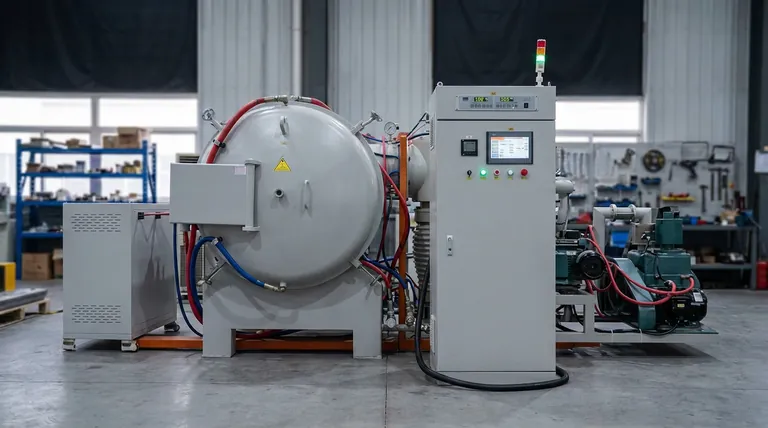
Blog The Architecture of Heat: Why Vacuum Furnace Temperature is a Design Choice, Not Just a Number
The Architecture of Heat: Why Vacuum Furnace Temperature is a Design Choice, Not Just a Number

The Architecture of Heat: Why Vacuum Furnace Temperature is a Design Choice, Not Just a Number

4 hours ago

There is a fundamental tension in materials science.

On one hand, you need extreme energy to change the state of matter—to sinter ceramics, melt alloys, or harden steel. On the other hand, that same energy tends to destroy the machinery used to create it.

The vacuum furnace is the engineer's answer to this paradox. It is a vessel designed to contain a controlled catastrophe.

When we ask, "What is the temperature range of a vacuum furnace?" we are often looking for a single number. But in practice, the answer is a spectrum, dictated not by how much power you can pump in, but by how well the "hot zone" can survive the environment it creates.

The Spectrum of Capability

Most laboratory and industrial needs fall into a predictable bell curve.

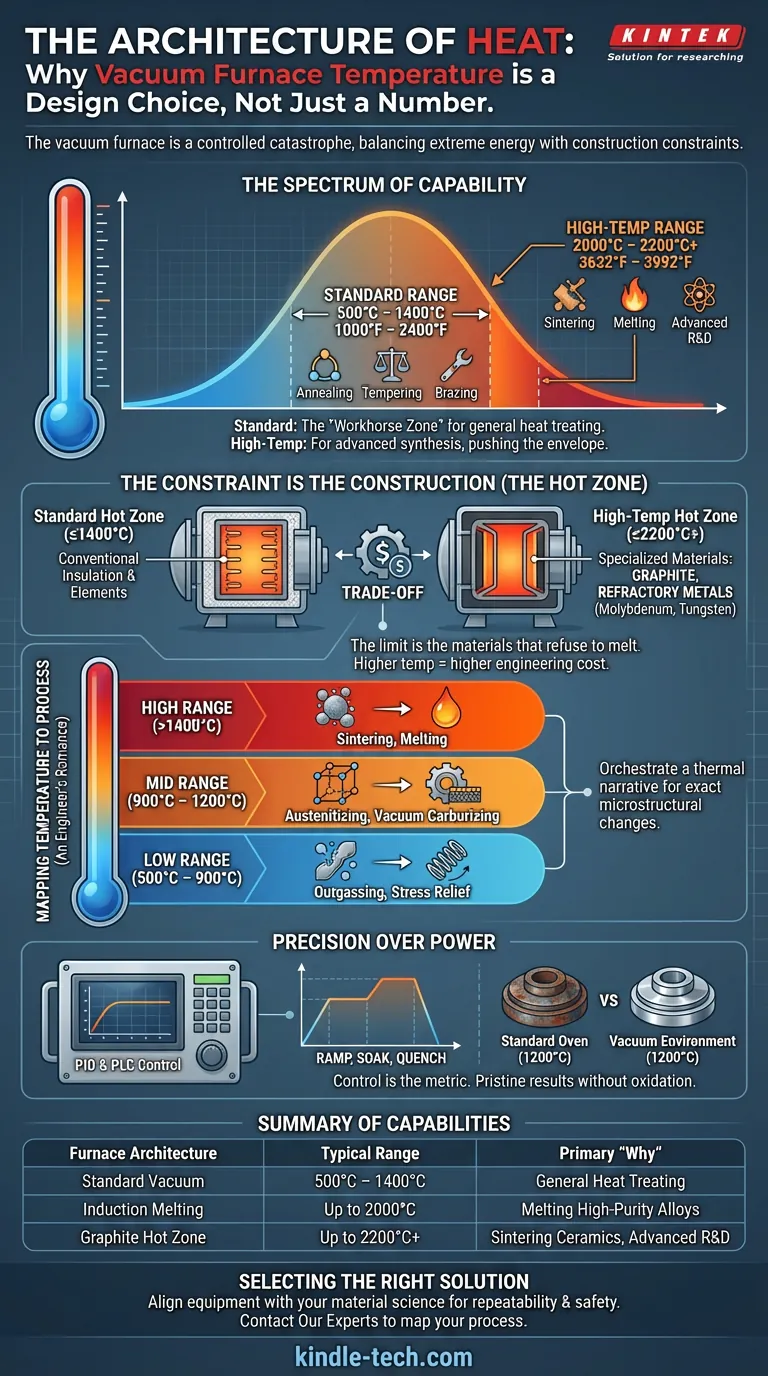
For the vast majority of standard heat-treating processes, the thermal requirements are modest relative to what physics allows. A standard vacuum furnace typically operates in the range of 500°C to 1400°C (1000°F to 2400°F).

This "standard" range is the workhorse zone. It covers:

  • Annealing: Relaxing the internal stresses of a metal.
  • Tempering: Balancing hardness with toughness.
  • Brazing: Joining components with standard filler metals.

However, the curve creates a tail. For advanced research and high-performance manufacturing, standard limits must be broken.

Specialized high-temperature models, such as induction or graphite furnaces, push the envelope significantly. These systems can reach 2000°C to 2200°C (3632°F to 3992°F). In rare, custom configurations, they go even higher.

The Constraint is the Construction

Why doesn't every furnace go to 2200°C?

The limiting factor is the "hot zone"—the internal chamber containing the heating elements and insulation.

To reach extreme temperatures, the furnace itself must be built from materials that refuse to melt or degrade under stress. This usually involves:

  • Graphite: Excellent for high temperatures (up to 3000°C in inert atmospheres) but reactive with certain materials.
  • Refractory Metals: Molybdenum or Tungsten, used when graphite contamination is a concern.

It is an engineering trade-off. A furnace built for 2200°C requires expensive, specialized insulation and power supplies that are overkill for a lab simply trying to anneal copper at 600°C.

Mapping Temperature to Process

Temperature is not just a setting on a dial; it is a switch that activates specific molecular behaviors.

The "Engineer's Romance" here lies in the precision. A vacuum furnace allows you to orchestrate a thermal narrative, holding materials at specific temperatures to achieve exact microstructural changes.

The Low Range (500°C – 900°C)

Here, the focus is often on purification and preparation.

  • Outgassing: removing volatile impurities.
  • Stress Relief: allowing a part to settle dimensionally before hardening.

The Mid Range (900°C – 1200°C)

This is the transformation zone.

  • Austenitizing: changing the crystal structure of steel.
  • Vacuum Carburizing: introducing carbon to the surface for hardness.

The High Range (>1400°C)

This is where advanced synthesis happens.

  • Sintering: bonding powder particles (metal or ceramic) without melting them completely.
  • Melting: Creating superalloys that require absolute purity.

Precision Over Power

There is a psychological trap in buying lab equipment: we tend to buy for the maximum capacity rather than the daily reality.

While peak temperature is a headline spec, control is the metric that matters.

Reaching 2000°C is useless if the temperature fluctuates wildly. High-quality vacuum furnaces utilize sophisticated PID (Proportional-Integral-Derivative) loops and PLCs. These systems don't just "heat up"; they manage the rate of climb (ramp), the stability of the hold (soak), and the speed of the cool-down (quench).

Furthermore, the vacuum environment ensures that this high heat doesn't result in oxidation. In a standard oven, 1200°C ruins a surface. In a vacuum, 1200°C leaves it pristine.

Summary of Capabilities

To visualize the landscape of thermal processing, consider this breakdown:

Furnace Architecture Typical Range Primary "Why"
Standard Vacuum 500°C – 1400°C General Heat Treating, Annealing, Brazing
Induction Melting Up to 2000°C Melting High-Purity Alloys
Graphite Hot Zone Up to 2200°C+ Sintering Ceramics, Advanced R&D

Selecting the Right Solution

The goal is not to buy the hottest furnace. The goal is to buy the furnace that aligns with your material science.

If you are sintering advanced ceramics, you need the graphite high-temp architecture. If you are tempering steel parts for aerospace, you need the precision of a standard range unit with exceptional uniformity controls.

At KINTEK, we understand that you aren't just buying a box that gets hot. You are investing in repeatability, safety, and the integrity of your research.

We offer a range of vacuum furnaces designed to meet these specific thermal horizons, from standard lab-scale units to high-temperature sintering systems.

Do you need help mapping your process to the right equipment?

Contact Our Experts to discuss your specific temperature requirements and let us help you engineer the perfect thermal environment.

Visual Guide
The Architecture of Heat: Why Vacuum Furnace Temperature is a Design Choice, Not Just a Number Visual Guide

Related Products

Related Articles

Related Products

Molybdenum Vacuum Heat Treat Furnace

Molybdenum Vacuum Heat Treat Furnace

Discover the benefits of a high-configuration molybdenum vacuum furnace with heat shield insulation. Ideal for high-purity, vacuum environments like sapphire crystal growth and heat treatment.

2200 ℃ Tungsten Vacuum Heat Treat and Sintering Furnace

2200 ℃ Tungsten Vacuum Heat Treat and Sintering Furnace

Experience the ultimate refractory metal furnace with our Tungsten vacuum furnace. Capable of reaching 2200℃, perfect for sintering advanced ceramics and refractory metals. Order now for high-quality results.

Vacuum Heat Treat and Molybdenum Wire Sintering Furnace for Vacuum Sintering

Vacuum Heat Treat and Molybdenum Wire Sintering Furnace for Vacuum Sintering

A vacuum molybdenum wire sintering furnace is a vertical or bedroom structure, which is suitable for withdrawal, brazing, sintering and degassing of metal materials under high vacuum and high temperature conditions. It is also suitable for dehydroxylation treatment of quartz materials.

2200 ℃ Graphite Vacuum Heat Treat Furnace

2200 ℃ Graphite Vacuum Heat Treat Furnace

Discover the power of the KT-VG Graphite Vacuum Furnace - with a maximum working temperature of 2200℃, it's perfect for vacuum sintering of various materials. Learn more now.

Graphite Vacuum Furnace Bottom Discharge Graphitization Furnace for Carbon Materials

Graphite Vacuum Furnace Bottom Discharge Graphitization Furnace for Carbon Materials

Bottom-out graphitization furnace for carbon materials, ultra-high temperature furnace up to 3100°C, suitable for graphitization and sintering of carbon rods and carbon blocks. Vertical design, bottom discharging, convenient feeding and discharging, high temperature uniformity, low energy consumption, good stability, hydraulic lifting system, convenient loading and unloading.

Vertical High Temperature Graphite Vacuum Graphitization Furnace

Vertical High Temperature Graphite Vacuum Graphitization Furnace

Vertical high temperature graphitization furnace for carbonization and graphitization of carbon materials up to 3100℃.Suitable for shaped graphitization of carbon fiber filaments and other materials sintered in a carbon environment.Applications in metallurgy, electronics, and aerospace for producing high-quality graphite products like electrodes and crucibles.

Vacuum Heat Treat Furnace with Ceramic Fiber Liner

Vacuum Heat Treat Furnace with Ceramic Fiber Liner

Vacuum furnace with polycrystalline ceramic fiber insulation liner for excellent heat insulation and uniform temperature field. Choose from 1200℃ or 1700℃ max. working temperature with high vacuum performance and precise temperature control.

1400℃ Controlled Atmosphere Furnace with Nitrogen and Inert Atmosphere

1400℃ Controlled Atmosphere Furnace with Nitrogen and Inert Atmosphere

Achieve precise heat treatment with KT-14A controlled atmosphere furnace. Vacuum sealed with a smart controller, it's ideal for lab and industrial use up to 1400℃.

Vacuum Hot Press Furnace Heated Vacuum Press Machine Tube Furnace

Vacuum Hot Press Furnace Heated Vacuum Press Machine Tube Furnace

Reduce forming pressure & shorten sintering time with Vacuum Tube Hot Press Furnace for high-density, fine-grain materials. Ideal for refractory metals.

Vacuum Hot Press Furnace Machine Heated Vacuum Press

Vacuum Hot Press Furnace Machine Heated Vacuum Press

Discover the advantages of Vacuum Hot Press Furnace! Manufacture dense refractory metals & compounds, ceramics, and composites under high temp and pressure.

Graphite Vacuum Furnace IGBT Experimental Graphitization Furnace

Graphite Vacuum Furnace IGBT Experimental Graphitization Furnace

IGBT experimental graphitization furnace, a tailored solution for universities and research institutions, with high heating efficiency, user-friendliness, and precise temperature control.

Vacuum Heat Treat Sintering Brazing Furnace

Vacuum Heat Treat Sintering Brazing Furnace

A vacuum brazing furnace is a type of industrial furnace used for brazing, a metalworking process that joins two pieces of metal using a filler metal that melts at a lower temperature than the base metals. Vacuum brazing furnaces are typically used for high-quality applications where a strong, clean joint is required.

Horizontal High Temperature Graphite Vacuum Graphitization Furnace

Horizontal High Temperature Graphite Vacuum Graphitization Furnace

Horizontal Graphitization Furnace: This type of furnace is designed with the heating elements placed horizontally, allowing for uniform heating of the sample. It's well-suited for graphitizing large or bulky samples that require precise temperature control and uniformity.

Laboratory Rapid Thermal Processing (RTP) Quartz Tube Furnace

Laboratory Rapid Thermal Processing (RTP) Quartz Tube Furnace

Get lightning-fast heating with our RTP Rapid Heating Tube Furnace. Designed for precise, high-speed heating and cooling with convenient sliding rail and TFT touch screen controller. Order now for ideal thermal processing!

Graphite Vacuum Continuous Graphitization Furnace

Graphite Vacuum Continuous Graphitization Furnace

High-temperature graphitization furnace is a professional equipment for graphitization treatment of carbon materials. It is a key equipment for the production of high-quality graphite products. It has high temperature, high efficiency and uniform heating. It is suitable for various high-temperature treatments and graphitization treatments. It is widely used in metallurgy, electronics, aerospace, etc. industry.

Graphite Vacuum Furnace High Thermal Conductivity Film Graphitization Furnace

Graphite Vacuum Furnace High Thermal Conductivity Film Graphitization Furnace

The high thermal conductivity film graphitization furnace has uniform temperature, low energy consumption and can operate continuously.

Ultra-High Temperature Graphite Vacuum Graphitization Furnace

Ultra-High Temperature Graphite Vacuum Graphitization Furnace

The ultra-high temperature graphitization furnace utilizes medium frequency induction heating in a vacuum or inert gas environment. The induction coil generates an alternating magnetic field, inducing eddy currents in the graphite crucible, which heats up and radiates heat to the workpiece, bringing it to the desired temperature. This furnace is primarily used for graphitization and sintering of carbon materials, carbon fiber materials, and other composite materials.

600T Vacuum Induction Hot Press Furnace for Heat Treat and Sintering

600T Vacuum Induction Hot Press Furnace for Heat Treat and Sintering

Discover the 600T Vacuum Induction Hot Press Furnace, designed for high-temperature sintering experiments in vacuum or protected atmospheres. Its precise temperature and pressure control, adjustable working pressure, and advanced safety features make it ideal for nonmetal materials, carbon composites, ceramics, and metal powders.

Small Vacuum Heat Treat and Tungsten Wire Sintering Furnace

Small Vacuum Heat Treat and Tungsten Wire Sintering Furnace

The small vacuum tungsten wire sintering furnace is a compact experimental vacuum furnace specially designed for universities and scientific research institutes. The furnace features a CNC welded shell and vacuum piping to ensure leak-free operation. Quick-connect electrical connections facilitate relocation and debugging, and the standard electrical control cabinet is safe and convenient to operate.

Vacuum Heat Treat and Sintering Furnace with 9MPa Air Pressure

Vacuum Heat Treat and Sintering Furnace with 9MPa Air Pressure

The air pressure sintering furnace is a high-tech equipment commonly used for the sintering of advanced ceramic materials. It combines vacuum sintering and pressure sintering techniques to achieve high-density and high-strength ceramics.


Leave Your Message



















