The Architecture of Nothingness: Mastering Precision with Vacuum Furnaces
In medicine, the most critical step often happens before the incision is even made: the creation of a sterile field. You cannot perform delicate work in a contaminated environment.
In materials science, the logic is identical.
We often think of furnaces as simple machines designed to add heat. But for advanced metallurgy, heat is only half the equation. The more important function is exclusion.
A vacuum furnace is a vessel designed to create a "sterile field" for materials. By mechanically removing the atmosphere, it eliminates the chaos of chemical reactions. It is a tool defined not by what it adds, but by what it takes away.
The Tyranny of Oxygen
The air around us is not neutral. To a piece of heated metal, the atmosphere is a hostile chemical soup.
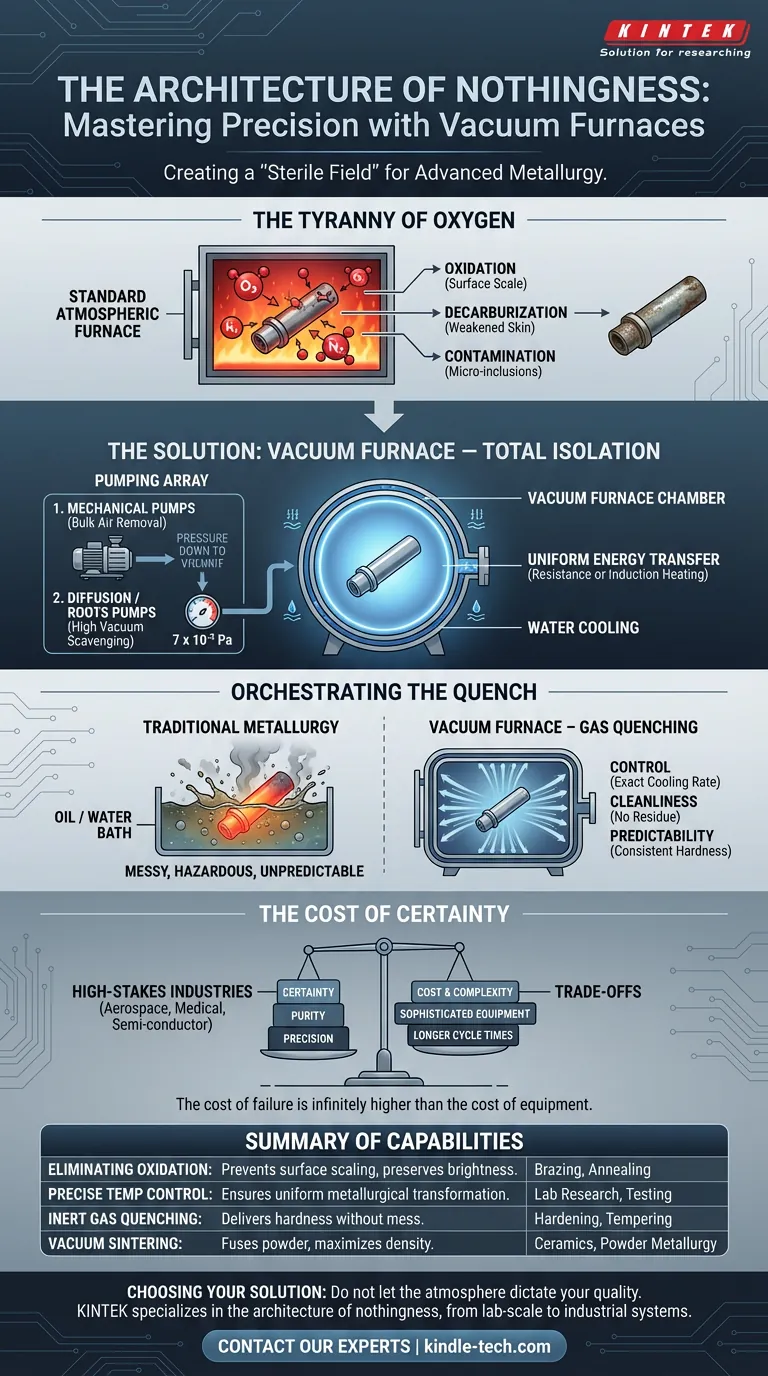
When you heat materials in a standard furnace, you are inviting oxygen and nitrogen to the party. The results are predictable and destructive:
- Oxidation: The formation of scale that ruins surface finishes.
- Decarburization: The leaching of carbon, weakening the material’s skin.
- Contamination: Micro-inclusions that compromise structural integrity.
Standard furnaces fight this with brute force or post-processing cleanup.
A vacuum furnace takes a more elegant approach: Total isolation.
By pumping pressure down to levels as low as $7 \times 10^{-3}$ Pa, the furnace ensures that the only changes occurring to the material are the ones you intentionally introduced.
The Mechanics of the Void
Creating nothing is surprisingly complex.
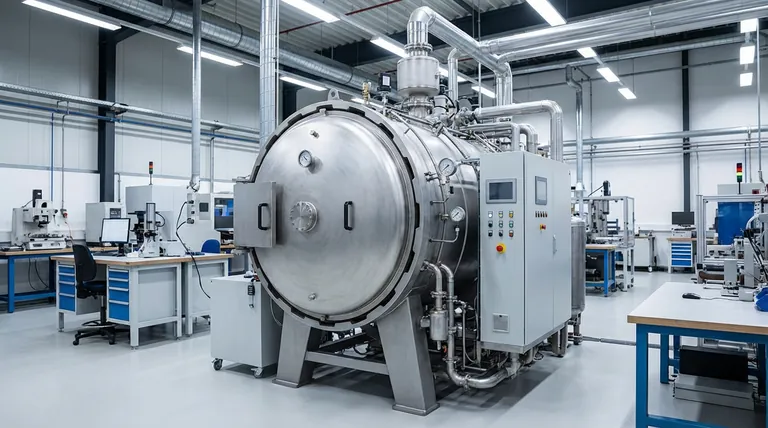
A vacuum furnace is a fortress against atmospheric pressure. The chamber is a sealed, double-walled vessel, often water-cooled to protect the structural integrity of the shell while the interior glows white-hot.
The heart of the system is the pumping array. It is a relay race of physics:
- Mechanical Pumps do the heavy lifting, removing the bulk of the air.
- Diffusion or Roots Pumps take over to scavenge the remaining molecules, achieving a high vacuum.
Inside this void, heating becomes a pure transfer of energy. Whether through resistance heating (graphite or refractory metals) or induction heating (magnetic fields), the energy is delivered with perfect uniformity. There is no air to create convection currents or uneven hot spots.
Orchestrating the Quench
The "Engineer’s Romance" of a vacuum furnace isn't just in the heating; it is in the violence of the cooling.
In traditional metallurgy, quenching often involves dunking hot metal into oil or water. It is messy, hazardous, and environmentally aggressive.
Vacuum furnaces utilize Gas Quenching.
Once the heating cycle is complete, the chamber is backfilled with a high-velocity stream of inert gas, such as argon or nitrogen. Because the gas is inert, it pulls heat away from the part without reacting with it.
This allows for:
- Control: You can dictate the exact cooling rate.
- Cleanliness: No oil residue to clean off.
- Predictability: The same hardness, every single time.
The Cost of Certainty
If vacuum furnaces are superior, why isn't every furnace a vacuum furnace?
The answer is the trade-off between cost and certainty.
Vacuum furnaces are complex ecosystems. They require sophisticated pumps, pristine seals, and specialized maintenance. The cycle times are longer because "creating nothing" (pumping down) takes time.
However, in high-stakes industries—aerospace, medical devices, semiconductor manufacturing—the cost of failure is infinitely higher than the cost of the equipment.
If you are sintering ceramics or melting high-purity alloys, you are paying for the absence of variables. You are buying certainty.
Summary of Capabilities
| Function | The "Why" | Typical Application |
|---|---|---|
| Eliminating Oxidation | Prevents surface scaling and preserves brightness. | Brazing, Annealing |
| Precise Temp Control | Ensures uniform metallurgical transformation. | Lab Research, Testing |
| Inert Gas Quenching | Delivers hardness without the mess of oil. | Hardening, Tempering |
| Vacuum Sintering | Fuses powder without melting; maximizes density. | Ceramics, Powder Metallurgy |
Choosing Your Solution
The decision to use a vacuum furnace comes down to your tolerance for error.
If you are processing simple parts where surface finish is secondary, atmospheric furnaces are faster and cheaper. But if your goal is absolute material purity, precise alloy chemistry, or specific hardness profiles, the atmosphere is your enemy.
At KINTEK, we specialize in the equipment that makes this precision possible. From compact lab-scale tube furnaces to industrial vacuum induction systems, we provide the architecture of nothingness that allows your materials to become something greater.
Do not let the atmosphere dictate the quality of your work.
Visual Guide
Related Products
- Vacuum Hot Press Furnace Heated Vacuum Press Machine Tube Furnace
- 600T Vacuum Induction Hot Press Furnace for Heat Treat and Sintering
- Vacuum Hot Press Furnace Machine Heated Vacuum Press
- Vacuum Heat Treat Furnace and Levitation Induction Melting Furnace
- 2200 ℃ Tungsten Vacuum Heat Treat and Sintering Furnace
Related Articles
- The Purity Paradox: Choosing the Heart of Your Vacuum Hot Press Furnace
- Comprehensive Guide to Vacuum Hot Press Furnace Application
- Vacuum Hot Press Furnace: A Comprehensive Guide
- Forging Perfection in a Void: The Physics of Ultra-Dense Materials
- Defeating the Void: The Quiet Power of Vacuum Hot Pressing