Blog The Art of Nothing: Navigating the Invisible Divide in Heat Treatment
The Art of Nothing: Navigating the Invisible Divide in Heat Treatment

The Art of Nothing: Navigating the Invisible Divide in Heat Treatment

1 hour ago

Oxygen is a relentless saboteur.

In the world of materials science, the moment you heat a metal, you accelerate its relationship with the air around it. Usually, this is a destructive relationship. Oxygen creates scaling. Water vapor invites decarburization. The seemingly invisible air in your lab becomes a thick, reactive soup that wants to compromise your component’s integrity.

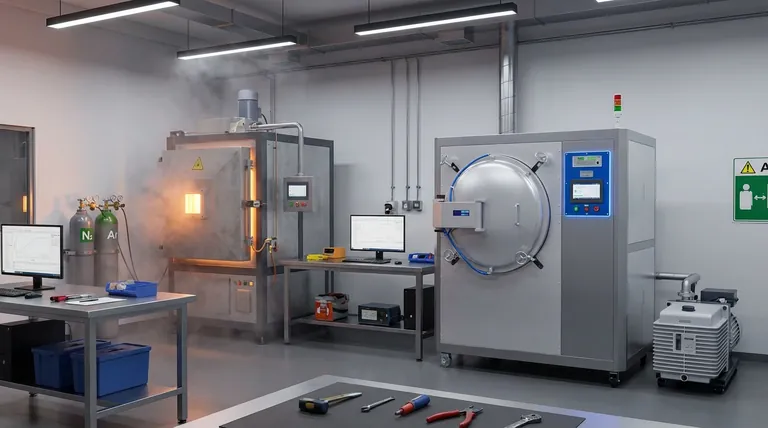
To solve this, engineers have developed two distinct philosophies.

One attempts to manage the crowd. The other attempts to empty the room.

This is the fundamental divergence between the Atmosphere Furnace and the Vacuum Furnace. It is not just a difference in machinery; it is a difference in how we define purity and control.

The Architecture of Controlled Chaos

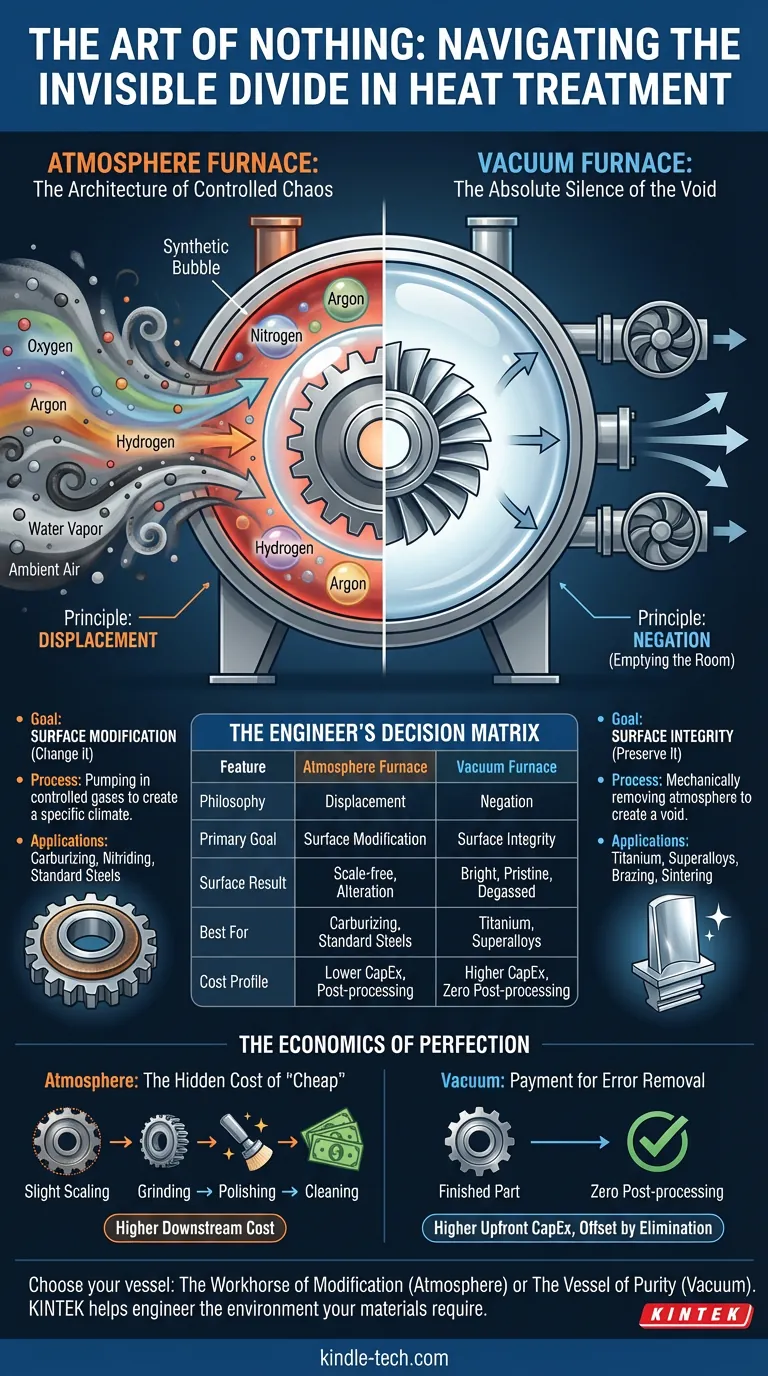
The Atmosphere Furnace operates on a principle of displacement.

If the ambient air is the enemy, the solution is to push it out and replace it with something friendly. You are not creating a void; you are engineering a specific climate.

By pumping in controlled gases—typically Nitrogen, Argon, or Hydrogen—you create a "synthetic bubble" around your material. This approach accepts that the part must be surrounded by something, so it ensures that "something" is predictable.

The Strategic Utility

Atmosphere furnaces are not just about protection; they are often about active modification. They are the tools of choice when you want to change the surface chemistry of a metal, not just preserve it.

  • Carburizing: Intentionally introducing carbon to steel to harden the surface.
  • Nitriding: Using nitrogen to create a tough, wear-resistant case.

However, there is a limitation. It is a statistical game. Even with high-quality gas flow, achieving 100% inertness is difficult. Trace impurities can remain. For high-volume steel processing, this is an acceptable, cost-effective trade-off.

The Absolute Silence of the Void

The Vacuum Furnace takes a more radical approach. It does not try to improve the air. It eliminates it.

When you seal the chamber and activate the pumps, you are mechanically removing the atmosphere. You are pulling out oxygen, nitrogen, and moisture until the chamber contains... nothing.

The Physics of Purity

In this void, oxidation is physically impossible because the reactants simply aren't there.

The results of vacuum processing often feel like engineering magic. Parts that go in dull and grey emerge "bright"—shiny, clean, and completely free of discoloration. The vacuum doesn't just protect; it cleans. It degasses the material, removing volatile contaminants from the metal's own structure.

This environment is non-negotiable for specific materials:

  • Reactive Metals: Titanium and Zirconium, which will destroy themselves if heated in the presence of oxygen.
  • Superalloys: High-performance materials used in aerospace that require zero surface compromise.
  • Brazing: Where the flow of alloy requires perfectly clean surfaces to bond without flux.

The Economics of Perfection

Why doesn't every lab use a vacuum furnace?

The answer lies in the "Psychology of Good Enough."

A vacuum furnace is a complex pressure vessel. It requires sophisticated pumps, seals, and leak detection. It is an investment in absolute certainty.

An atmosphere furnace is simpler. It creates a "good enough" environment for the vast majority of standard industrial hardening and annealing tasks.

The Hidden Cost of "Cheap"

However, looking only at the upfront price tag is a mistake.

If you use an atmosphere furnace for a sensitive part, the part may come out with slight scaling. You then have to pay for:

  1. Grinding
  2. Polishing
  3. Cleaning

A vacuum furnace produces a finished part. The higher upfront capital cost is often offset by the elimination of these downstream cleaning steps. You are paying for the removal of error.

The Engineer’s Decision Matrix

Choosing between these two technologies is a decision about your material's final destiny.

Feature Atmosphere Furnace Vacuum Furnace
Philosophy Displacement: Replace bad air with good gas. Negation: Remove all air entirely.
Primary Goal Surface Modification (change it). Surface Integrity (preserve it).
Surface Result Scale-free (mostly), potential for alteration. Bright, pristine, degassed.
Best For Carburizing, Nitriding, Standard Steels. Titanium, Superalloys, Brazing, Sintering.
Cost Profile Lower CapEx, potentially higher post-processing. Higher CapEx, zero post-processing.

Conclusion

If your goal is to chemically alter the surface of a steel gear, the Atmosphere Furnace is your instrument. It is the workhorse of modification.

If your goal is to preserve the atomic fidelity of a titanium implant or an aerospace turbine blade, the Vacuum Furnace is your sanctuary. It is the vessel of purity.

At KINTEK, we understand that this choice defines your workflow. We do not just sell equipment; we help you engineer the environment your materials require. Whether you need the controlled chemistry of an atmosphere system or the deep silence of a high-vacuum chamber, we have the precision tools to make it happen.

Contact Our Experts

Visual Guide

The Art of Nothing: Navigating the Invisible Divide in Heat Treatment Visual Guide

Related Products

Related Articles

Related Products

Vacuum Heat Treat Furnace with Ceramic Fiber Liner

Vacuum Heat Treat Furnace with Ceramic Fiber Liner

Vacuum furnace with polycrystalline ceramic fiber insulation liner for excellent heat insulation and uniform temperature field. Choose from 1200℃ or 1700℃ max. working temperature with high vacuum performance and precise temperature control.

Vacuum Heat Treat Sintering Brazing Furnace

Vacuum Heat Treat Sintering Brazing Furnace

A vacuum brazing furnace is a type of industrial furnace used for brazing, a metalworking process that joins two pieces of metal using a filler metal that melts at a lower temperature than the base metals. Vacuum brazing furnaces are typically used for high-quality applications where a strong, clean joint is required.

1700℃ Controlled Atmosphere Furnace Nitrogen Inert Atmosphere Furnace

1700℃ Controlled Atmosphere Furnace Nitrogen Inert Atmosphere Furnace

KT-17A Controlled atmosphere furnace: 1700℃ heating, vacuum sealing technology, PID temperature control, and versatile TFT smart touch screen controller for laboratory and industrial use.

Molybdenum Vacuum Heat Treat Furnace

Molybdenum Vacuum Heat Treat Furnace

Discover the benefits of a high-configuration molybdenum vacuum furnace with heat shield insulation. Ideal for high-purity, vacuum environments like sapphire crystal growth and heat treatment.

Mesh belt controlled atmosphere furnace

Mesh belt controlled atmosphere furnace

Discover our KT-MB mesh belt sintering furnace - perfect for high-temperature sintering of electronic components & glass insulators. Available for open air or controlled atmosphere environments.

2200 ℃ Tungsten Vacuum Heat Treat and Sintering Furnace

2200 ℃ Tungsten Vacuum Heat Treat and Sintering Furnace

Experience the ultimate refractory metal furnace with our Tungsten vacuum furnace. Capable of reaching 2200℃, perfect for sintering advanced ceramics and refractory metals. Order now for high-quality results.

Vacuum Heat Treat and Molybdenum Wire Sintering Furnace for Vacuum Sintering

Vacuum Heat Treat and Molybdenum Wire Sintering Furnace for Vacuum Sintering

A vacuum molybdenum wire sintering furnace is a vertical or bedroom structure, which is suitable for withdrawal, brazing, sintering and degassing of metal materials under high vacuum and high temperature conditions. It is also suitable for dehydroxylation treatment of quartz materials.

1200℃ Controlled Atmosphere Furnace Nitrogen Inert Atmosphere Furnace

1200℃ Controlled Atmosphere Furnace Nitrogen Inert Atmosphere Furnace

Discover our KT-12A Pro Controlled atmosphere furnace - high precision, heavy duty vacuum chamber, versatile smart touch screen controller, and excellent temperature uniformity up to 1200C. Ideal for both laboratory and industrial application.

Graphite Vacuum Furnace High Thermal Conductivity Film Graphitization Furnace

Graphite Vacuum Furnace High Thermal Conductivity Film Graphitization Furnace

The high thermal conductivity film graphitization furnace has uniform temperature, low energy consumption and can operate continuously.

Vacuum Heat Treat and Sintering Furnace with 9MPa Air Pressure

Vacuum Heat Treat and Sintering Furnace with 9MPa Air Pressure

The air pressure sintering furnace is a high-tech equipment commonly used for the sintering of advanced ceramic materials. It combines vacuum sintering and pressure sintering techniques to achieve high-density and high-strength ceramics.

High Pressure Laboratory Vacuum Tube Furnace Quartz Tubular Furnace

High Pressure Laboratory Vacuum Tube Furnace Quartz Tubular Furnace

KT-PTF High Pressure Tube Furnace: Compact split tube furnace with strong positive pressure resistance. Working temp up to 1100°C and pressure up to 15Mpa. Also works under controller atmosphere or high vacuum.

Vacuum Hot Press Furnace Heated Vacuum Press Machine Tube Furnace

Vacuum Hot Press Furnace Heated Vacuum Press Machine Tube Furnace

Reduce forming pressure & shorten sintering time with Vacuum Tube Hot Press Furnace for high-density, fine-grain materials. Ideal for refractory metals.

Horizontal High Temperature Graphite Vacuum Graphitization Furnace

Horizontal High Temperature Graphite Vacuum Graphitization Furnace

Horizontal Graphitization Furnace: This type of furnace is designed with the heating elements placed horizontally, allowing for uniform heating of the sample. It's well-suited for graphitizing large or bulky samples that require precise temperature control and uniformity.

Laboratory Vacuum Tilt Rotary Tube Furnace Rotating Tube Furnace

Laboratory Vacuum Tilt Rotary Tube Furnace Rotating Tube Furnace

Discover the versatility of Laboratory Rotary Furnace: Ideal for calcination, drying, sintering, and high-temperature reactions. Adjustable rotating and tilting functions for optimal heating. Suitable for vacuum and controlled atmosphere environments. Learn more now!

Vacuum Hot Press Furnace Machine Heated Vacuum Press

Vacuum Hot Press Furnace Machine Heated Vacuum Press

Discover the advantages of Vacuum Hot Press Furnace! Manufacture dense refractory metals & compounds, ceramics, and composites under high temp and pressure.

Controlled Nitrogen Inert Hydrogen Atmosphere Furnace

Controlled Nitrogen Inert Hydrogen Atmosphere Furnace

KT-AH Hydrogen atmosphere furnace - induction gas furnace for sintering/annealing with built-in safety features, dual housing design, and energy-saving efficiency. Ideal for lab and industrial use.

Vertical High Temperature Graphite Vacuum Graphitization Furnace

Vertical High Temperature Graphite Vacuum Graphitization Furnace

Vertical high temperature graphitization furnace for carbonization and graphitization of carbon materials up to 3100℃.Suitable for shaped graphitization of carbon fiber filaments and other materials sintered in a carbon environment.Applications in metallurgy, electronics, and aerospace for producing high-quality graphite products like electrodes and crucibles.

Vacuum Dental Porcelain Sintering Furnace

Vacuum Dental Porcelain Sintering Furnace

Get precise and reliable results with KinTek's Vacuum Porcelain Furnace. Suitable for all porcelain powders, it features hyperbolic ceramic furnace function, voice prompt, and automatic temperature calibration.

600T Vacuum Induction Hot Press Furnace for Heat Treat and Sintering

600T Vacuum Induction Hot Press Furnace for Heat Treat and Sintering

Discover the 600T Vacuum Induction Hot Press Furnace, designed for high-temperature sintering experiments in vacuum or protected atmospheres. Its precise temperature and pressure control, adjustable working pressure, and advanced safety features make it ideal for nonmetal materials, carbon composites, ceramics, and metal powders.

Ultra-High Temperature Graphite Vacuum Graphitization Furnace

Ultra-High Temperature Graphite Vacuum Graphitization Furnace

The ultra-high temperature graphitization furnace utilizes medium frequency induction heating in a vacuum or inert gas environment. The induction coil generates an alternating magnetic field, inducing eddy currents in the graphite crucible, which heats up and radiates heat to the workpiece, bringing it to the desired temperature. This furnace is primarily used for graphitization and sintering of carbon materials, carbon fiber materials, and other composite materials.


Leave Your Message