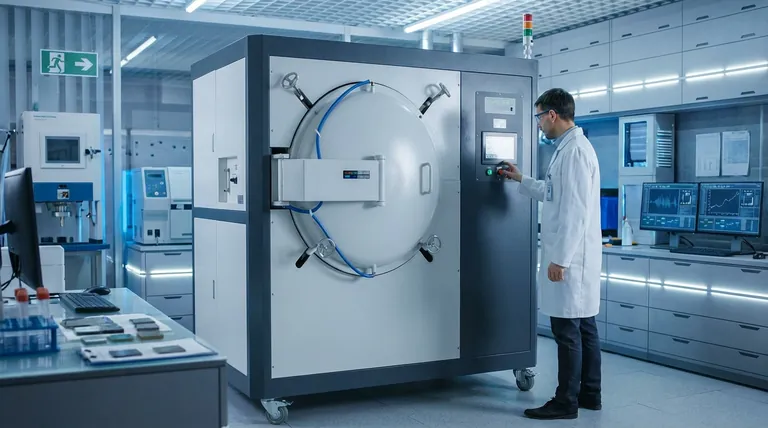
The Invisible Enemy of Precision
In the world of material science, the atmosphere is not your friend.
When we think of heating metal, we often imagine a blacksmith’s forge—fire, air, and brute force. But in high-precision laboratory environments, air is a contaminant. It is a variable that introduces chaos.
Oxygen reacts. Nitrogen scales. Moisture corrupts.
To achieve perfection in metallurgy—whether brazing, annealing, or sintering—you must remove the environment entirely.
This is the principle of the vacuum furnace. It is not merely an oven; it is a time capsule that isolates materials from the chemical aggression of the natural world.
The Engineering of Nothingness
The concept is deceptively simple: heat a material in a space where nothing else exists. However, achieving this state of "nothingness" requires a symphony of three integrated systems.
It is a process of subtraction before it is a process of addition.
1. The Vessel (The Chamber)
The process begins with the chamber. It is a sealed fortress designed to withstand a massive pressure differential. While the outside world presses in with atmospheric force, the inside remains a void. It must contain the extreme heat of the process while maintaining a hermetic seal against the outside air.
2. The Eviction (The Vacuum System)
You cannot simply pump air out once. It is a multi-stage struggle against physics.
- The Roughing Pump: First, a mechanical pump removes the bulk of the atmosphere.
- The Diffusion Pump: Once the limit is reached, a secondary high-vacuum system takes over, hunting down remaining molecules to achieve the deep pressure levels required for high-purity work.
3. The Thermal Engine (Heating and Cooling)
Once the stage is set, the heat is applied. But the cooling cycle is equally critical. To cool the material without re-introducing oxygen, the furnace often circulates high-purity inert gases (like argon or nitrogen), bringing the temperature down quickly and uniformly.
How to Heat Without Air
In a conventional oven, heat travels by convection—warm air moving over a surface. In a vacuum, there is no air to carry the heat.
The vacuum furnace must rely on physics that function in silence.
Resistance Heating (The Glow)
Think of an incandescent bulb filament, but on an industrial scale. High-resistance elements—made of graphite or molybdenum—glow white-hot. Since there is no air to transfer this heat, it travels via thermal radiation, striking the workpiece directly.
Induction Heating (The Invisible Hand)
This method feels closer to magic. A powerful induction coil surrounds the chamber. It generates an alternating magnetic field that induces eddy currents inside the metal workpiece itself.
The heat is not applied from the outside; it is generated from within the metal’s own resistance. It is rapid, clean, and contactless.
Why We Choose Complexity
Operating a vacuum furnace is difficult. It requires time to pump down. It demands rigorous maintenance of seals. It imposes strict safety protocols regarding high voltages and pressures.
Why do engineers accept this complexity?
Because the trade-off is purity.
The benefits of the vacuum environment are absolute:
- Elimination of Oxidation: Without oxygen, metals can reach extreme temperatures without tarnishing or scaling. The surface remains pristine.
- Prevention of Decarburization: In standard steel treating, carbon can leach out of the surface, softening the part. The vacuum locks the carbon in, preserving mechanical integrity.
- Repeatability: By removing the atmosphere, you remove the variables. The results are identical, every single time.
Selecting the Right Approach
Not all vacuums are created equal. The design you choose dictates the result you achieve.
| If your goal is... | The ideal technology is... | Why? |
|---|---|---|
| Melting High-Purity Alloys | Vacuum Induction Furnace | Contactless heating ensures zero chemical contamination. |
| Brazing or Annealing | Resistance Heating | Excellent temperature uniformity for finished parts. |
| Small/Unique Samples | Vacuum Tube Furnace | Efficient for specific, small-scale laboratory applications. |
Conclusion: The Quiet Science
The vacuum furnace transforms heat treatment from a chaotic event into a precise science. It proves that sometimes, the most important part of a process is what you take away.
By removing the air, we allow the material to become the best version of itself.
Ready to bring this level of control to your laboratory?
KINTEK provides the high-performance equipment necessary to master these environments. Whether you need the contactless precision of induction or the uniformity of resistance heating, our solutions are engineered for the rigorous demands of modern research.
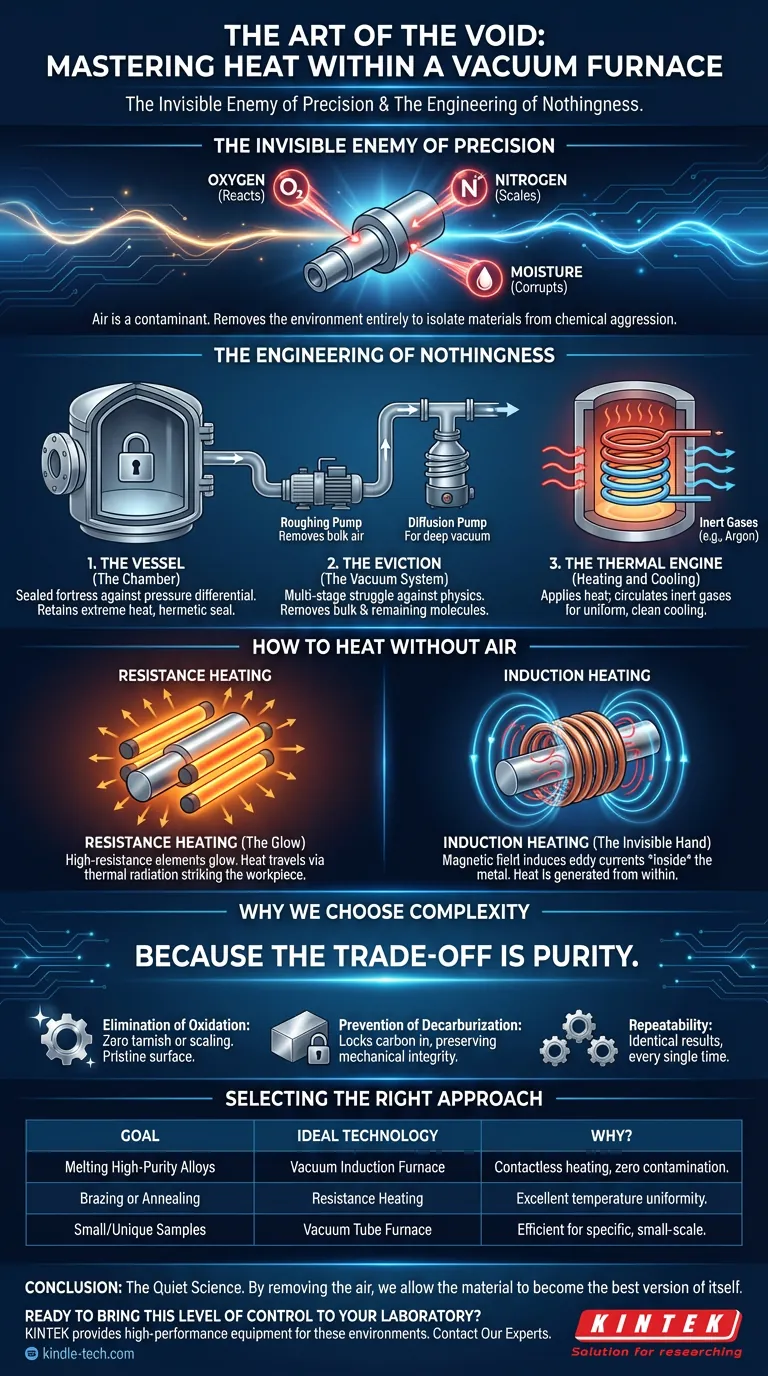
Visual Guide
Related Products
- Vacuum Hot Press Furnace Heated Vacuum Press Machine Tube Furnace
- 600T Vacuum Induction Hot Press Furnace for Heat Treat and Sintering
- Vacuum Hot Press Furnace Machine Heated Vacuum Press
- Vacuum Heat Treat Furnace and Levitation Induction Melting Furnace
- 2200 ℃ Tungsten Vacuum Heat Treat and Sintering Furnace
Related Articles
- The Purity Paradox: Choosing the Heart of Your Vacuum Hot Press Furnace
- Comprehensive Guide to Vacuum Hot Press Furnace Application
- Vacuum Hot Press Furnace: A Comprehensive Guide
- Forging Perfection in a Void: The Physics of Ultra-Dense Materials
- Defeating the Void: The Quiet Power of Vacuum Hot Pressing



















