Blog The Engineer's Dilemma: Speed vs. Certainty in Vacuum Furnace Quenching
The Engineer's Dilemma: Speed vs. Certainty in Vacuum Furnace Quenching

The Engineer's Dilemma: Speed vs. Certainty in Vacuum Furnace Quenching

2 hours ago

The Illusion of a Simple Choice

Every engineering decision is a story of trade-offs. We balance cost against performance, speed against reliability. But some of the most critical trade-offs are not between two visible benefits, but between a tangible gain and an invisible risk.

The choice between nitrogen and argon for vacuum furnace quenching is a perfect example.

On the surface, it seems simple. One gas is dramatically faster and cheaper. The other is not. But the real decision lies in understanding the chemistry that happens in the seconds after the heat turns off—a hidden world where the wrong choice can silently compromise the integrity of your most critical components.

Cooling in a Void

A vacuum is the perfect insulator. With no air to transfer energy, heat only escapes through slow, inefficient radiation. This is ideal for heating but a major problem when you need to cool a part quickly to lock in specific material properties.

This is the purpose of gas quenching.

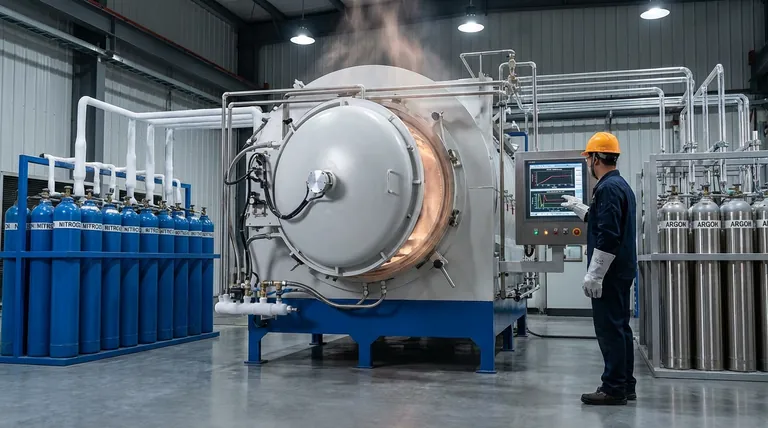
By backfilling the hot chamber with an inert gas like nitrogen or argon, we introduce a medium for convection. A powerful fan transforms this static gas into a high-velocity current, creating a bridge that rapidly pulls heat from the workpiece and transfers it to the furnace's water-cooled heat exchanger.

The efficiency of this bridge is determined by the gas you choose.

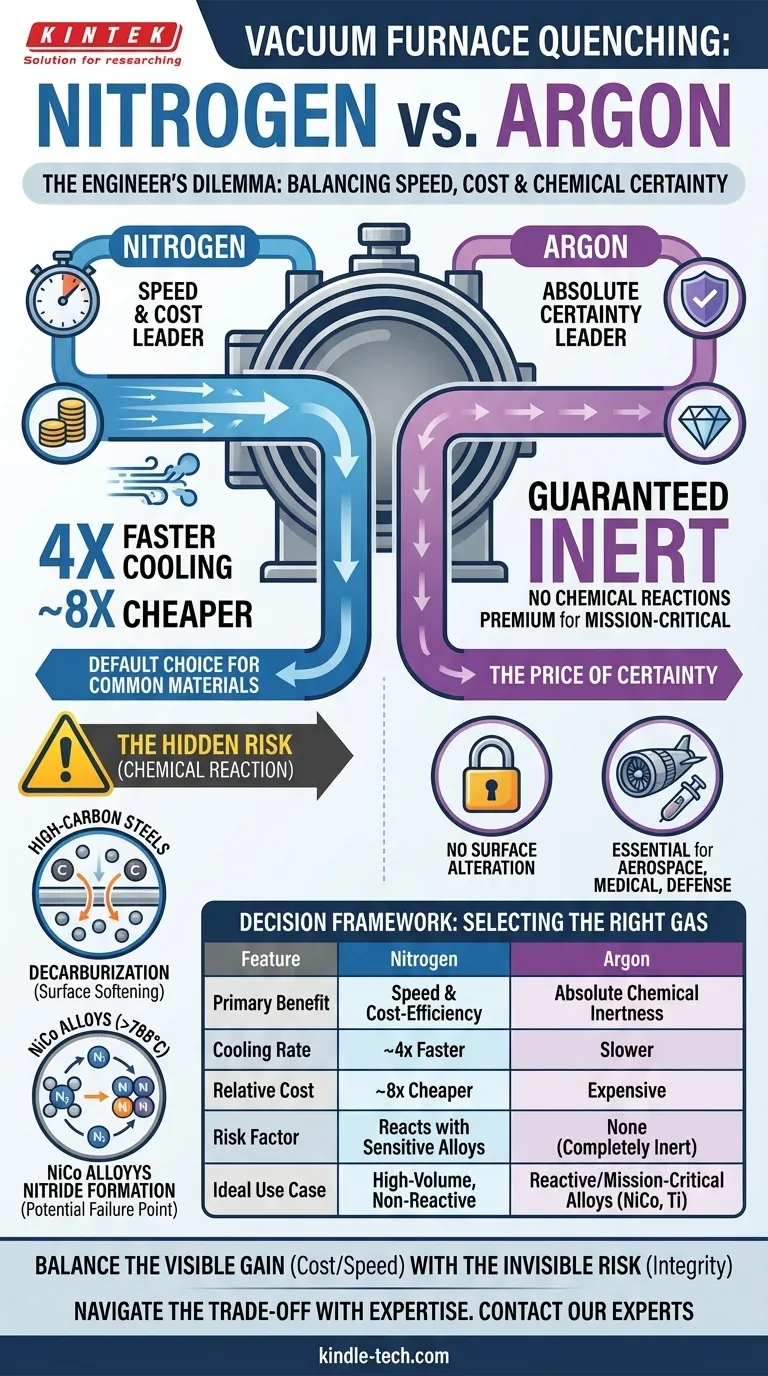
The Allure of Nitrogen: A Fourfold Speed at an Eighth of the Cost

From a purely economic and logistical standpoint, nitrogen is the undisputed champion.

The Numbers Don't Lie

Under typical furnace conditions, nitrogen has physical properties that allow it to transfer heat far more effectively than argon.

  • Cooling Rate: Approximately 4 times faster.
  • Cost: Approximately 8 times cheaper.

For any production manager, this is an irresistible combination. Faster cycles mean higher throughput. Lower consumable costs mean better margins.

The Psychology of the Default

Because of these overwhelming advantages, nitrogen is the default choice for a vast range of heat-treating applications. It's the logical, data-backed decision for common steels and other non-reactive materials. The savings are immediate, measurable, and significant.

But relying on the default without understanding its limitations is where the danger lies.

The Hidden Variable: When Chemistry Betrays Physics

Nitrogen's one weakness is a crucial one: at the extreme temperatures of a vacuum furnace, it is not perfectly inert. It can, and does, react with certain materials. This reaction is a silent saboteur, often invisible to the naked eye.

A Tale of Two Alloys

Consider two scenarios:

  1. High-Carbon Steels: Nitrogen can have a slight decarburizing effect on the surface. It reacts with and removes carbon atoms, subtly altering the part's surface hardness and wear resistance. The component may pass initial inspection but fail prematurely in the field.

  2. Nickel-Cobalt (NiCo) Alloys: This is where the risk becomes acute. Above 1450°F (788°C), nitrogen reacts with the surface of these critical alloys to form nitrates. For a part destined for an aerospace turbine or a medical implant, this unintended chemical change isn't a minor flaw—it's a potential point of catastrophic failure.

Argon: The Price of Absolute Certainty

This is where argon enters the equation. Argon is not the "slow, expensive gas." It is the "guaranteed inert gas."

The Noble Promise

As a noble gas, argon is chemically aloof. Its atomic structure makes it unwilling to react with other elements, regardless of temperature. It will not form nitrides, cause decarburization, or alter the surface chemistry of your workpiece in any way.

It simply does one job with absolute fidelity: it carries heat away. Nothing more.

When Is Certainty Worth the Cost?

Choosing argon is like buying an expensive insurance policy. You are paying a premium to eliminate a specific, high-consequence risk. This premium is non-negotiable when:

  • Treating reactive materials like titanium, refractory metals, or NiCo alloys.
  • Working with high-carbon steels where surface integrity is paramount.
  • Manufacturing mission-critical components for aerospace, medical, or defense applications where failure is not an option.

A Decision Framework

The right choice is not about which gas is "better," but which gas is right for your specific material and application.

Feature Nitrogen Argon
Primary Benefit Speed & Cost-Efficiency Absolute Chemical Inertness
Cooling Rate ~4x Faster Slower
Relative Cost ~8x Cheaper Expensive
Risk Factor Can react with sensitive alloys at high temperatures. None. Completely inert across all temperature ranges.
Ideal Use Case High-volume treatment of common, non-reactive materials. Treatment of reactive or mission-critical alloys (NiCo, Ti).

Ultimately, the decision requires balancing the visible, daily cost of the gas against the invisible, potential cost of a compromised part. Navigating this complex trade-off demands both the right equipment and deep process expertise.

Contact Our Experts

Visual Guide

The Engineer's Dilemma: Speed vs. Certainty in Vacuum Furnace Quenching Visual Guide

Related Products

Related Articles

Related Products

Vacuum Hot Press Furnace Heated Vacuum Press Machine Tube Furnace

Vacuum Hot Press Furnace Heated Vacuum Press Machine Tube Furnace

Reduce forming pressure & shorten sintering time with Vacuum Tube Hot Press Furnace for high-density, fine-grain materials. Ideal for refractory metals.

600T Vacuum Induction Hot Press Furnace for Heat Treat and Sintering

600T Vacuum Induction Hot Press Furnace for Heat Treat and Sintering

Discover the 600T Vacuum Induction Hot Press Furnace, designed for high-temperature sintering experiments in vacuum or protected atmospheres. Its precise temperature and pressure control, adjustable working pressure, and advanced safety features make it ideal for nonmetal materials, carbon composites, ceramics, and metal powders.

Vacuum Hot Press Furnace Machine Heated Vacuum Press

Vacuum Hot Press Furnace Machine Heated Vacuum Press

Discover the advantages of Vacuum Hot Press Furnace! Manufacture dense refractory metals & compounds, ceramics, and composites under high temp and pressure.

Vacuum Heat Treat Furnace and Levitation Induction Melting Furnace

Vacuum Heat Treat Furnace and Levitation Induction Melting Furnace

Experience precise melting with our Vacuum Levitation Melting Furnace. Ideal for high melting point metals or alloys, with advanced technology for effective smelting. Order now for high-quality results.

2200 ℃ Tungsten Vacuum Heat Treat and Sintering Furnace

2200 ℃ Tungsten Vacuum Heat Treat and Sintering Furnace

Experience the ultimate refractory metal furnace with our Tungsten vacuum furnace. Capable of reaching 2200℃, perfect for sintering advanced ceramics and refractory metals. Order now for high-quality results.

Vacuum Heat Treat and Pressure Sintering Furnace for High Temperature Applications

Vacuum Heat Treat and Pressure Sintering Furnace for High Temperature Applications

Vacuum pressure sintering furnaces are designed for high temperature hot pressing applications in metal and ceramic sintering. Its advanced features ensure precise temperature control, reliable pressure maintenance, and a robust design for seamless operation.

Molybdenum Vacuum Heat Treat Furnace

Molybdenum Vacuum Heat Treat Furnace

Discover the benefits of a high-configuration molybdenum vacuum furnace with heat shield insulation. Ideal for high-purity, vacuum environments like sapphire crystal growth and heat treatment.

Graphite Vacuum Furnace IGBT Experimental Graphitization Furnace

Graphite Vacuum Furnace IGBT Experimental Graphitization Furnace

IGBT experimental graphitization furnace, a tailored solution for universities and research institutions, with high heating efficiency, user-friendliness, and precise temperature control.

Vacuum Sealed Continuous Working Rotary Tube Furnace Rotating Tube Furnace

Vacuum Sealed Continuous Working Rotary Tube Furnace Rotating Tube Furnace

Experience efficient material processing with our vacuum-sealed rotary tube furnace. Perfect for experiments or industrial production, equipped with optional features for controlled feeding and optimized results. Order now.

2200 ℃ Graphite Vacuum Heat Treat Furnace

2200 ℃ Graphite Vacuum Heat Treat Furnace

Discover the power of the KT-VG Graphite Vacuum Furnace - with a maximum working temperature of 2200℃, it's perfect for vacuum sintering of various materials. Learn more now.

Lab-Scale Vacuum Induction Melting Furnace

Lab-Scale Vacuum Induction Melting Furnace

Get precise alloy composition with our Vacuum Induction Melting Furnace. Ideal for aerospace, nuclear energy, and electronic industries. Order now for effective smelting and casting of metals and alloys.

Vacuum Heat Treat Sintering Brazing Furnace

Vacuum Heat Treat Sintering Brazing Furnace

A vacuum brazing furnace is a type of industrial furnace used for brazing, a metalworking process that joins two pieces of metal using a filler metal that melts at a lower temperature than the base metals. Vacuum brazing furnaces are typically used for high-quality applications where a strong, clean joint is required.

Ultra-High Temperature Graphite Vacuum Graphitization Furnace

Ultra-High Temperature Graphite Vacuum Graphitization Furnace

The ultra-high temperature graphitization furnace utilizes medium frequency induction heating in a vacuum or inert gas environment. The induction coil generates an alternating magnetic field, inducing eddy currents in the graphite crucible, which heats up and radiates heat to the workpiece, bringing it to the desired temperature. This furnace is primarily used for graphitization and sintering of carbon materials, carbon fiber materials, and other composite materials.

Small Vacuum Heat Treat and Tungsten Wire Sintering Furnace

Small Vacuum Heat Treat and Tungsten Wire Sintering Furnace

The small vacuum tungsten wire sintering furnace is a compact experimental vacuum furnace specially designed for universities and scientific research institutes. The furnace features a CNC welded shell and vacuum piping to ensure leak-free operation. Quick-connect electrical connections facilitate relocation and debugging, and the standard electrical control cabinet is safe and convenient to operate.

Vacuum Heat Treat Furnace with Ceramic Fiber Liner

Vacuum Heat Treat Furnace with Ceramic Fiber Liner

Vacuum furnace with polycrystalline ceramic fiber insulation liner for excellent heat insulation and uniform temperature field. Choose from 1200℃ or 1700℃ max. working temperature with high vacuum performance and precise temperature control.

Vacuum Heat Treat and Molybdenum Wire Sintering Furnace for Vacuum Sintering

Vacuum Heat Treat and Molybdenum Wire Sintering Furnace for Vacuum Sintering

A vacuum molybdenum wire sintering furnace is a vertical or bedroom structure, which is suitable for withdrawal, brazing, sintering and degassing of metal materials under high vacuum and high temperature conditions. It is also suitable for dehydroxylation treatment of quartz materials.

Vacuum Arc Induction Melting Furnace

Vacuum Arc Induction Melting Furnace

Discover the power of Vacuum Arc Furnace for melting active & refractory metals. High-speed, remarkable degassing effect, and free of contamination. Learn more now!

Horizontal High Temperature Graphite Vacuum Graphitization Furnace

Horizontal High Temperature Graphite Vacuum Graphitization Furnace

Horizontal Graphitization Furnace: This type of furnace is designed with the heating elements placed horizontally, allowing for uniform heating of the sample. It's well-suited for graphitizing large or bulky samples that require precise temperature control and uniformity.

Non Consumable Vacuum Arc Induction Melting Furnace

Non Consumable Vacuum Arc Induction Melting Furnace

Explore the benefits of Non-Consumable Vacuum Arc Furnace with high melting point electrodes. Small, easy to operate & eco-friendly. Ideal for laboratory research on refractory metals & carbides.

Vacuum Dental Porcelain Sintering Furnace

Vacuum Dental Porcelain Sintering Furnace

Get precise and reliable results with KinTek's Vacuum Porcelain Furnace. Suitable for all porcelain powders, it features hyperbolic ceramic furnace function, voice prompt, and automatic temperature calibration.


Leave Your Message