The Illusion of Automation
A modern vacuum furnace is a marvel of engineering. With its polished stainless-steel chamber, network of pumps, and glowing digital displays, it projects an aura of self-sufficiency. It’s easy to believe the process is entirely automated—a set of instructions executed flawlessly by a machine.
This is a dangerous illusion.
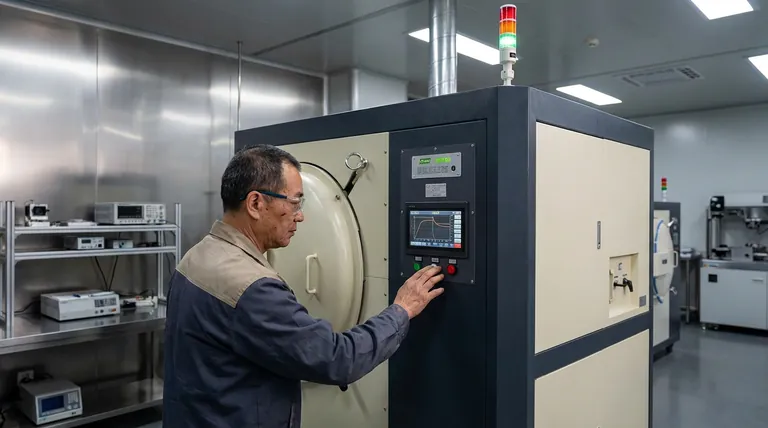
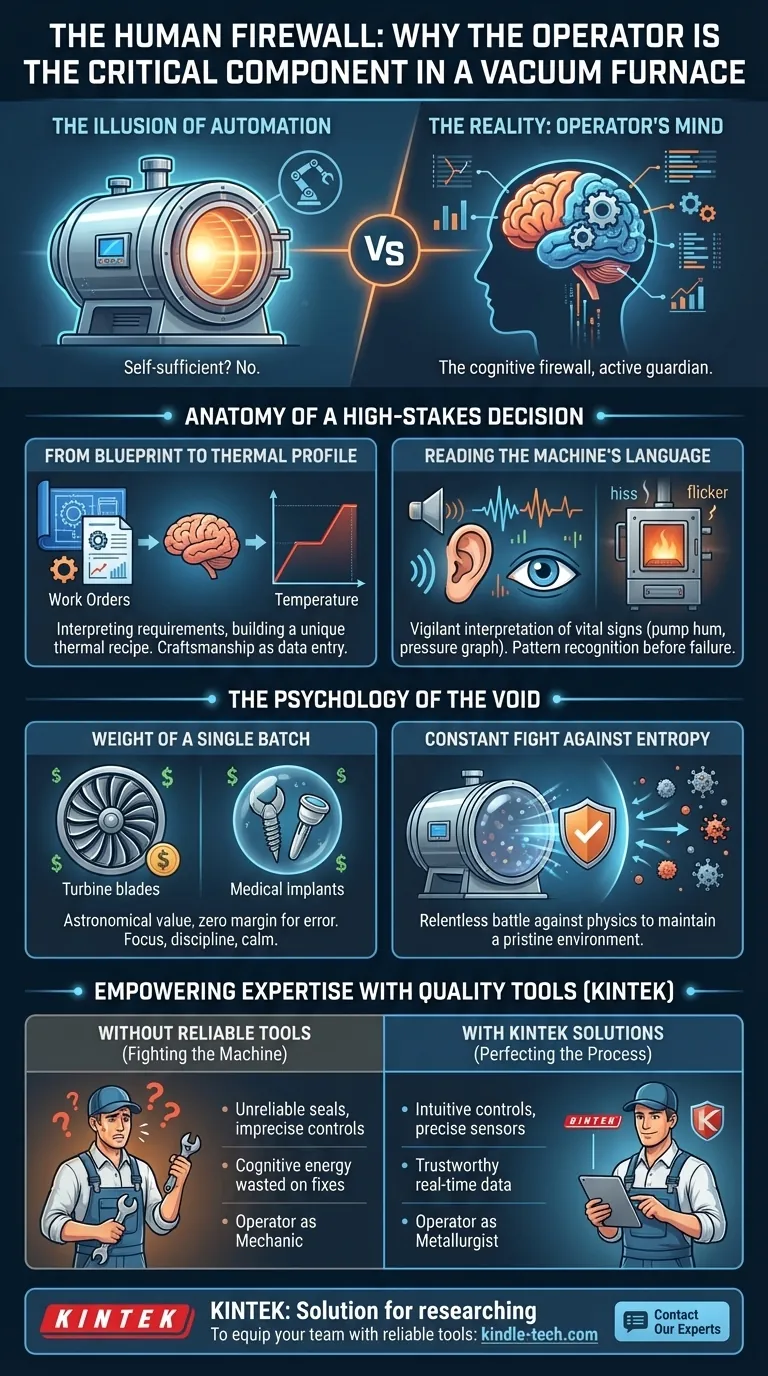
Behind the data and the automated sequences is a human mind. The vacuum furnace operator is not a passive observer but the system's cognitive firewall, the active guardian of an extremely fragile and valuable process. Their judgment is the invisible variable that separates a perfect metallurgical transformation from a catastrophic failure.
Anatomy of a High-Stakes Decision
The operator's work is a continuous translation of abstract requirements into physical reality, often under immense pressure. It’s a task that extends far beyond a pre-flight checklist.
From Blueprint to Thermal Profile
Before the furnace door is even sealed, the operator interprets metallurgical blueprints and work orders. They don’t just enter numbers; they build a thermal story.
They must consider the mass and geometry of the parts, anticipating how heat will transfer and where stresses might accumulate. They program precise temperature ramps, hold times, and vacuum levels, creating a unique recipe designed to coax a specific crystalline structure out of a raw alloy. This is craftsmanship disguised as data entry.
Reading the Machine's Language
Once a cycle begins, the operator becomes a vigilant interpreter. The hum of the diffusion pump, a subtle flicker on a pressure graph, the rate of temperature rise—these are not just data points. They are the furnace's vital signs.
An experienced operator develops an intuition for the system. They can differentiate the benign groan of a cooling system from the subtle hiss of a developing vacuum leak. This is the ability to recognize a pattern on the edge of failure, long before a blaring alarm signals that a batch of aerospace components, worth hundreds of thousands of dollars, is already compromised.
The Psychology of the Void
The operator’s role is as much about managing psychology as it is about managing technology. They work in an environment where the stakes are astronomical and the margin for error is nearly zero.
The Weight of a Single Batch
Imagine being responsible for a chamber containing precision-machined turbine blades or medical implants. The value of the material is immense, but the value of the process is even higher. A single miscalculation or a moment of inattention can nullify months of prior work and investment. This constant pressure demands a unique blend of focus, discipline, and calm.
The Constant Fight Against Entropy
A deep vacuum is an inherently unnatural state. The universe wants to fill it. The operator's primary task is a relentless battle against physics—a fight to keep the chaos of the outside atmosphere from contaminating the pristine environment within. Every seal, every valve, every connection is a potential point of failure. The operator is the commander holding the line.
Empowering the Expert with the Right Tools
An operator’s skill is the ultimate asset, but that skill is either amplified or constrained by the quality of their equipment. Giving a master artisan a flawed tool limits their potential.
A furnace with unreliable seals, imprecise temperature controllers, or inconsistent vacuum pumps forces the operator to spend their cognitive energy fighting the machine instead of perfecting the process. They become a mechanic instead of a metallurgist.
This is the principle that guides our work at KINTEK. We understand that the most advanced laboratory equipment serves one primary purpose: to provide a stable, reliable, and precise foundation upon which human expertise can build.
| Operator's Role | How Quality Equipment Helps |
|---|---|
| Process Setup | Intuitive controls and precise sensors ensure the operator's plan is executed flawlessly. |
| Real-Time Monitoring | Clear, accurate readouts provide trustworthy data, eliminating guesswork. |
| Troubleshooting | Durable, well-engineered components minimize unexpected failures and simplify diagnostics. |
| Overall Focus | A reliable system frees the operator's attention to focus on process quality, not just survival. |
By providing robust vacuum furnaces and high-purity consumables, we empower the experts in your lab. We build the tools that get out of the way, allowing talent and experience to become the decisive factors in achieving perfect results. The goal isn't just to automate a task, but to create an environment where human judgment can be applied with maximum effect.
To ensure your team is equipped with the reliable, high-performance tools they deserve, Contact Our Experts
Visual Guide
Related Products
- Vacuum Hot Press Furnace Heated Vacuum Press Machine Tube Furnace
- 600T Vacuum Induction Hot Press Furnace for Heat Treat and Sintering
- Vacuum Hot Press Furnace Machine Heated Vacuum Press
- Vacuum Heat Treat Furnace and Levitation Induction Melting Furnace
- 2200 ℃ Tungsten Vacuum Heat Treat and Sintering Furnace
Related Articles
- The Purity Paradox: Choosing the Heart of Your Vacuum Hot Press Furnace
- Comprehensive Guide to Vacuum Hot Press Furnace Application
- Vacuum Hot Press Furnace: A Comprehensive Guide
- Forging Perfection in a Void: The Physics of Ultra-Dense Materials
- Defeating the Void: The Quiet Power of Vacuum Hot Pressing