The Tyranny of the Void
In the world of advanced materials, the ultimate enemy is empty space.
A microscopic void, a pocket of nothingness trapped within a ceramic armor plate or a semiconductor target, isn't just an imperfection. It's a point of catastrophic failure waiting to happen. It's a stress concentrator, a weak link in a chain designed for extreme performance.
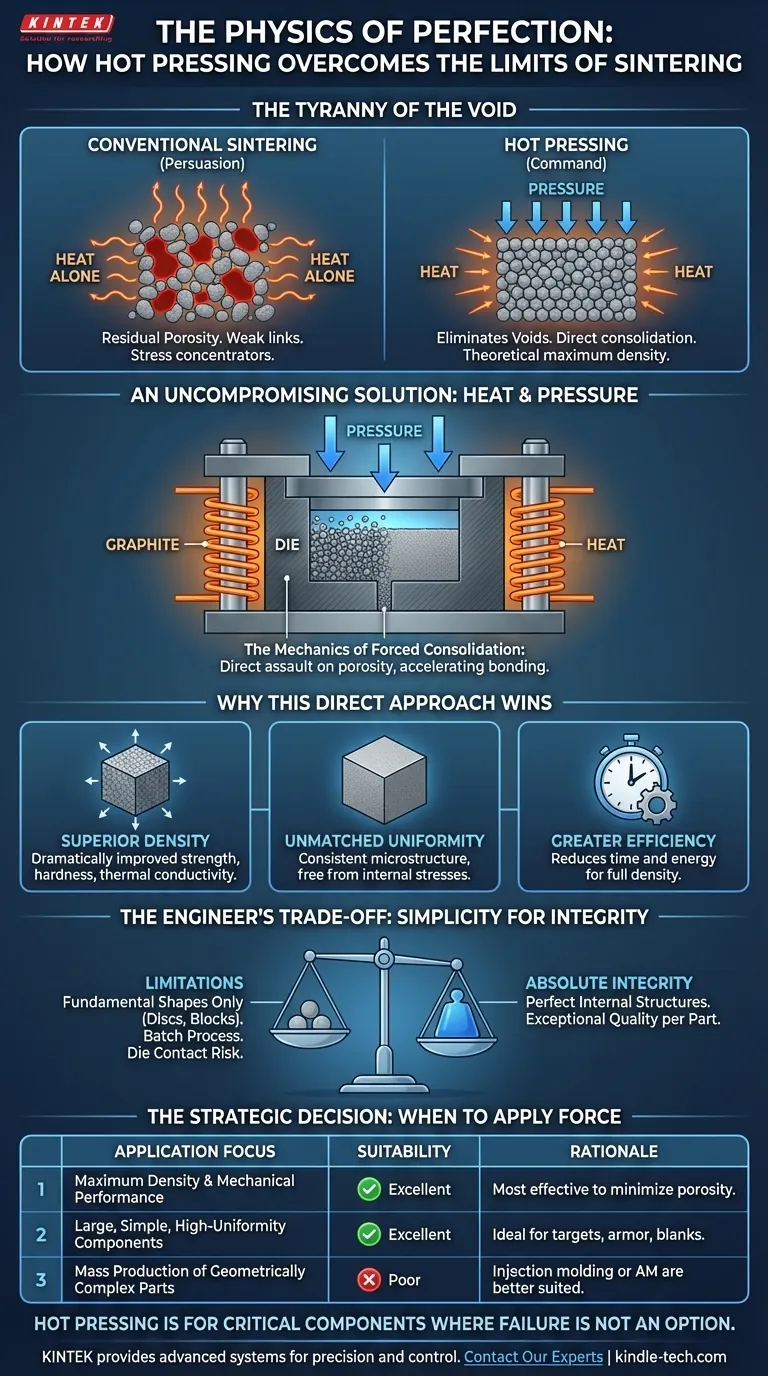
Conventional sintering, which relies on heat alone, coaxes material particles to bond over time. But it's a process of persuasion, and it can leave behind residual porosity—tiny voids that compromise the material's theoretical strength and integrity. For the most demanding applications, persuasion isn't enough. You need force.
An Uncompromising Solution: Heat and Pressure
Hot pressing is less a technique and more a different philosophy. It doesn't persuade; it commands.
By applying intense mechanical pressure at the same time as high temperature, it physically forces material particles together, brutally and efficiently eliminating the voids between them. This dual-action approach transforms the slow, diffusion-based dance of sintering into a direct, deterministic act of consolidation.
The Mechanics of Forced Consolidation
The process is elegantly simple. A powdered material is loaded into a die, typically made of graphite to withstand the extreme conditions. As the die is heated, making the particles malleable, a powerful mechanical press applies force.
There is nowhere for the voids to hide. The pressure physically closes the gaps, accelerating atomic bonding and driving the material toward its theoretical maximum density. It’s a direct assault on porosity.
Why This Direct Approach Wins
This combination of heat and force yields several profound advantages:
- Superior Density: It achieves densities that are difficult or impossible to reach with pressureless sintering, resulting in dramatically improved mechanical strength, hardness, and thermal conductivity.
- Unmatched Uniformity: Heating and pressing within a contained die creates a highly uniform environment. The result is a consistent microstructure, free from the internal stresses or weak spots that can plague larger components made with other methods.
- Greater Efficiency: By combining two processes into one, hot pressing significantly reduces the time and energy needed to produce a fully dense component, especially for large-diameter materials like sputtering targets.
The Engineer's Trade-Off: Simplicity for Integrity
This power comes with a clear set of trade-offs. Choosing hot pressing is a conscious engineering decision to prioritize absolute material integrity over other design freedoms.
It’s a choice that reflects a deep understanding of what truly matters for performance.
A Focus on Fundamental Shapes
The rigid die that enables such high pressure also limits the geometric complexity of the final part. Hot pressing excels at producing fundamental shapes—discs, blocks, and cylinders—with perfect internal structures. It trades intricate features for flawless substance.
The Deliberate Rhythm of a Batch Process
Hot pressing is inherently a batch process. Each component must be loaded, processed, and removed individually. This makes it unsuitable for high-volume, low-cost manufacturing. Its value lies not in throughput, but in the exceptional quality of each part produced.
The Intimacy of Contact
The material is in direct contact with the die walls at extreme temperatures. This introduces the risk of chemical interaction or contamination, a factor that must be carefully managed. This challenge, however, is a reminder of the controlled, intimate nature of the process.
The Strategic Decision: When to Apply Force
Understanding when to use hot pressing is key to leveraging its power. The choice becomes clear when viewed through the lens of final application requirements.
| Application Focus | Hot Pressing Suitability | Rationale |
|---|---|---|
| Maximum Density & Mechanical Performance | Excellent | The applied pressure is the most effective way to minimize residual porosity. |
| Large, Simple, High-Uniformity Components | Excellent | Ideal for sputtering targets, armor plates, and large optical blanks. |
| Mass Production of Geometrically Complex Parts | Poor | Methods like injection molding or additive manufacturing are better suited. |
Ultimately, hot pressing is the tool you reach for when "good enough" isn't an option. It's for critical components where failure is not a possibility and material performance is paramount.
The incredible potential of this technique, however, is only realized when the process is perfectly controlled. The precision of the temperature, the stability of the pressure, and the reliability of the system are not just variables; they are the foundation of the final product's perfection. This is where the quality of the laboratory equipment becomes the deciding factor between a standard material and a superior one.
At KINTEK, we provide the advanced hot pressing systems and consumables engineered for the precision and control required to forge the materials of tomorrow.
When your research demands the highest possible density and performance, ensure your equipment is up to the task. Contact Our Experts
Visual Guide
Related Products
- Automatic Heated Hydraulic Press Machine with Heated Plates for Laboratory Hot Press 25T 30T 50T
- Manual High Temperature Heated Hydraulic Press Machine with Heated Plates for Lab
- Touchscreen Automatic Vacuum Heat Press
- 30T 40T Split Automatic Heated Hydraulic Press Machine with Heated Plates for Laboratory Hot Press
- Vacuum Hot Press Furnace Machine Heated Vacuum Press
Related Articles
- Why Your Composite and Polymer Parts Keep Failing: The Secret Is Simultaneous Heat and Pressure
- The Physics of Flawless Materials: Deconstructing the Hydraulic Hot Press
- Precision Under Pressure: The Physics and Psychology of the Hydraulic Hot Press
- Hydraulic Hot Press: Principles, Components, Features, Advantages, and Applications
- Comprehensive Guide to Hydraulic Hot Press: Function, Features and Applications