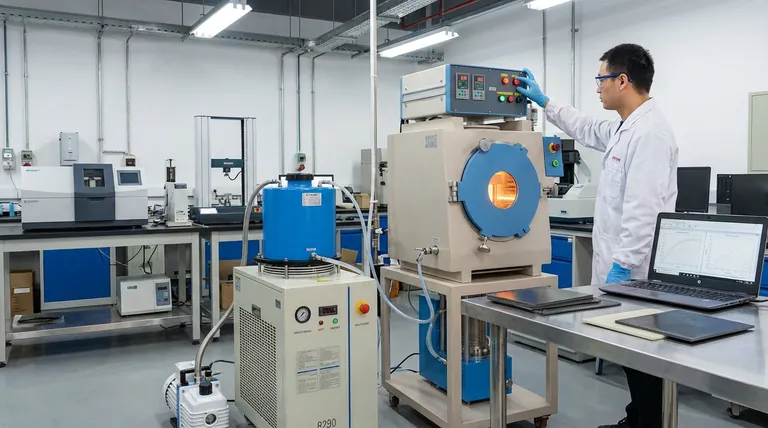
The Hidden Enemy Within Every Material
Imagine designing a critical component for an aerospace application. Its failure isn't just a defect; it's a catastrophic event. The greatest threat isn't always an external force, but an internal, invisible flaw—a microscopic void, an imperfect bond, or a latent instability waiting to reveal itself under stress.
Most manufacturing processes shape materials. Hot press forming, however, does something more fundamental. It re-engineers a material from the inside out, waging a war against imperfection to achieve a level of certainty that other methods cannot promise.
The Synergistic Dance of Heat and Pressure
The process is a masterclass in control, built on the partnership of two powerful forces. They are not independent variables but a synergistic pair, working in concert to transform a material's very structure.
Heat: The Agent of Possibility
Temperature is the catalyst. It doesn't just warm the material; it makes it receptive to change. By raising the temperature, we lower the material's internal resistance to deformation.
For metals, this means reaching a state of plasticity where shaping requires less brute force. For composites, it awakens the latent power of resins and adhesives, preparing them to form unbreakable molecular bonds. Heat unlocks a material's potential for a more perfect form.
Pressure: The Architect of Order
If heat creates possibility, pressure imposes order. An immense, uniform force, typically applied by a hydraulic system, descends upon the pliable material.
This pressure is the architect. It forces the material to conform perfectly to a mold, methodically squeezing out air pockets and eliminating voids. In laminates or composites, it ensures every layer makes intimate, complete contact. It transforms a collection of parts into a single, dense, monolithic structure.
The Anatomy of a Superior Product
This precise control over a material's internal world translates directly into superior external characteristics. It’s not just about looking good; it's about being fundamentally better.
From Voids to Valor: Structural Integrity
By eliminating internal voids, hot pressing creates components that are profoundly stronger and more durable. That invisible void is a stress concentrator, a starting point for a crack. A dense, uniform structure, however, distributes loads evenly, dramatically increasing the material's resilience and lifespan.
The War on Warping: Dimensional Stability
The combination of intense heat and pressure "sets" the material's final form, locking its molecular structure in place. This process minimizes the risk of warping, shrinking, or twisting over time, even under changing environmental conditions. For products requiring tight tolerances—from high-end cabinetry to precision scientific instruments—this stability is non-negotiable.
A Flawless First Impression: Surface Quality
The immense pressure from a heated, smooth platen creates an equally smooth and consistent surface finish. This often reduces or eliminates the need for costly and time-consuming secondary finishing processes.
The Unavoidable Calculus: Cost vs. Certainty
Hot press forming is not a universal solution. Its power comes with a specific set of trade-offs. The decision to use it is a strategic one, based on a clear understanding of what you are paying for.
| Consideration | The Strategic Trade-Off |
|---|---|
| Cycle Time | The process is deliberate, not slow. Time is required for heating and cooling under pressure. You trade speed for structural perfection. |
| Energy Cost | Maintaining high temperatures consumes energy. This is the energy required to fundamentally re-engineer the material. |
| Capital Investment | High-performance hot presses are robust, complex machines. The investment is in equipment capable of mastering extreme forces with absolute precision. |
Choosing this method is an investment in the final outcome. You are accepting higher upfront costs and longer cycle times in exchange for unparalleled quality and long-term performance.
A Framework for Your Decision
When should you make this investment? The choice depends entirely on the consequences of failure and the value of perfection.
-
Choose hot pressing when...
- Maximum Strength is Essential: For structural components where failure is not an option.
- Dimensional Accuracy is Paramount: For high-value products that must maintain their form and function over time.
- Material Properties are Critical: For advanced composites and alloys where internal density dictates performance.
-
Consider alternatives when...
- Low Cost is the Primary Driver: For high-volume, non-structural parts where internal perfection is secondary to speed and economy.
Ultimately, hot press forming is for creators who understand that the quality of a product is determined by its least visible, most fundamental properties. To achieve that, you need equipment that delivers unwavering control and reliability.
If your goal is to produce materials with uncompromising structural integrity and dimensional certainty, our team can help you specify the right equipment for the task. Contact Our Experts
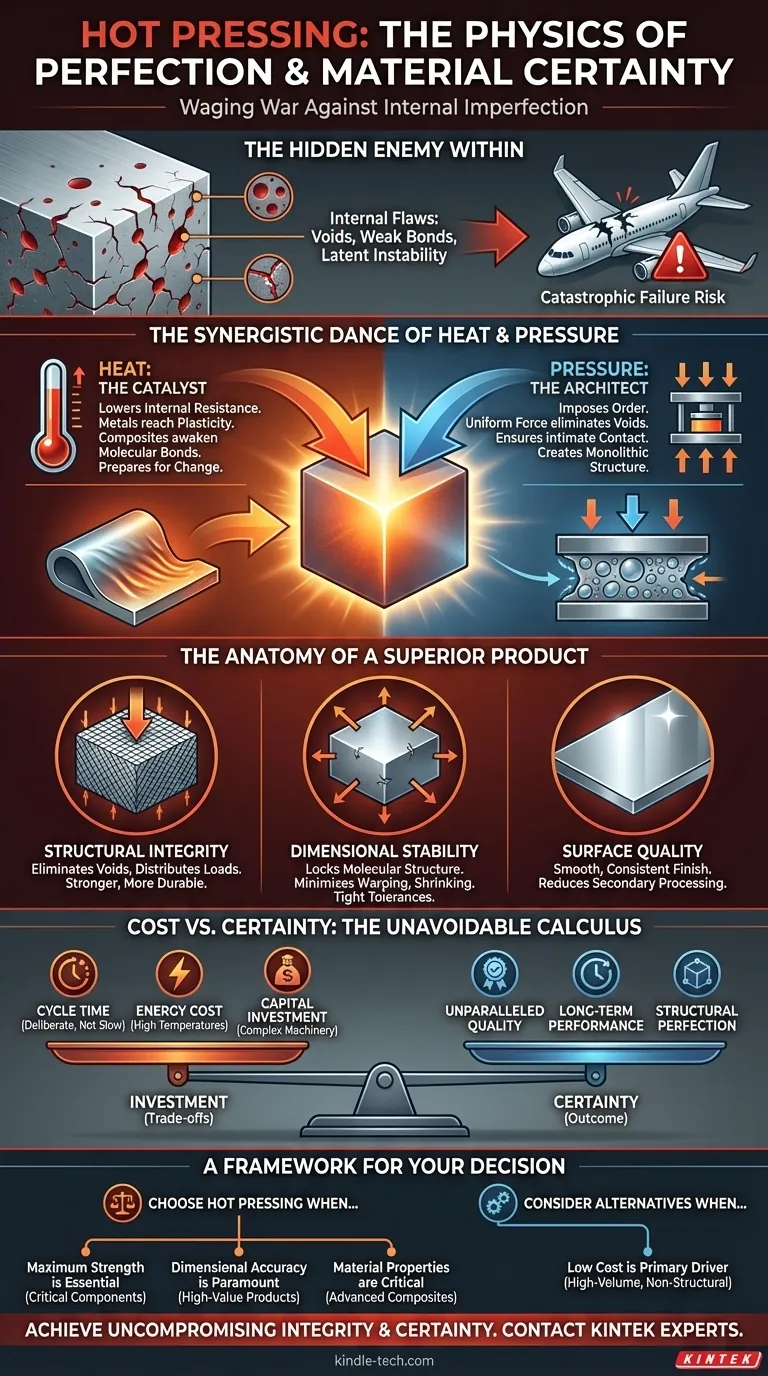
Visual Guide
Related Products
- Automatic Heated Hydraulic Press Machine with Heated Plates for Laboratory Hot Press 25T 30T 50T
- Manual High Temperature Heated Hydraulic Press Machine with Heated Plates for Lab
- Touchscreen Automatic Vacuum Heat Press
- 30T 40T Split Automatic Heated Hydraulic Press Machine with Heated Plates for Laboratory Hot Press
- Vacuum Hot Press Furnace Machine Heated Vacuum Press
Related Articles
- Why Your Composite and Polymer Parts Keep Failing: The Secret Is Simultaneous Heat and Pressure
- The Physics of Flawless Materials: Deconstructing the Hydraulic Hot Press
- Precision Under Pressure: The Physics and Psychology of the Hydraulic Hot Press
- Hydraulic Hot Press: Principles, Components, Features, Advantages, and Applications
- Comprehensive Guide to Hydraulic Hot Press: Function, Features and Applications