The Illusion of a Single Machine
The term "hot press" is a masterpiece of engineering understatement. It describes a machine that presses a graphic onto a t-shirt. It also describes a machine that solders mission-critical aerospace electronics.
How can one name cover two tasks with such wildly different consequences for failure?
This isn't just a quirk of language. It reveals a fundamental truth about manufacturing: the most profound engineering challenges are often hidden behind the simplest principles. In this case, the controlled application of heat and pressure to create a permanent change.
The Unifying Principle: A Physics of Commitment
Every hot press, regardless of its purpose, manipulates two of nature's most basic forces. But understanding them requires looking beyond the physics and into the psychology of their application.
Heat: The Energy to Change State
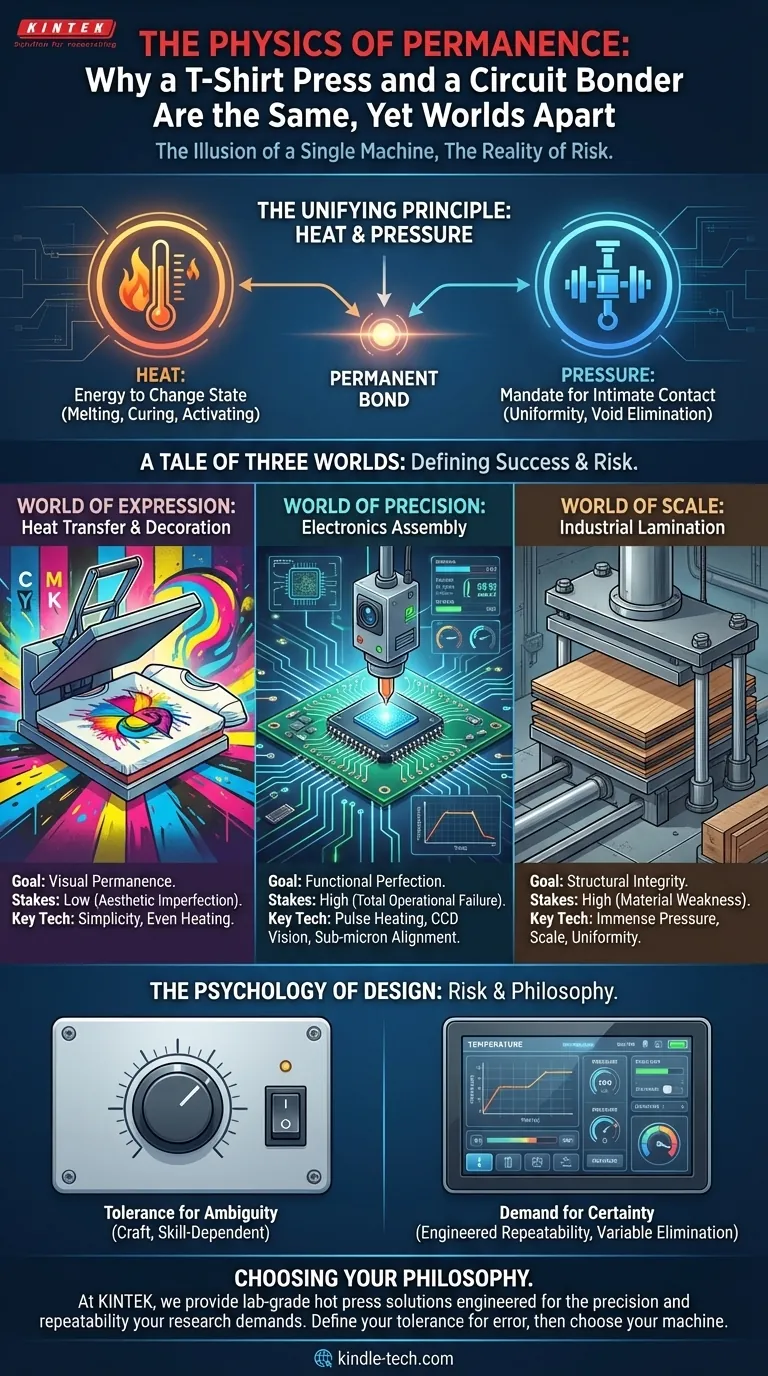
Heat is the catalyst. It provides the energy required for a material to cross a threshold from which it cannot return—melting solder, curing an industrial adhesive, or activating the ink in a sublimation transfer.
In its simplest form, it's a heated platen. But in a high-stakes environment like electronics assembly, control is everything. Advanced systems use pulse heating for rapid, precise thermal cycles. This isn't just about efficiency; it's about risk management. It delivers the exact energy needed to form a bond without the collateral damage of overheating sensitive components.
Pressure: The Mandate for Intimate Contact
Pressure is the enforcer. It ensures that the materials being joined are in absolute, uniform, intimate contact. Without it, heat transfer is uneven, bonds are incomplete, and voids create points of failure.
This force can be generated by a simple manual lever or a massive hydraulic system. The goal is the same: to leave no room for ambiguity. Pressure guarantees that when heat activates the change, that change occurs everywhere it's supposed to, creating a single, consolidated entity.
A Tale of Three Worlds
The vast difference in hot press machines comes from the world they were built to serve. Each world has a different definition of success and a different tolerance for failure.
The World of Expression: Heat Transfer & Decoration
This is the most familiar application. Using materials like Heat Transfer Vinyl (HTV), these machines apply designs to garments and promotional items.
The goal is visual permanence. The stakes are relatively low. A slight temperature variance might go unnoticed. The machine is a tool of creation, where a small imperfection is often just part of the craft.
The World of Precision: Electronics Assembly
Here, a specialized hot press—often called a hot bar reflow soldering machine—creates the electrical and mechanical bonds on a circuit board.
The goal is functional perfection. The stakes are absolute. A single misaligned or incomplete solder joint can render a device worth thousands of dollars inert. These machines don't just use heat and pressure; they orchestrate them with CCD vision systems for sub-micron alignment and multi-stage temperature profiles that follow a precise script. Failure is not an option.
The World of Scale: Industrial Lamination
In heavy industry, behemoth hot presses use immense force to manufacture materials like plywood. Layers of wood veneer and adhesive are fused into a single, structurally superior sheet.
The goal is structural integrity. The stakes are high, but defined by strength and durability. The engineering focuses on generating and evenly distributing massive, consistent pressure over large surfaces to cure adhesives and create a new, powerful composite.
The Psychology of a Machine's Design
The difference between a $300 craft press and a $30,000 industrial bonder isn't just the materials or features. It's the philosophy of risk embedded in their design.
A simple clamshell press with a manual dial reflects a tolerance for ambiguity. It's designed for a process where the user's skill can compensate for the machine's simplicity.
An automated soldering press with real-time temperature displays and digital pressure gauges reflects a demand for certainty. It is engineered to eliminate variables, because in its world, variables are synonymous with failure. Features like titanium indenters for perfect heat uniformity aren't luxuries; they are a necessary investment in repeatability.
| Application Category | Primary Goal | Defining Risk | Key Technology Focus |
|---|---|---|---|
| Heat Transfer | Visual Permanence | Aesthetic imperfection | Simplicity, Even Heating |
| Electronics Assembly | Functional Perfection | Total operational failure | Precision, Control, Alignment |
| Industrial Lamination | Structural Integrity | Material weakness, delamination | High Pressure, Scale, Uniformity |
Choosing Your Philosophy, Not Just Your Machine
Understanding this distinction is the key to selecting the right tool. You aren't just buying a machine that provides heat and pressure. You are choosing a system designed to manage the level of risk inherent in your work.
Whether your lab is focused on material science, rapid prototyping, or small-scale electronics production, the core principles remain the same. The crucial first step is to define your tolerance for error, because that will define the machine you need. At KINTEK, we provide a range of laboratory-grade hot press solutions engineered for the precision and repeatability your research and production demand.
To find the equipment that aligns with your philosophy of precision and performance, Contact Our Experts.
Visual Guide
Related Products
- Automatic Heated Hydraulic Press Machine with Heated Plates for Laboratory Hot Press 25T 30T 50T
- Manual High Temperature Heated Hydraulic Press Machine with Heated Plates for Lab
- Touchscreen Automatic Vacuum Heat Press
- 30T 40T Split Automatic Heated Hydraulic Press Machine with Heated Plates for Laboratory Hot Press
- Vacuum Hot Press Furnace Machine Heated Vacuum Press
Related Articles
- Why Your Composite and Polymer Parts Keep Failing: The Secret Is Simultaneous Heat and Pressure
- The Physics of Flawless Materials: Deconstructing the Hydraulic Hot Press
- Precision Under Pressure: The Physics and Psychology of the Hydraulic Hot Press
- Hydraulic Hot Press: Principles, Components, Features, Advantages, and Applications
- Comprehensive Guide to Hydraulic Hot Press: Function, Features and Applications