Blog The Physics of Purity: Why Heating in a Vacuum Unlocks Material Potential
The Physics of Purity: Why Heating in a Vacuum Unlocks Material Potential

The Physics of Purity: Why Heating in a Vacuum Unlocks Material Potential

1 hour ago

The Illusion of "Empty" Air

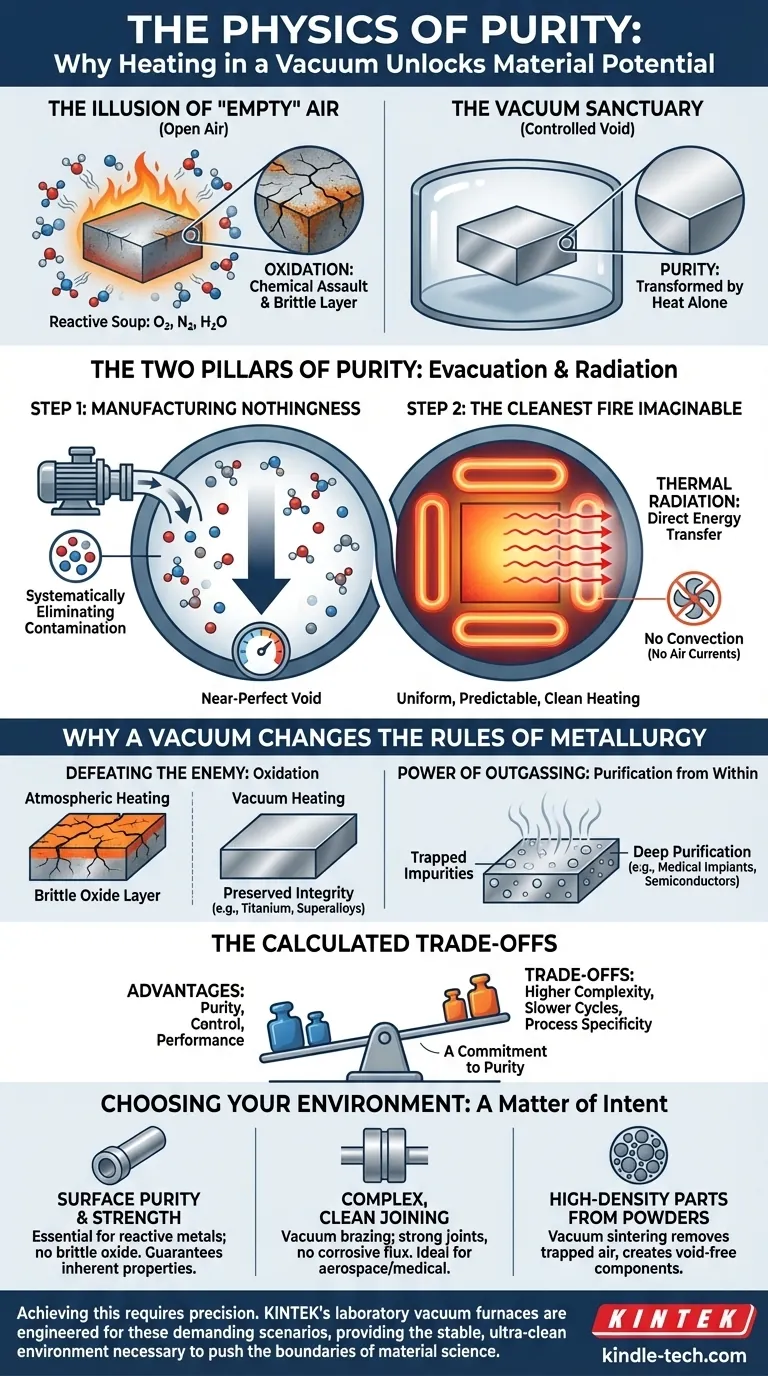
When we heat a material in the open air, we are doing more than just raising its temperature. We are exposing it to a chemical assault.

The air we breathe, seemingly harmless, is a reactive soup of oxygen, nitrogen, and moisture. At high temperatures, these gases become aggressive agents, eager to bond with and corrupt the surfaces of pristine metals. This process, oxidation, is the enemy of performance.

The fundamental purpose of a vacuum furnace is not just to heat, but to create a sanctuary. By removing the atmosphere, we control the environment on a molecular level, allowing materials to be transformed by heat alone, without the chaos of unwanted chemical reactions.

The Two Pillars of Purity: Evacuation and Radiation

Every vacuum furnace cycle is a precisely choreographed dance between two fundamental stages, moving from a chaotic atmosphere to a controlled void.

Step One: Manufacturing Nothingness

The process begins by sealing the material inside a robust chamber. Then, a powerful vacuum system—a network of pumps, valves, and sensors—roars to life.

Its sole purpose is to remove the air, molecule by molecule. It is not simply emptying a box; it is systematically eliminating the threat of contamination. The pressure drops precipitously, creating an environment cleaner than any cleanroom, a near-perfect void.

Step Two: The Cleanest Fire Imaginable

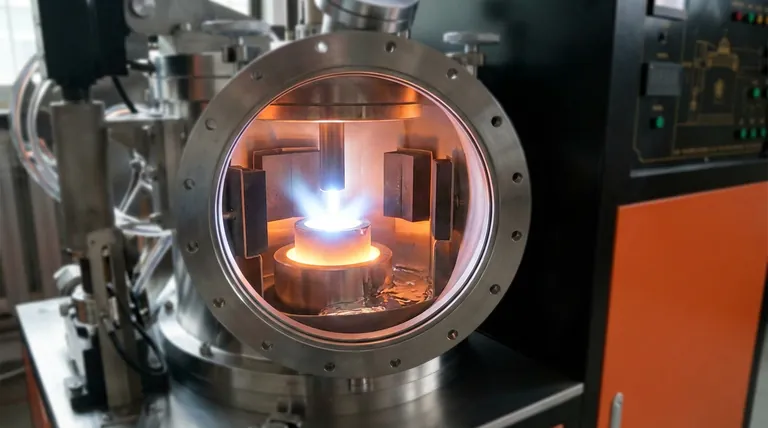
Once this pristine vacuum is established, the heating system engages. Inside the chamber, heating elements made of graphite or refractory metals begin to glow.

But here, the physics of heat transfer changes completely. In a normal furnace, heat swirls around through convection, an inefficient and uneven process like trying to warm yourself in a gusty wind.

In a vacuum, there is no air to create those currents. Heat moves almost entirely through thermal radiation—a direct, line-of-sight transfer of energy from the hot elements to the material. It's the difference between a chaotic bonfire and a focused laser. The result is exceptionally uniform, predictable, and clean heating.

Why a Vacuum Changes the Rules of Metallurgy

Removing the atmosphere fundamentally alters what is possible in material science, unlocking properties that are unattainable under normal conditions.

Defeating the Enemy of Strength: Oxidation

For materials like titanium, stainless steel, and aerospace superalloys, oxygen is poison at high temperatures. It forms a brittle oxide layer that compromises surface integrity, weakens the component, and can lead to catastrophic failure.

A vacuum furnace starves this reaction of its key ingredient. It allows these advanced metals to be hardened, annealed, or brazed without compromising their chemical composition or structural integrity.

The Power of Outgassing: Purification from Within

The vacuum’s influence extends beyond the material's surface. As the material heats up in the near-perfect vacuum, trapped gases and impurities deep within its structure are drawn out.

This process, known as outgassing, is a form of deep purification. It is essential for components used in medical implants, semiconductors, and high-energy physics, where even the slightest internal impurity can be a critical flaw.

The Calculated Trade-Offs

While incredibly powerful, a vacuum furnace is a specialized instrument. Its advantages come with deliberate engineering trade-offs.

  • Higher Complexity: Building a chamber that can withstand atmospheric pressure from the outside while maintaining an internal void requires sophisticated engineering and materials, leading to higher initial costs.
  • Slower Cycles: Creating a vacuum takes time. So does cooling, as there is no air to help carry heat away. Cooling is often assisted by backfilling the chamber with an inert gas like argon, but the process is inherently more deliberate than in an atmospheric furnace.
  • Process Specificity: Some processes, like carburizing, require a reactive atmosphere to donate carbon to a steel's surface. By its very nature, a vacuum is unsuitable for such additive processes.

Choosing Your Environment: A Matter of Intent

The decision to use a vacuum furnace is a commitment to purity and control. It is chosen when the material's final properties are non-negotiable.

Application Focus Why Vacuum is Essential
Surface Purity & Strength Essential for heat-treating reactive metals (titanium, superalloys) without creating a brittle oxide layer. Guarantees the material's inherent properties are preserved.
Complex, Clean Joining Vacuum brazing creates exceptionally strong, clean joints without the corrosive flux chemicals required in atmospheric brazing, ideal for intricate aerospace or medical parts.
High-Density Parts from Powders Vacuum sintering or hot pressing is required to remove trapped air between powder particles, resulting in dense, void-free components with superior mechanical properties.

Achieving this level of control requires equipment built with the same philosophy of precision. KINTEK's laboratory vacuum furnaces are engineered for these demanding scenarios, providing the stable, ultra-clean environment necessary to push the boundaries of material science. They are not just tools for heating; they are instruments for achieving perfection.

If your work demands ultimate purity and predictable performance, the controlled void of a vacuum furnace is your most powerful ally. Contact Our Experts to explore how the right environment can transform your materials.

Visual Guide
The Physics of Purity: Why Heating in a Vacuum Unlocks Material Potential Visual Guide

Related Products

Related Articles

Related Products

Vacuum Hot Press Furnace Heated Vacuum Press Machine Tube Furnace

Vacuum Hot Press Furnace Heated Vacuum Press Machine Tube Furnace

Reduce forming pressure & shorten sintering time with Vacuum Tube Hot Press Furnace for high-density, fine-grain materials. Ideal for refractory metals.

600T Vacuum Induction Hot Press Furnace for Heat Treat and Sintering

600T Vacuum Induction Hot Press Furnace for Heat Treat and Sintering

Discover the 600T Vacuum Induction Hot Press Furnace, designed for high-temperature sintering experiments in vacuum or protected atmospheres. Its precise temperature and pressure control, adjustable working pressure, and advanced safety features make it ideal for nonmetal materials, carbon composites, ceramics, and metal powders.

Vacuum Hot Press Furnace Machine Heated Vacuum Press

Vacuum Hot Press Furnace Machine Heated Vacuum Press

Discover the advantages of Vacuum Hot Press Furnace! Manufacture dense refractory metals & compounds, ceramics, and composites under high temp and pressure.

Vacuum Heat Treat Furnace and Levitation Induction Melting Furnace

Vacuum Heat Treat Furnace and Levitation Induction Melting Furnace

Experience precise melting with our Vacuum Levitation Melting Furnace. Ideal for high melting point metals or alloys, with advanced technology for effective smelting. Order now for high-quality results.

2200 ℃ Tungsten Vacuum Heat Treat and Sintering Furnace

2200 ℃ Tungsten Vacuum Heat Treat and Sintering Furnace

Experience the ultimate refractory metal furnace with our Tungsten vacuum furnace. Capable of reaching 2200℃, perfect for sintering advanced ceramics and refractory metals. Order now for high-quality results.

Vacuum Heat Treat and Pressure Sintering Furnace for High Temperature Applications

Vacuum Heat Treat and Pressure Sintering Furnace for High Temperature Applications

Vacuum pressure sintering furnaces are designed for high temperature hot pressing applications in metal and ceramic sintering. Its advanced features ensure precise temperature control, reliable pressure maintenance, and a robust design for seamless operation.

Molybdenum Vacuum Heat Treat Furnace

Molybdenum Vacuum Heat Treat Furnace

Discover the benefits of a high-configuration molybdenum vacuum furnace with heat shield insulation. Ideal for high-purity, vacuum environments like sapphire crystal growth and heat treatment.

Graphite Vacuum Furnace IGBT Experimental Graphitization Furnace

Graphite Vacuum Furnace IGBT Experimental Graphitization Furnace

IGBT experimental graphitization furnace, a tailored solution for universities and research institutions, with high heating efficiency, user-friendliness, and precise temperature control.

Vacuum Sealed Continuous Working Rotary Tube Furnace Rotating Tube Furnace

Vacuum Sealed Continuous Working Rotary Tube Furnace Rotating Tube Furnace

Experience efficient material processing with our vacuum-sealed rotary tube furnace. Perfect for experiments or industrial production, equipped with optional features for controlled feeding and optimized results. Order now.

2200 ℃ Graphite Vacuum Heat Treat Furnace

2200 ℃ Graphite Vacuum Heat Treat Furnace

Discover the power of the KT-VG Graphite Vacuum Furnace - with a maximum working temperature of 2200℃, it's perfect for vacuum sintering of various materials. Learn more now.

Lab-Scale Vacuum Induction Melting Furnace

Lab-Scale Vacuum Induction Melting Furnace

Get precise alloy composition with our Vacuum Induction Melting Furnace. Ideal for aerospace, nuclear energy, and electronic industries. Order now for effective smelting and casting of metals and alloys.

Vacuum Heat Treat Sintering Brazing Furnace

Vacuum Heat Treat Sintering Brazing Furnace

A vacuum brazing furnace is a type of industrial furnace used for brazing, a metalworking process that joins two pieces of metal using a filler metal that melts at a lower temperature than the base metals. Vacuum brazing furnaces are typically used for high-quality applications where a strong, clean joint is required.

Ultra-High Temperature Graphite Vacuum Graphitization Furnace

Ultra-High Temperature Graphite Vacuum Graphitization Furnace

The ultra-high temperature graphitization furnace utilizes medium frequency induction heating in a vacuum or inert gas environment. The induction coil generates an alternating magnetic field, inducing eddy currents in the graphite crucible, which heats up and radiates heat to the workpiece, bringing it to the desired temperature. This furnace is primarily used for graphitization and sintering of carbon materials, carbon fiber materials, and other composite materials.

Small Vacuum Heat Treat and Tungsten Wire Sintering Furnace

Small Vacuum Heat Treat and Tungsten Wire Sintering Furnace

The small vacuum tungsten wire sintering furnace is a compact experimental vacuum furnace specially designed for universities and scientific research institutes. The furnace features a CNC welded shell and vacuum piping to ensure leak-free operation. Quick-connect electrical connections facilitate relocation and debugging, and the standard electrical control cabinet is safe and convenient to operate.

Vacuum Heat Treat Furnace with Ceramic Fiber Liner

Vacuum Heat Treat Furnace with Ceramic Fiber Liner

Vacuum furnace with polycrystalline ceramic fiber insulation liner for excellent heat insulation and uniform temperature field. Choose from 1200℃ or 1700℃ max. working temperature with high vacuum performance and precise temperature control.

Vacuum Heat Treat and Molybdenum Wire Sintering Furnace for Vacuum Sintering

Vacuum Heat Treat and Molybdenum Wire Sintering Furnace for Vacuum Sintering

A vacuum molybdenum wire sintering furnace is a vertical or bedroom structure, which is suitable for withdrawal, brazing, sintering and degassing of metal materials under high vacuum and high temperature conditions. It is also suitable for dehydroxylation treatment of quartz materials.

Vacuum Arc Induction Melting Furnace

Vacuum Arc Induction Melting Furnace

Discover the power of Vacuum Arc Furnace for melting active & refractory metals. High-speed, remarkable degassing effect, and free of contamination. Learn more now!

Horizontal High Temperature Graphite Vacuum Graphitization Furnace

Horizontal High Temperature Graphite Vacuum Graphitization Furnace

Horizontal Graphitization Furnace: This type of furnace is designed with the heating elements placed horizontally, allowing for uniform heating of the sample. It's well-suited for graphitizing large or bulky samples that require precise temperature control and uniformity.

Non Consumable Vacuum Arc Induction Melting Furnace

Non Consumable Vacuum Arc Induction Melting Furnace

Explore the benefits of Non-Consumable Vacuum Arc Furnace with high melting point electrodes. Small, easy to operate & eco-friendly. Ideal for laboratory research on refractory metals & carbides.

Vacuum Dental Porcelain Sintering Furnace

Vacuum Dental Porcelain Sintering Furnace

Get precise and reliable results with KinTek's Vacuum Porcelain Furnace. Suitable for all porcelain powders, it features hyperbolic ceramic furnace function, voice prompt, and automatic temperature calibration.


Leave Your Message